

8 Best Crypto Exchanges in India for 2026
We believe in full transparency with our readers. Some of our content includes affiliate links, and we may earn a commission through these partnerships. However, this potential compensation never influences our analysis, opinions, or reviews. Our editorial content is created independently of our marketing partnerships, and our ratings are based solely on our established evaluation criteria. Read More





Based on our research, Binance is currently the best crypto exchange in India. This centralized exchange holds licenses in India and is compliant with Indian AML and KYC laws. Binance lets you buy crypto with INR via its P2P marketplace, which supports local payment methods such as Paytm, Digital eRupee, IMPS, UPI, and bank transfers.
The Binance platform also employs excellent security measures, including several multi-factor authentication options, and offers trading fees below the industry standard.
While crypto trading is legal in India, in 2026, India’s Financial Intelligence Unit (FIU) introduced new AML and KYC guidelines for crypto exchanges. To prevent deepfake attacks, exchanges must use live selfie verification with liveness detection, “penny-drop” bank validation, and geotagging. This makes finding a fully compliant crypto exchange in India quite challenging.
To help you out, we analyzed and tested more than 40 platforms, basing our research on their regulatory compliance, available markets, INR support, trading tools and fees, security features, and ease of use. Here’s what we found.
List of Crypto Exchanges in India
Take a look at our table to find out which exchanges made it on our list and what their key features are:
| Exchange | Supported Coins | Trading Fees (Maker/Taker) | INR Support |
|---|---|---|---|
| Binance | 620+ | 0.100% / 0.100% | Via its P2P marketplace (Paytm, Digital eRupee, IMPS, UPI, and bank transfers) |
| Kraken | 540+ | 0.25% / 0.40% for spot, 0.0200% / 0.0500% for futures | No dedicated INR market; available payment methods vary by provider |
| Bybit | 650+ | 0.1000% / 0.1000% for spot, 0.0200% / 0.0550% for futures | Via its P2P marketplace and third-party payment providers |
| OKX | 350+ | 0.080% / 0.100% for spot, 0.020% / 0.050% for futures | Via its P2P marketplace and third-party payment providers |
| Coinbase | 369 | 0.40% / 0.60% for spot, 0% / 0.03% for futures | No direct INR deposits or withdrawals |
| KuCoin | 1,000+ | 0.10% / 0.10% for spot, 0.02% / 0.06% for futures | Via its P2P marketplace and third-party payment providers |
| Best Wallet | 1,000+ | Network-dependent fees with no additional markup | Via third-party payment partners such as MoonPay, Topper, and Banxa |
| CoinDCX | 500+ | 0.50% for spot, 0.02% / 0.05% for futures | Bank transfers (IMPS, NEFT, and RTGS) |
8 Best Crypto Exchanges in India: Full Reviews
Now that you know which exchanges offer the best options for Indian traders, take a look at our in-depth reviews to find the one that suits you best.
1. Binance – The Best Crypto Exchange in India Overall
- Supported Coins: 620+ (The P2P market in India supports BTC, BNB, ETH, TRX, SHIB, XRP, SOL, TON, DOGE, PEPE, USDT, USDC, and FDUSD)
- Maker/Taker Fees: 0.100% / 0.100%
- Payment Methods: Paytm, PhonePe, Digital eRupee, IMPS, UPI, bank transfers
- Regulatory Status: Registered with FIU-IND
Binance is registered with FIU-IND and compliant with Indian AML laws, which enables it to operate legally in India. This centralized exchange supports INR as a payment method. However, due to regulatory laws, direct INR deposits via traditional bank accounts are not supported. Instead, you can use INR to buy BTC, BNB, ETH, TRX, SHIB, XRP, SOL, TON, DOGE, PEPE, USDT, USDC, and FDUSD via its P2P marketplace.
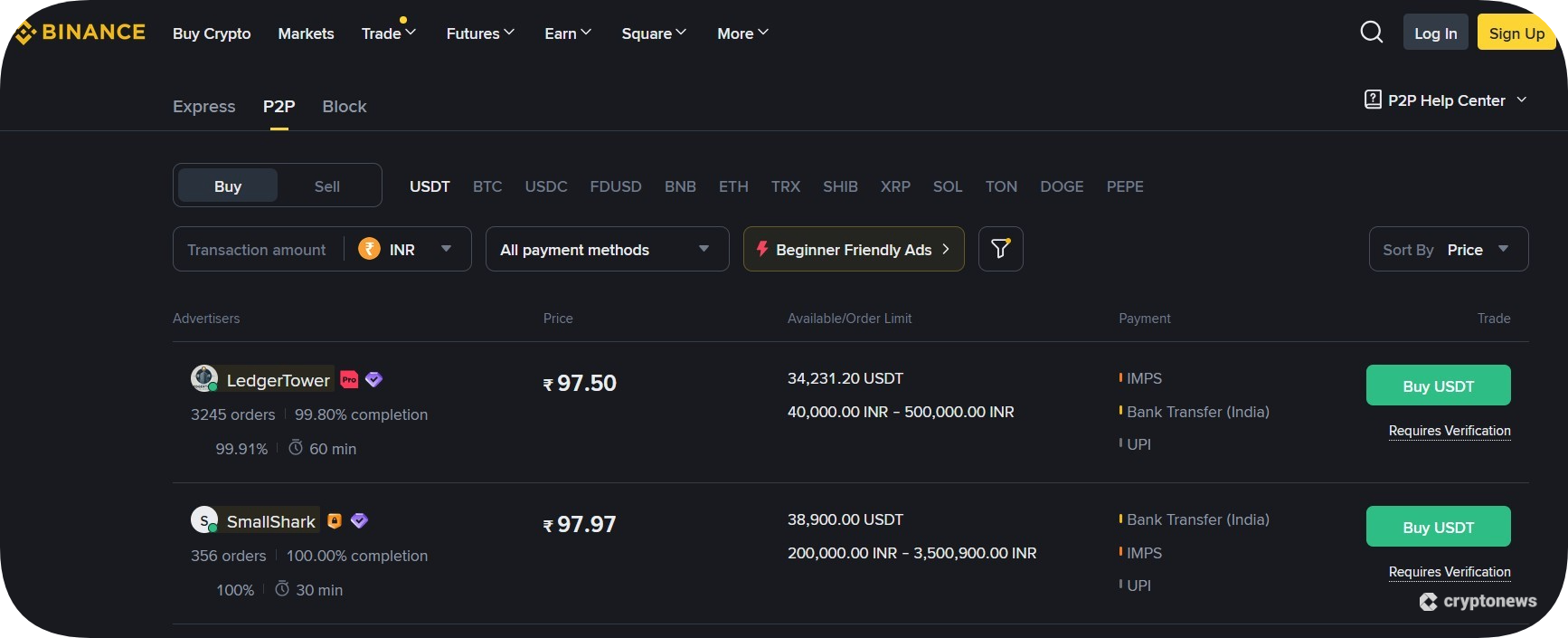
Binance’s P2P marketplace supports multiple payment methods, including Paytm, Digital eRupee, IMPS, UPI, and bank transfers. You can also use phone number-based payment methods like GPay, PhonePe, and Mobikwik. You can take advantage of its P2P express mode to find the best offers. Keep in mind that both new and existing Indian users must complete KYC verification, which includes submitting their PAN card details and undergoing live face verification.
We noticed that Binance doesn’t automatically deduct a 1% TDS on crypto trades – you have to manually calculate, report, and pay TDS, which can be a drag. On a positive note, the trading fees are lower than the industry standard. Maker and taker fees start at 0.100%, while BNB token holders get a 25% fee discount, which equals 0.07500%.
Binance Key Takeaways
- Registered with FIU-IND and compliant with Indian AML laws.
- Binance’s P2P marketplace supports multiple local payment methods, such as Paytm, Digital eRupee, IMPS, UPI, and bank transfers.
- Offers a wide range of trading products – spot, margin, demo trading, and staking. Binance Futures are currently not available in India.
Pros
- Registered with FIU-IND
- Supports local payment methods – Digital eRupee, IMPS, and UPI
- Highly liquid P2P marketplace
- Competitive trading fees
- Binance’s P2P market in India supports BTC, BNB, ETH, TRX, SHIB, XRP, SOL, TON, DOGE, PEPE, USDT, USDC, FDUSD
Cons
- Binance doesn’t automatically deduct a 1% TDS on crypto trades
2. Kraken – The Best Crypto Exchange in India for Advanced Trading
- Supported Coins: 540+
- Maker/Taker Fees: 0.25% / 0.40% for spot, 0.0200% / 0.0500% for futures
- Payment Methods: Bank transfers, credit/debit cards, Apple Pay, Google Pay, and PayPal
- Regulatory Status: Internationally regulated exchange
Kraken is a long-running centralized exchange built around active and experienced traders. Its main platform provides straightforward buying and selling, while Kraken Pro adds advanced order types, customizable trading screens, margin markets, and derivatives.
The exchange supports more than 540 cryptocurrencies and 1,000 trading pairs. Users can access spot markets alongside over 150 margin-enabled markets with leverage of up to 5x. Kraken also offers more than 350 USD-settled perpetual futures and over 100 multi-collateral futures contracts, although product availability varies by jurisdiction.
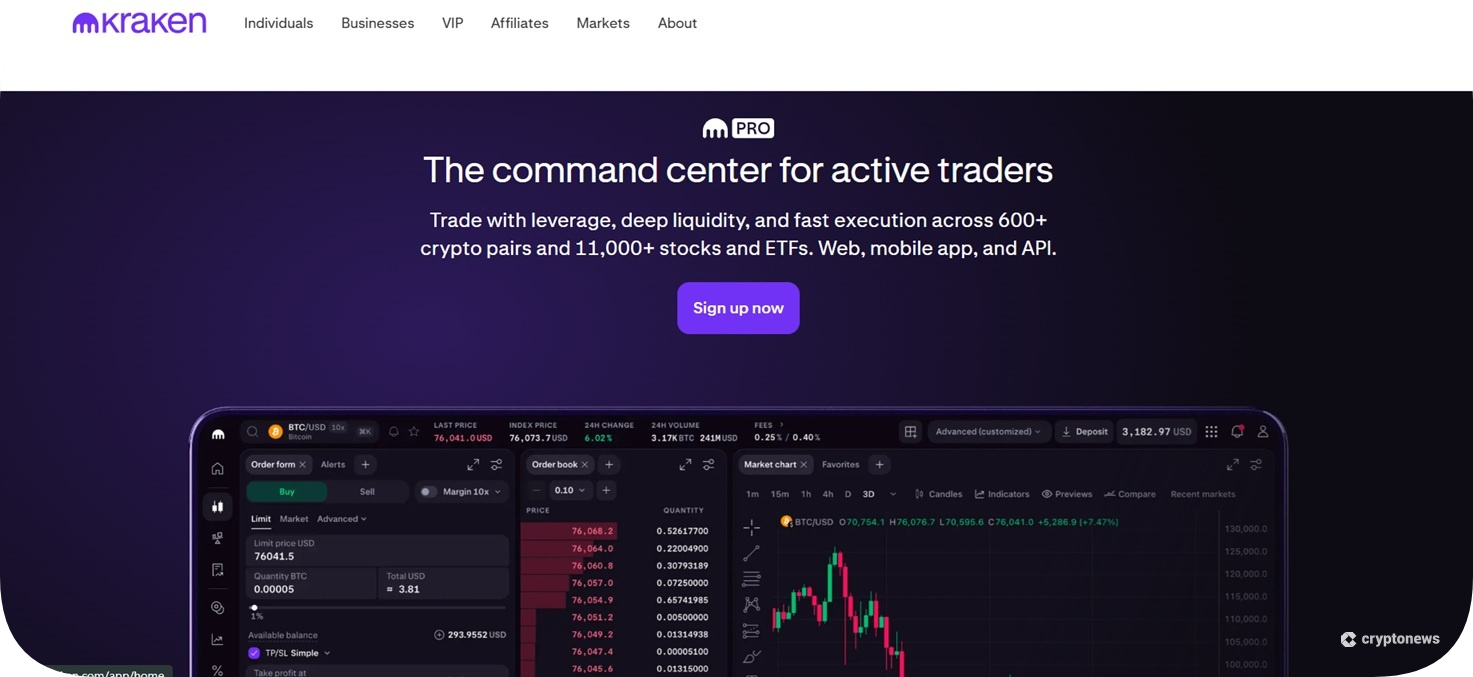
Kraken Pro is the strongest reason to consider the platform – traders can arrange their own dashboards, monitor several markets at once, place orders directly from charts, and use tools such as stop-loss, take-profit, immediate-or-cancel, and reduce-only orders. Kraken Pro is available through desktop and mobile apps and does not carry a separate subscription charge.
Security is another major part of Kraken’s offering, with a combination of hot and cold storage, passkey-compatible two-factor authentication, withdrawal-address confirmations, account timeouts, encrypted connections, and continuous monitoring. It also publishes Proof of Reserves information covering eligible spot, margin, and staking balances.
Kraken’s standard spot fees begin at 0.25% for makers and 0.40% for takers. These rates are higher than Binance’s entry-level fees, but its futures pricing is more competitive, starting at 0.0200% for makers and 0.0500% for takers. Higher-volume traders can qualify for lower rates.
Kraken Key Takeaways
- Kraken Pro provides customizable dashboards, chart-based order management, and advanced order types.
- Trade 540+ cryptocurrencies, spot markets, margin positions, and a broad range of futures contracts.
- Security features include cold storage, passkey-compatible 2FA, Proof of Reserves, and real-time monitoring.
Pros
- Advanced Kraken Pro trading platform
- Supports 540+ cryptocurrencies and 1,000 trading pairs
- Competitive futures trading fees
- Margin trading with up to 5x leverage
- Strong account-security controls
Cons
- Entry-level spot fees are higher than those of some competitors
- Advanced tools may feel complicated for first-time traders
- Some products are restricted depending on the user’s location
3. Bybit – The Best Crypto Exchange in India for Derivatives Trading
- Supported Coins: 650+
- Maker/Taker Fees: 0.1000% / 0.1000% for spot, 0.0200% / 0.0550% for futures
- Payment Methods: P2P trading, credit/debit cards, bank transfers, and third-party payment providers
- Regulatory Status: Available to Indian users
Bybit is a large centralized exchange aimed primarily at active traders, supporting more than 650 cryptocurrencies for spot trading, alongside margin markets, options, and over 550 perpetual futures contracts. Its derivatives selection and leverage of up to 125x make it particularly suitable for experienced users who want more than straightforward crypto purchases.
Spot and margin traders can access hundreds of cryptocurrency pairs, with margin of up to 10x available on many USDT markets. Bybit’s derivatives platform includes more than 520 USDT-denominated perpetual contracts and over 35 USDC contracts. Options are also available for BTC, ETH, and SOL.
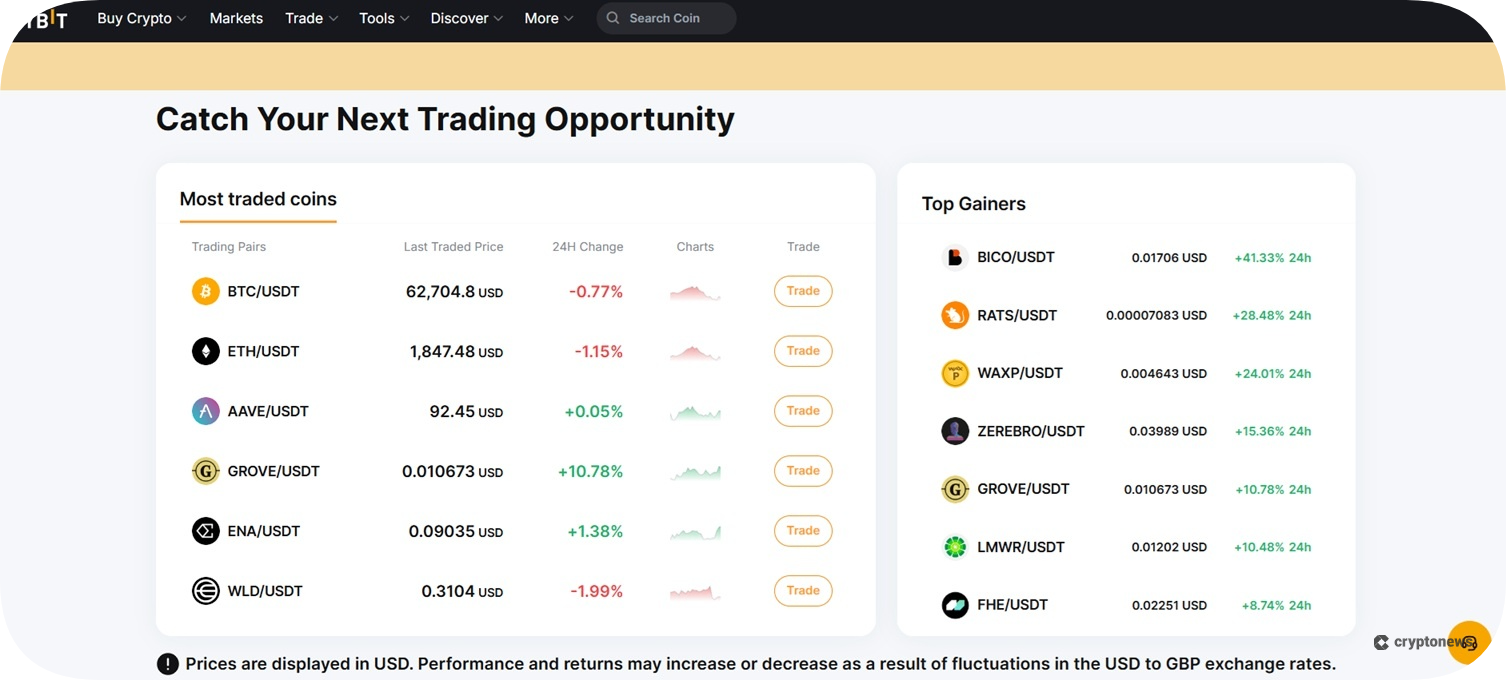
The exchange includes TradingView charts, order-book data, technical indicators, and several advanced order types. Users can also automate strategies through Bybit’s trading bots or follow experienced traders using its copy-trading service. Bybit publishes statistics for each available trader, including historical returns, win rates, follower numbers, and the average profit or loss generated by followers.
Bybit also operates a P2P marketplace that supports over 60 fiat currencies and more than 300 cryptocurrencies. Indian users can use the marketplace to buy or sell crypto through available local payment methods, although individual offers, exchange rates, and payment options depend on the merchant. P2P transactions require identity verification but do not carry a separate Bybit trading fee.
The standard spot fee is 0.1000% for both makers and takers. Futures fees begin at 0.0200% for makers and 0.0550% for takers, while options start at 0.0200% and 0.0300%, respectively. High-volume traders and users who maintain larger account balances can qualify for lower fees through the exchange’s VIP program.
Bybit’s Earn section includes staking, flexible and fixed-term savings products, liquidity mining, and dual-asset strategies. These products carry different levels of risk, and advertised yields may change according to the asset and market conditions.
Bybit also uses two-factor authentication, anti-phishing codes, multi-signature wallets, real-time monitoring, and an insurance fund.
Bybit Key Takeaways
- Trade more than 650 spot cryptocurrencies and over 550 perpetual futures contracts.
- Advanced tools include copy trading, automated trading bots, TradingView charts, and leverage of up to 125x.
- Its P2P marketplace supports over 60 fiat currencies and does not charge separate transaction fees.
Pros
- Supports 650+ spot cryptocurrencies
- More than 550 perpetual futures contracts
- Futures leverage of up to 125x
- Copy trading and automated trading bots
- Multiple staking and yield products
Cons
- The large number of products creates a steep learning curve
- High leverage significantly increases the risk of losses
4. OKX – The Best Crypto Exchange in India for Automated Trading
- Supported Coins: 350+
- Maker/Taker Fees: 0.080% / 0.100% for spot, 0.020% / 0.050% for futures
- Payment Methods: P2P trading, credit/debit cards, bank transfers, and third-party payment providers
- Regulatory Status: Available to Indian users
OKX is a feature-rich centralized exchange that combines spot and derivatives trading with copy trading, automated bots, staking, and a non-custodial wallet. Its broad toolkit makes it particularly suitable for active traders who want to automate strategies or manage multiple types of positions from a single account.
The exchange lists more than 350 cryptocurrencies across over 500 spot trading pairs. Users can trade standard USDT and USDC markets, crypto-to-crypto pairs, and selected fiat-denominated markets. Margin of up to 10x is available on supported spot pairs, while the demo account lets new users test the platform without putting funds at risk.
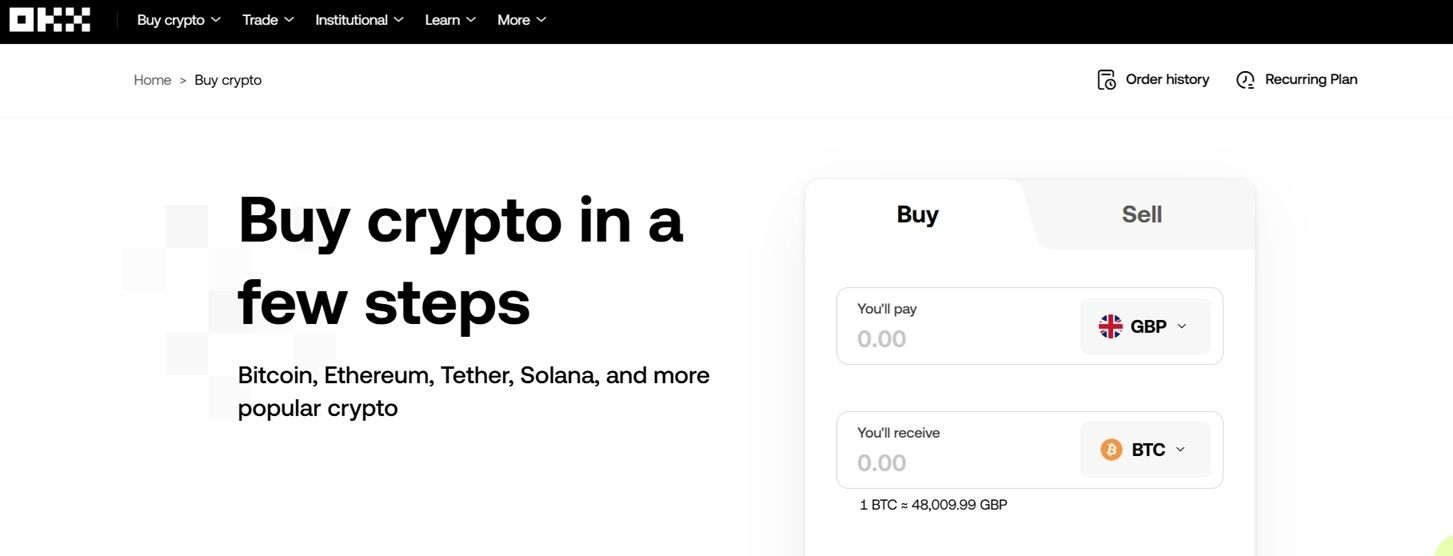
OKX offers perpetual futures with leverage of up to 100x and expiry futures with leverage of up to 125x. Contracts can be margined using USDT, USDC, or selected cryptocurrencies, giving traders more control over how collateral is managed. It also offers pre-market futures, which allow eligible users to trade certain tokens before their official spot listing.
Automated trading is one of OKX’s strongest features, with 12 pre-built bots covering strategies such as spot grids, futures grids, recurring purchases, dollar-cost averaging, arbitrage, portfolio rebalancing, and time-weighted orders. More experienced users can also create custom bots through TradingView signals or the OKX API.
OKX supports both spot and futures copy trading. Users can review lead traders’ performance and automatically replicate their positions, while controls such as spread protection and position limits help manage execution. Copy traders share a portion of profitable trades with the lead trader, with the exact percentage depending on the trader selected.
Standard spot fees begin at 0.080% for makers and 0.100% for takers. Futures fees start at 0.020% for makers and 0.050% for takers, while options fees begin at 0.030% for both sides of the trade. Rates fall for users who meet higher account-balance or monthly trading-volume requirements.
The exchange also offers Simple Earn, on-chain staking, structured products, crypto-backed loans, and its Jumpstart token-launch platform. Through Jumpstart, eligible users can stake assets or pledge tokens to participate in selected new-project distributions.
OKX Wallet extends the platform beyond centralized trading as the non-custodial wallet supports multiple blockchain networks, cross-chain swaps, NFTs, and access to more than 1,000 decentralized applications. Its Smart Account feature can also allow users to pay certain network fees using stablecoins rather than the blockchain’s native token.
OKX Key Takeaways
- Use 12 pre-built trading bots for grid trading, recurring purchases, arbitrage, portfolio rebalancing, and other strategies.
- Trade more than 500 spot pairs alongside perpetual, expiry, pre-market, and options products.
- Its non-custodial wallet supports cross-chain swaps, NFTs, and access to over 1,000 dApps.
Pros
- Supports 350+ cryptocurrencies and 500+ spot pairs
- Includes 12 automated trading bots
- Offers spot and futures copy trading
- Competitive spot and derivatives fees
- Integrated non-custodial Web3 wallet
Cons
- The wide range of products may overwhelm beginners
- Some trading features are restricted by location
- Third-party payment providers may charge additional fees
5. Coinbase – The Best India-Friendly Exchange for Crypto‑to‑Crypto Trading
- Supported Coins: 369
- Maker/Taker Fees: 0.40%/0.60% for spot, 0%/0.03% for futures
- Payment Methods: A full fiat on-ramp is planned for 2026
- Regulatory Status: Registered with FIU-IND
Coinbase is one of the newest names on the FIU-registered crypto exchange list. After suspending its services in India in 2023, Coinbase re-entered the Indian market in late 2025. However, its services are currently limited to crypto-to-crypto trading. Indian users can also use Coinbase’s Simple Trade and Advanced Trade interface, trade perpetual futures (INTX derivatives), use its native wallet, earn staking rewards on eligible assets, and send and receive crypto to and from other wallets/exchanges.
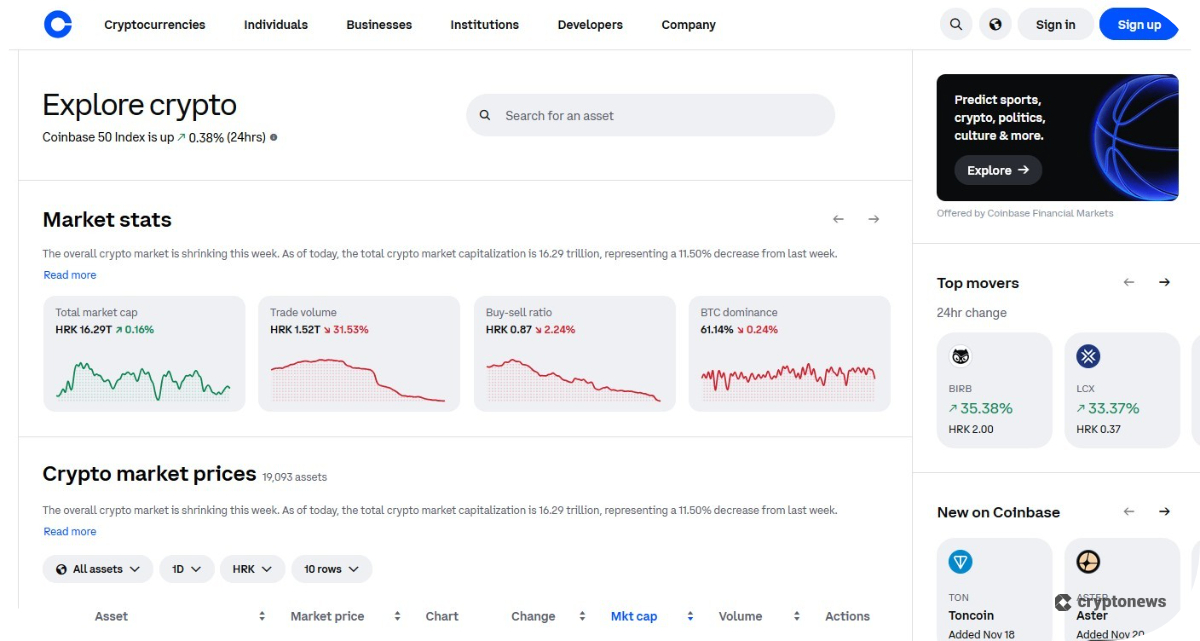
However, to send/receive crypto from accounts/wallets outside of Coinbase, you must provide your full name, country of residence, and personal ID number (Aadhaar number or PAN). Coinbase currently doesn’t support direct INR deposits and withdrawals. This option will be introduced before the end of 2026.
We also noticed that spot trading fees are higher than the industry standard. They start at 0.40% for makers and 0.60% for takers, which makes this exchange less suitable for active traders.
Coinbase Key Takeaways
- Indian users can trade 369 cryptocurrencies and perpetual futures (INTX derivatives).
- Earn staking rewards on eligible assets, and send and receive crypto to and from other wallets/exchanges.
- Use both the Simple Trade and the Advanced Trade interface.
Pros
- Registered with FIU-IND
- Supports crypto-to-crypto trading and perpetual futures
- Offers a native wallet
- Simple and advanced interface
Cons
- Indian users are currently limited to crypto-to-crypto trading
- No direct INR bank deposits or withdrawals (at the time of writing)
6. KuCoin – The Best Crypto Exchange in India for Altcoin Trading
- Supported Coins: 1,000+
- Maker/Taker Fees: 0.10% / 0.10% for spot, 0.02% / 0.06% for futures
- Payment Methods: P2P trading, credit/debit cards, crypto deposits, and third-party payment providers
- Regulatory Status: Available to Indian users
KuCoin is a centralized exchange best known for its unusually broad selection of cryptocurrencies. It lists more than 1,000 coins and tokens, including many smaller altcoins that may not yet be available on larger exchanges. This makes it a strong option for traders who want access to projects beyond established assets such as Bitcoin, Ethereum, and Solana.
The platform combines spot trading with margin markets, perpetual futures, options, leveraged tokens, staking, and automated trading bots. Although experienced traders will get the most from this range, KuCoin also offers instant purchases, help prompts, and demo futures trading with virtual funds.
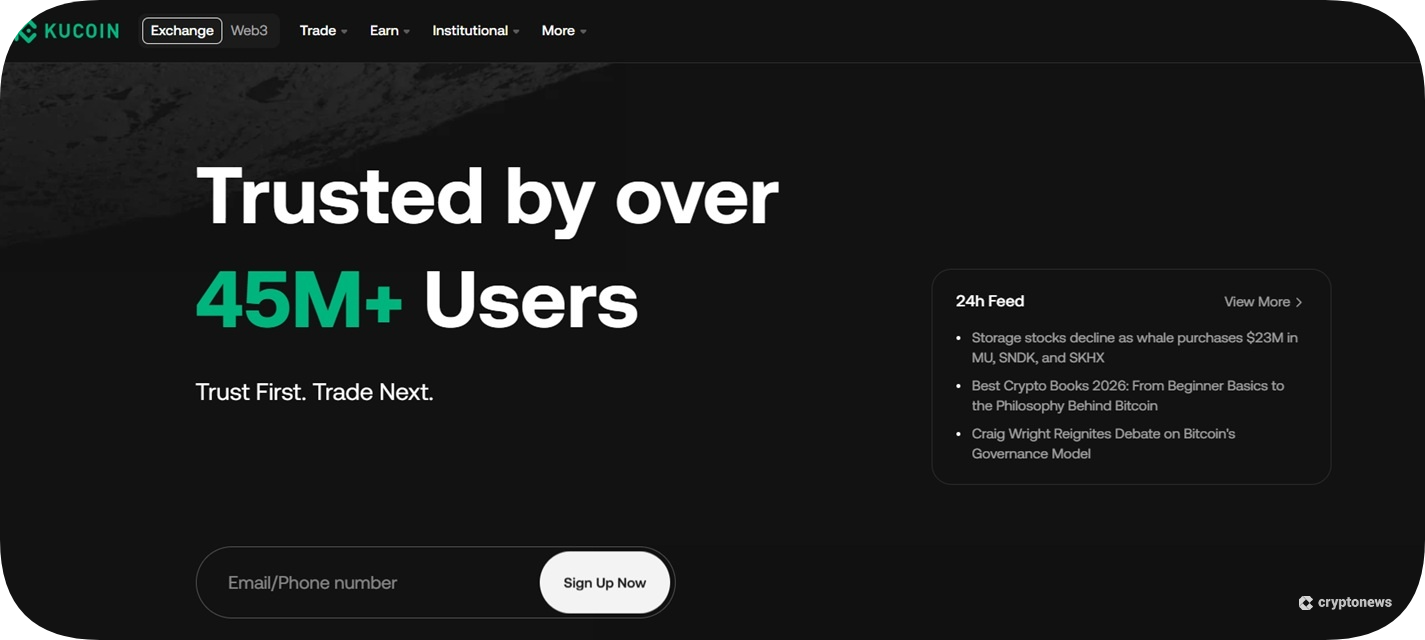
KuCoin’s spot platform supports standard market and limit orders alongside stop-limit, stop-market, and trailing-stop orders. Traders can also use isolated or cross margin with leverage of up to 10x. The trading interface brings spot, margin, futures, and bot tools together, making it convenient to move between markets once users are familiar with the layout.
Perpetual futures are available on a broad range of established cryptocurrencies, altcoins, and meme coins, with leverage of up to 100x on selected contracts. KuCoin supports both USDT-margined and coin-margined futures, while quarterly contracts are available for Bitcoin. Options trading is currently more limited, covering BTC and ETH through a simplified interface.
Automated trading is another important part of KuCoin’s offering. Its bots include spot grid, futures grid, dollar-cost averaging, infinity grid, and smart portfolio rebalancing strategies. Users can rely on suggested settings or customize parameters such as trading ranges, investment intervals, and portfolio weightings.
KuCoin also provides early access to new token projects through its Launch Hub. Its GemPool, Pre-Market, Spotlight, GemVote, and BurningDrop services let eligible users participate by staking assets, committing funds, voting, or completing platform tasks. Availability and participation requirements vary between individual launches.
Spot trading fees begin at 0.10% for both makers and takers. Futures fees start at 0.02% for makers and 0.06% for takers. KuCoin uses a tiered VIP structure, so fees can fall as trading volume or KCS holdings increase. Users can also receive a 20% trading-fee discount by paying fees with the platform’s KCS token.
The KuCoin Web3 Wallet provides non-custodial access to networks such as Ethereum, Solana, BNB Smart Chain, Polygon, and KuCoin Community Chain. It also supports WalletConnect, allowing users to interact with decentralized exchanges, staking platforms, blockchain games, and other dApps.
KuCoin Key Takeaways
- Trade more than 1,000 cryptocurrencies, including smaller altcoins that may not yet be listed on larger exchanges.
- Automate strategies using grid, DCA, infinity grid, futures, and portfolio-rebalancing bots.
- Access new token projects through GemPool, Pre-Market, Spotlight, GemVote, and BurningDrop.
Pros
- Supports more than 1,000 cryptocurrencies
- Competitive spot and futures trading fees
- Wide selection of automated trading bots
- Early access to selected token launches
- 20% fee discount when paying with KCS
Cons
- The advanced trading interface may overwhelm beginners
- Direct fiat deposit options vary by location
- Options trading is limited to BTC and ETH
7. Best Wallet DEX – The Best Crypto Exchange in India for Decentralized Trading
- Supported Coins: 1,000+
- Maker/Taker Fees: Network dependent (no markup)
- Payment Methods: Credit/debit card, SEPA, Skrill
- Regulatory Status: None
Best Wallet differs from the other platforms on our list. This is a non-custodial wallet with an integrated decentralized exchange (DEX). It lets you trade and swap 1,000 cryptocurrencies across 60+ blockchains. It aggregates liquidity from 330 DEXs and 30 bridges to provide the best rates. Moreover, setting up the wallet doesn’t require going through KYC verification.
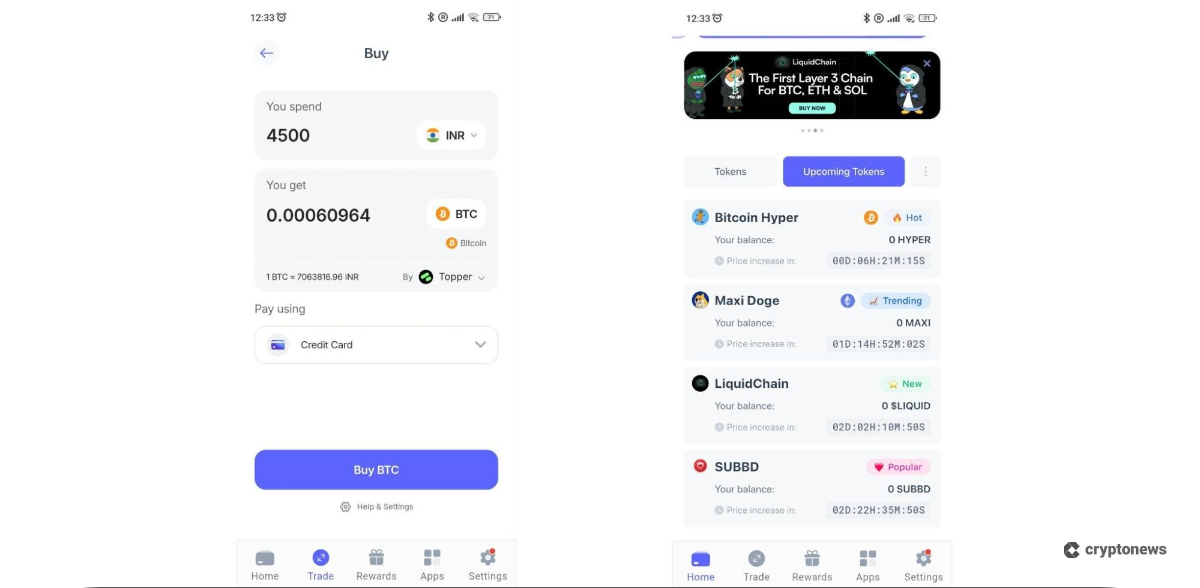
You can buy crypto with INR using the wallet’s external licensed payment partners, like MoonPay, Topper, and Banxa. There are no fees for storing crypto, while fees for INR deposits are determined by the payment providers. Best Wallet also stands out with its upcoming tokens page, which features hot presale tokens with high growth potential.
On the flip side, Best Wallet doesn’t process card payments for presale tokens. These transactions are handled by a third-party payment provider, Wert, which doesn’t support INR. This means that you have to use crypto to buy presale tokens.
Best Wallet Key Takeaways
- Its integrated DEX aggregates liquidity from 330 DEXs and 30 bridges to give you the best rates.
- Buy crypto with INR using the wallet’s external licensed payment partners, like MoonPay, Topper, and Banxa.
- Its upcoming tokens page features hot presale tokens with high growth potential.
Pros
- Trade 1,000 cryptocurrencies across 60+ blockchains
- Supports cross-chain swaps
- Self-custodial storage
- Buy crypto with INR at low fees
Cons
- Buying crypto with INR requires going through KYC verification
- Best Wallet doesn’t process card payments for presale tokens
8. CoinDCX – The Best Indian Crypto Exchange to Trade Futures
- Supported Coins: 500+
- Maker/Taker Fees: 0.50% (spot), 0.02% / 0.05% (futures)
- Payment Methods: Bank transfers (IMPS, NEFT, RTGS)
- Regulatory Status: Registered with FIU-IND
CoinDCX is an Indian-based exchange registered with FIU-IND. It supports multiple trading options, including spot trading, futures, and staking. What sets it apart is its support for INR margin futures. You don’t have to convert INR to USDT to trade futures contracts; you can use INR as margin. CoinDCX supports 300+ futures markets with up to 100x leverage on BTC and ETH and up to 50x leverage on other pairs, while the minimum order size stands at ₹100.
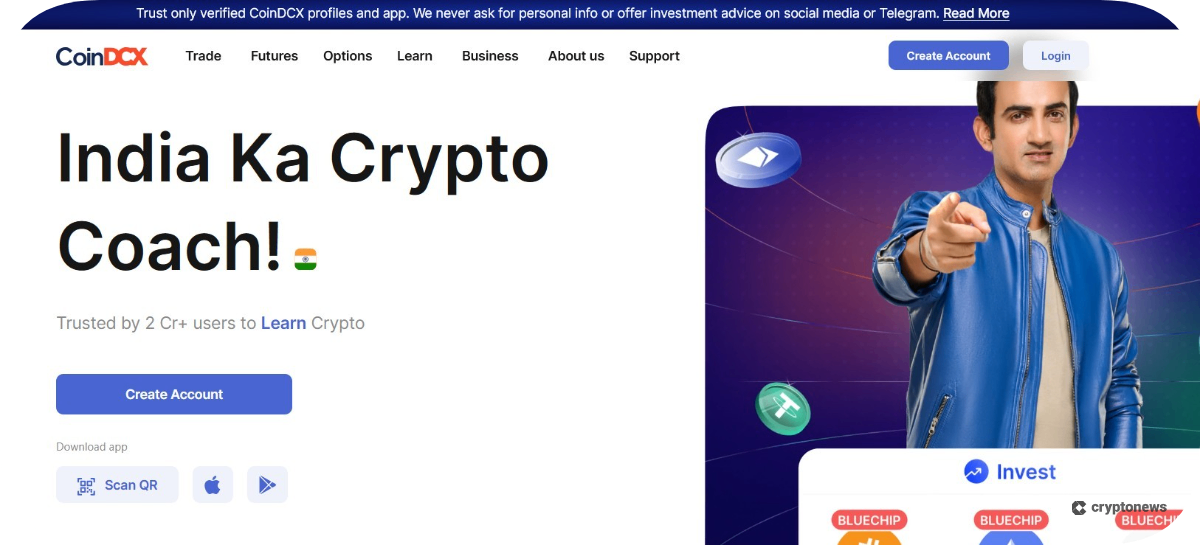
CoinDCX supports free INR deposits and withdrawals via bank transfers (IMPS, NEFT, RTGS). The minimum deposit and withdrawal limit is INR 100. However, CoinDCX doesn’t support direct bank transfers from Google Pay or UPI apps. We also liked its Insta feature, which lets you buy and sell 100+ coins instantly in INR without using complex order books.
The trading fees on CoinDCX start at 0.50% (both maker and taker) for spot and at 0.02% (maker) and 0.05% (taker) for futures, which is much higher compared to its competitors.
CoinDCX Key Takeaways
- Use INR as margin to trade 300+ futures markets with up to 100x leverage on BTC and ETH and up to 50x leverage on other pairs.
- Insta feature lets you trade 100+ coins instantly with INR
- Supports free INR deposits and withdrawals via bank transfers (IMPS, NEFT, RTGS).
Pros
- Trade INR futures with up to 100x leverage
- No deposit/withdrawal fees when using INR
- ISO/IEC 27001:2022 certified
- Supports 300+ futures markets
Cons
- Doesn’t support direct bank transfers from Google Pay or UPI apps
- High trading fees
What Is a Cryptocurrency Exchange?
Crypto exchanges are online platforms where you can trade digital assets. They can also provide services such as swaps, staking, futures, spot, and options trading. An Indian crypto exchange lets you buy and sell digital assets with both fiat (INR) and crypto.
Crypto exchanges can be centralized and decentralized. The former is owned and operated by a centralized authority that matches buy and sell orders on an order book, while the latter enables direct trades between users via smart contracts.
Are Crypto Exchanges Legal in India?
Cryptocurrencies are classified as Virtual Digital Assets (VDAs) under Indian law. This means that you can buy, sell, hold, and trade cryptocurrencies as property or investments. However, to be considered legal, crypto exchanges must be registered with the Financial Intelligence Unit – India (FIU‑IND). They must also comply with the KYC and AML laws.
In 2025, the FIU banned 25 offshore crypto exchanges, including BingX, PrimeXBT, and Phemex, for operating without proper registration. However, several major exchanges have recently re-entered the Indian market after registering with the FIU-IND and complying with AML laws. These include Coinbase, Binance, Bybit, and Bitget.
As of Jan. 2026, 49 crypto exchanges (45 domestic and 4 offshore exchanges) are registered with FIU-IND.
Do I Need KYC to Trade Crypto in India?
As mentioned above, to be considered legal, an Indian crypto exchange must implement KYC verification. Besides submitting your government ID (PAN, Aadhaar, passport, voter ID), you must also go through live selfie verification with liveness detection, “penny-drop” bank validation, and geotagging:
- Take a live selfie during the KYC process and follow the instructions, such as blinking or tilting your head.
- Enter your bank account number and IFSC code. The exchange will send a refundable ₹1 credit to your account so your bank can confirm that your account is active and that the name on the account matches your identity. Once verification is successful, ₹1 will be refunded to your bank account.
- Record your latitude/longitude, IP address, timestamp, and date.
How Are Crypto Exchanges in India Regulated?
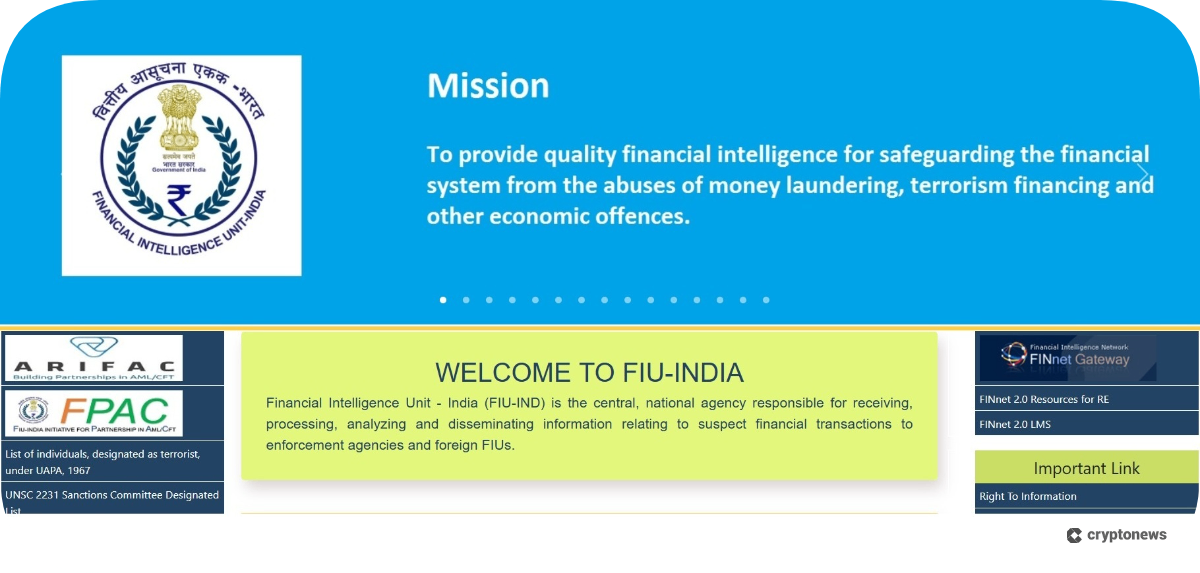
Crypto exchanges in India are regulated by the Financial Intelligence Unit – India (FIU-IND). To operate legally in India, both onshore and offshore exchanges must register with FIU‑IND. The Ministry of Finance oversees crypto taxes, while the Reserve Bank of India (RBI) regulates the digital rupee and oversees banks that deal with exchanges. Crypto derivatives trading is currently in a regulatory gray area.
What Fees Do Crypto Exchanges in India Charge?
Crypto exchanges in India charge various fees. Here are the main ones to take into account:
- Deposit fees: Most crypto exchanges charge zero fees for direct INR deposits via UPI and IMPS. However, some exchanges may charge a small fee for using specific features.
- Withdrawal fees: INR withdrawals usually come with a small fee. For example, ZebPay charges a flat ₹15 fee for INR withdrawals.
- Fiat purchases: Fiat purchase fees depend on the payment method. Bank transfers are usually the cheapest, while P2P trading comes with higher fees. You’ll also pay higher fees if you use third-party on-ramp providers.
- Network fees: You must cover gas fees when sending crypto from an external wallet or exchange. These fees depend on the blockchain.
- Additional fees: All fees (including deposit/withdrawal fees) are subject to 18% GST. Moreover, exchanges must deduct 1% TDS on eligible crypto transfers exceeding certain annual thresholds: ₹50,000 per year for individuals without business income and ₹10,000 per year for others.
How to Choose an Indian Crypto Exchange: Cryptonews Research Methodology
Finding the best crypto exchange in India is not easy, especially due to strict regulatory oversight and complex KYC requirements. Before hitting the Sign up button, pay attention to the following factors.
Regulations (20%)
Rule number one – choose an exchange that’s registered with FIU-IND and that follows KYC and AML laws. Trading on unregulated exchanges is dangerous and may be illegal. Moreover, unregulated platforms don’t use protection mechanisms, such as security funds or insurance schemes. They can also engage in unethical practices, such as Ponzi schemes and rug pulls.
Available Markets (20%)
Opt for exchanges that support both major cryptocurrencies and small-cap tokens to diversify your portfolio. You should also give an advantage to platforms that offer a wide range of products and services, including spot, futures, options trading, and crypto baskets.
INR Support (10%)
Choosing a crypto exchange that accepts INR deposits/withdrawals is essential if you want to avoid conversion fees. You should also find platforms that support both instant bank transfers (IMPS, NEFT, RTGS) and UPI (Google Pay, PhonePe, Paytm, Cred). Exchanges that support INR via local banking channels are generally more aligned with the local regulations, especially regarding tax compliance.
Trading Tools (10%)
Use exchanges that offer a range of trading tools, from trading APIs to quick trades and SIPs. Beginners can opt for platforms with simple interfaces and educational resources, while professionals will benefit most from exchanges that offer advanced charting features.
Trading Fees (10%)
Trading fees will have a big impact on your profitability, especially if you’re an active trader. This is why you should find exchanges with low trading fees.
Security (20%)
Security must be your top priority. A good FIU-registered crypto exchange in India will utilize both basic security features, like 2FA and cold storage, and advanced features, like MPC technology, multi-approval withdrawals, and real-time reserve tracking. In addition, choose exchanges that undergo regular security audits and have no history of hacks.
Ease of Use (10%)
Last but not least, opt for exchanges with clear dashboards, which enable easy navigation. For example, a user-friendly exchange will highlight its most important functions (deposit, buy, sell), while advanced options will be placed into sub-categories.
Conclusion: What Is the Best Crypto Exchange in India?
To be considered legal, crypto exchanges in India must be regulated by FIU-IND and comply with the new AML and KYC guidelines, including live selfie verification with liveness detection, “penny-drop” bank validation, and geotagging. After testing 40+ exchanges, we believe that Binance has what it takes to take the number one position.
Binance is registered with FIU-IND and allows you to buy crypto with INR through its P2P marketplace. Plus, you can use local payment methods, like Paytm, Digital eRupee, IMPS, UPI, and bank transfers. On the downside, Binance doesn’t automatically deduct a 1% TDS on crypto trades.
Visit BinanceFAQs
What is FIU registration, and why does it matter?
Can I access international exchanges from India?
How to withdraw crypto to INR instantly?
What is the largest crypto exchange in India?
References
- Coinbase Relaunches in India: Crypto-to-Crypto Trading Resumes, INR Support Delayed Until 2026 (IndianWeb2)
- Financial Intelligence Unit – India
- Financial Intelligence Unit (FIU IND) issues notices for non-compliance to 25 offshore Virtual Digital Assets Service providers (VDA SPs) under Section 13 of the Prevention of Money Laundering Act (PML) Act, 2002 (PIB)
- 49 crypto currency exchanges registered with FIU during 2024-25 fiscal: Report (BFSI)
- Reserve Bank of India (RBI)
- Crypto taxation in India: Analysis (Tax TMI)
2M+
250+
8
70





 in numbers

About Cryptonews
Our goal is to offer a comprehensive and objective perspective on the cryptocurrency market, enabling our readers to make informed decisions in this ever-changing landscape.
Our editorial team of more than 70 crypto professionals works to maintain the highest standards of journalism and ethics. We follow strict editorial guidelines to ensure the integrity and credibility of our content.
Whether you’re looking for breaking news, expert opinions, or market insights, Cryptonews has been your go-to destination for everything cryptocurrency since 2017.