
Best Exchanges For Privacy Coins: Swap XMR, ZCash Anonymously


Centralized exchanges have spent the better part of 4 years quietly exiting the privacy coin market, yet volume on coins such as Monero (XMR) has remained steady or increased between 2022 and 2026.
Why? Because privacy coins are useful – even needed. And despite exchanges playing safe around compliance, even institutions get it, with Grayscale filing to convert its Zcash Trust into a spot ETF. People have legitimate reasons, arguably a right, to move value without broadcasting their financial history to anyone running a blockchain explorer.
The practical consequence of delistings is that non-custodial swap platforms have helped users who other venues are turning away. We explore the five best options available today for swapping into and out of XMR, ZEC, and other privacy coins without creating an account or submitting identity documents. We cover how each platform works, what fees look like, known risks, and the mechanics of executing a swap.
Focusing on Monero and Zcash, note that they handle privacy differently, and that difference affects which wallets and platforms you use. Monero enforces privacy by default (ring signatures, stealth addresses, and RingCT obscure the sender, receiver, and amount on every transaction) while Zcash is opt-in, supporting transparent addresses (visible on-chain, like Bitcoin) and shielded addresses (where sender, receiver, and amount are hidden using zk-SNARKs). We’ll point this out as appropriate below.
The Best No-KYC Privacy Coin Exchanges: Ranked
| Platform | Type | Fees | Average Speed | Privacy Coins Supported | Privacy Level | Limits |
| GhostSwap | Instant No-KYC Swap | Low, built into spread | 5–20 mins | XMR, ZEC, DASH + 1,600 others | High | None stated |
| SwapRocket | Instant No-KYC Swap | ~0.5%–2% all-in | 5–20 mins | XMR, ZEC, DASH + 2,000 others | High | None / Very High |
| Trocador | Aggregator | Varies by provider | 5–30 mins | XMR, ZEC via partners | High (partner-dependent) | Provider-dependent |
| RetoSwap (Haveno) | P2P DEX | 0.1% maker / 0.5%–1% taker | Variable | XMR (native); BTC, ETH, fiat pairs | Maximal | Varies |
| FixedFloat | Instant | 1% fixed / 0.5% float | Near-instant (Lightning) | XMR, ZEC, others | Medium-High | Undisclosed |
1. GhostSwap: Best Overall for Anonymous Privacy Coin Swaps
- Fees: Built into exchange rate (no additional charges)
- Supported Pairs: 1,600+ cryptocurrencies, including BTC/XMR, ETH/XMR, USDT/XMR, BTC/ZEC, ETH/ZEC, USDT/ZEC, and more
- Processing Time: 5–20 minutes depending on chain
- Limits: None for most pairs
GhostSwap is a non-custodial, no-account swap platform that supports both Monero and Zcash without applying any registration requirement, regardless of swap size. It is an extremely easy platform to use, and the process is the same for every pair: you select an input asset, select an output asset, provide a destination wallet address, and send funds to the generated one-time deposit address.
At no point do you need an email, a name, or an identity document, and the platform has a reliable history, with more than $750 million in swaps so far across around 1.5 million traders, operating entirely anonymously.
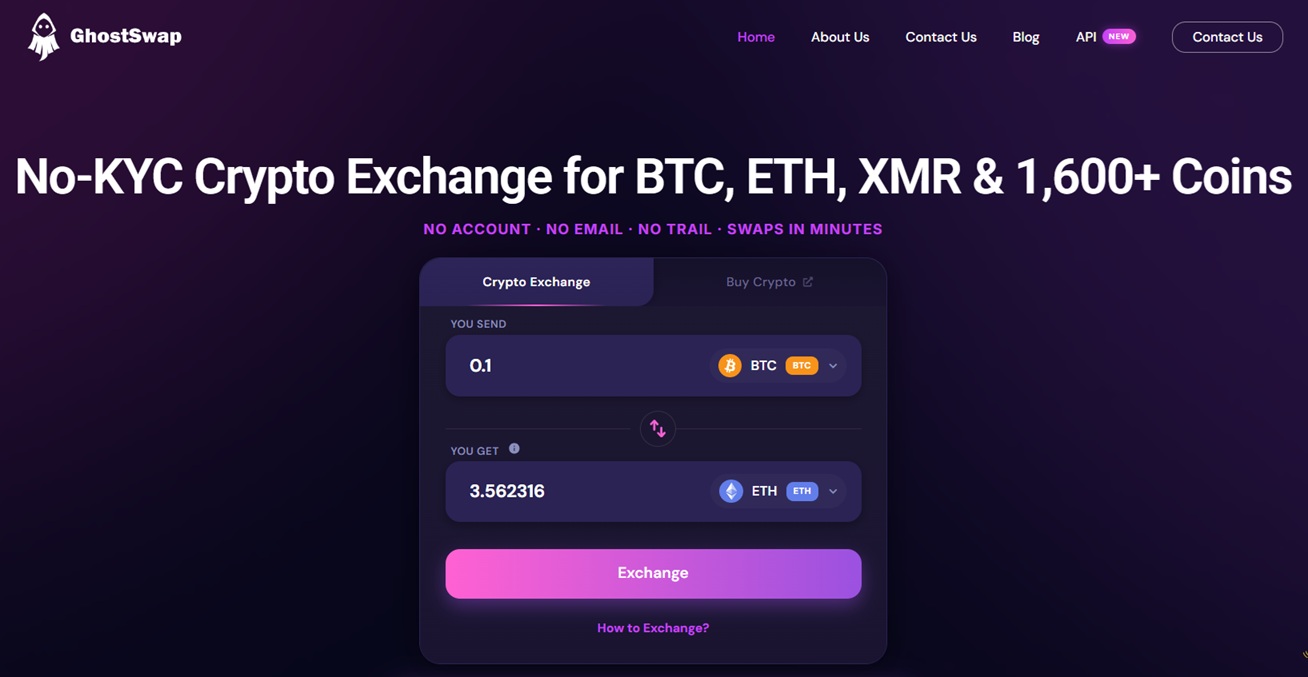
For XMR swaps, GhostSwap generates a unique deposit address from where you send your BTC, ETH or whatever input asset you have, and Monero arrives at the wallet address you specified. Bitcoin requires one to two network confirmations (typically ten to twenty minutes) after which Monero is sent and arrives within two to ten minutes. Ethereum will operate more quickly if the chain is not congested, and SOL to XMR can happen within minutes. Basically, the total elapsed time is a function of network congestion on the input chain.
ZEC swaps work on the same basis, and GhostSwap supports both transparent and shielded Zcash addresses as destinations (if you receive ZEC to a transparent address, the on-chain privacy advantage disappears). If you use a shielded z-address, you get the full benefit of Zcash’s zk-SNARK protections on the receiving end. Zcash transaction fees on-chain are also minimal, typically less than $0.01, so the cost of an exploratory test transaction before committing a larger amount is worth it for first time users.
GhostSwap’s fees are embedded in the displayed rate before you confirm, with no checkout surprises and, when we tested across around a dozen (non-privacy) pairs, fees were below what centralized exchanges charge for equivalent swaps. The absence of withdrawal fees (a recurring hidden cost on custodial platforms) reinforces the advantage.
GhostSwap is also Tor- and VPN-compatible without throttling, which means you can stop network-level metadata exposure on top of the on-chain privacy the coins themselves provide. The Telegram bot, launched in 2025, extends the exact same model to the popular messaging app with the same zero-registration.
If a swap gets delayed, GhostSwap has 24/7 live support via on-site chat. Staff can track transaction hashes on-chain and provide status updates. It is not a replacement for double-checking your destination address before sending (remember that crypto transactions are irreversible), but it is a very useful service for slower-than-expected swaps, which are nearly always network congestion issues rather than platform problems.
It’s worth noting that GhostSwap is crypto-in, crypto-out with no fiat off-ramps. While there is a new “Buy Crypto” feature on the site, it varies by region and involves bank accounts or bank cards, so we did not test it here as our focus is privacy (rather than the KYC that invariably comes in with fiat transfers).
- No registration or ID at any swap size
- Supports both XMR and ZEC (including shielded z-addresses)
- 1,600+ assets with native cross-chain support
- All-in fees visible before confirmation
- Tor/VPN-compatible and Telegram bot for in-app swaps
- No stated upper limits on most pairs
- No off-ramps
- Minimum swap amounts vary by pair (shown on-screen before starting)
2. SwapRocket: Best for Rate Aggregation Across Privacy Pairs
- Fees: 0.5%–2% embedded in the displayed rate
- Supported Pairs: 2,000+ cryptocurrencies, including XMR, ZEC, and DASH
- Processing Time: 5–30 minutes; average closer to 5–10 minutes once the deposit confirms
- Limits: None stated / no KYC trigger thresholds
SwapRocket launched in mid-2025 as a non-custodial, no-KYC instant swap aggregator and quickly built an audience (more than 150,000 regular users), offering swap services and, for our purposes, privacy coin exchanges, just at the time that centralized exchanges were getting cold feet.
By routing through more than 20 liquidity providers in real time, the platform can compete on rates for XMR and ZEC pairs without requiring any account creation or data submission.
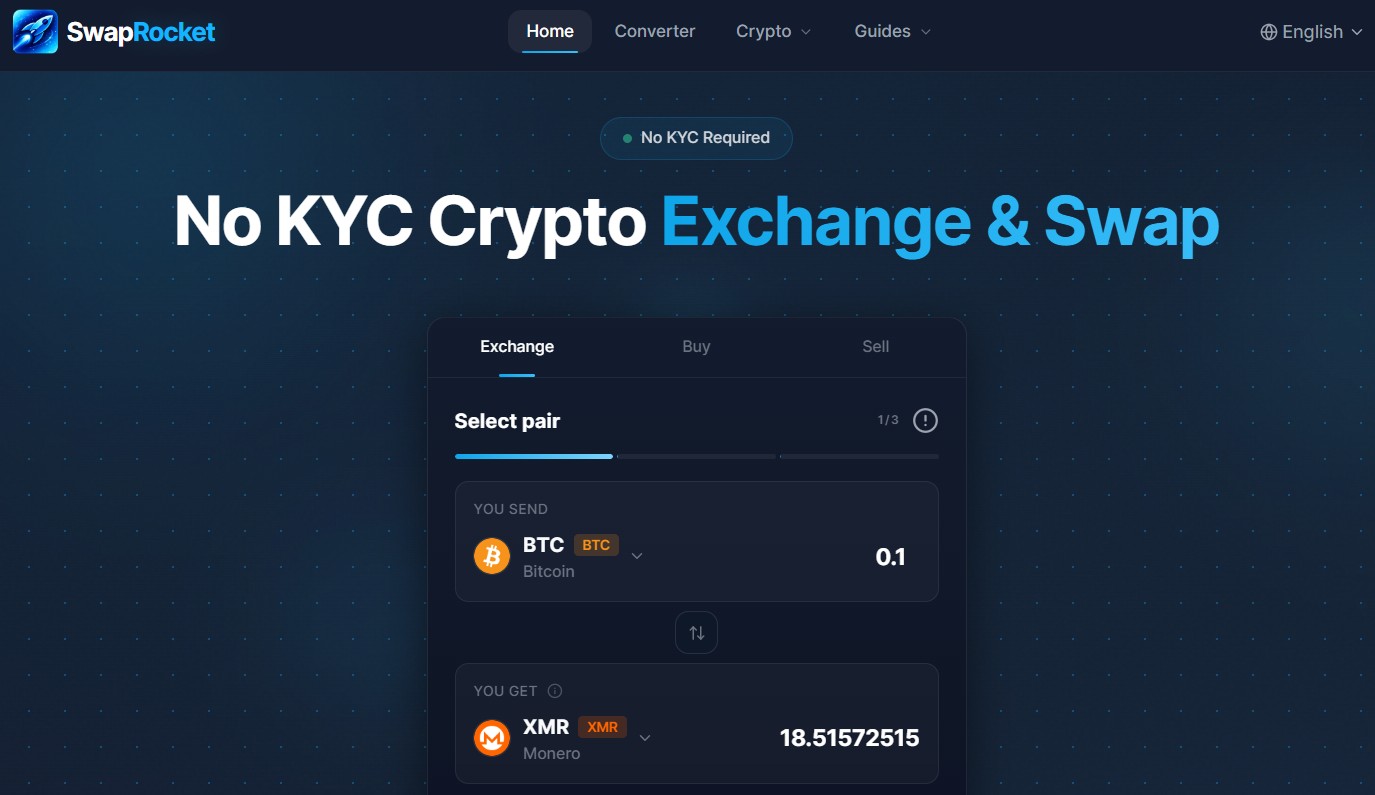
As the best of these types of exchanges offers, the process is easy: select your input, select your output, enter a destination address, send your deposit to the generated deposit address. SwapRocket never takes custody of funds, the displayed rate is all-in (service fee and network costs baked in), and the amount shown in the quote is what arrives in your wallet. Swaps generally complete within a few minutes of the input chain confirming, and the platform is fully compatible with VPN and Tor connections.
Privacy coin support is a genuine focus, with XMR, ZEC, and DASH all supported, and the multi-provider liquidity model means the rates tend to be competitive rather than padded.
There is also 24/7 live chat and email support available for transaction tracking.
- Real-time aggregation from 20+ liquidity providers
- Full no-KYC and no-account model at any volume
- XMR, ZEC, and DASH all actively supported
- Non-custodial (funds never held by the platform)
- Tor/VPN-friendly; fast average swap times
- No dedicated mobile app
- Launched mid-2025, so track record is shorter
3. Trocador.app: Best for Rate Comparison and Tor-Native Users
- Fees: You pay whatever the chosen provider charges
- Supported Pairs: XMR, ZEC, and cross-chain pairs across 20+ partner services
- Processing Time: Provider-dependent; typically 5–30 minutes
- Limits: Set by the selected partner exchange
Trocador is a comparison engine and routing layer, rather than a swap service in its own right. It queries more than 20 instant-swap partners simultaneously, displays the resulting rates side by side, includes each partner’s estimated KYC risk, and then routes the trade to whichever provider you select. Trocador itself never touches your funds.
The engineering choices are extremely privacy-conscious at an infrastructure level, for instance, JavaScript can be disabled entirely, a Tor onion address and I2P mirror are available, and Trocador itself performs no tracking or fingerprinting.
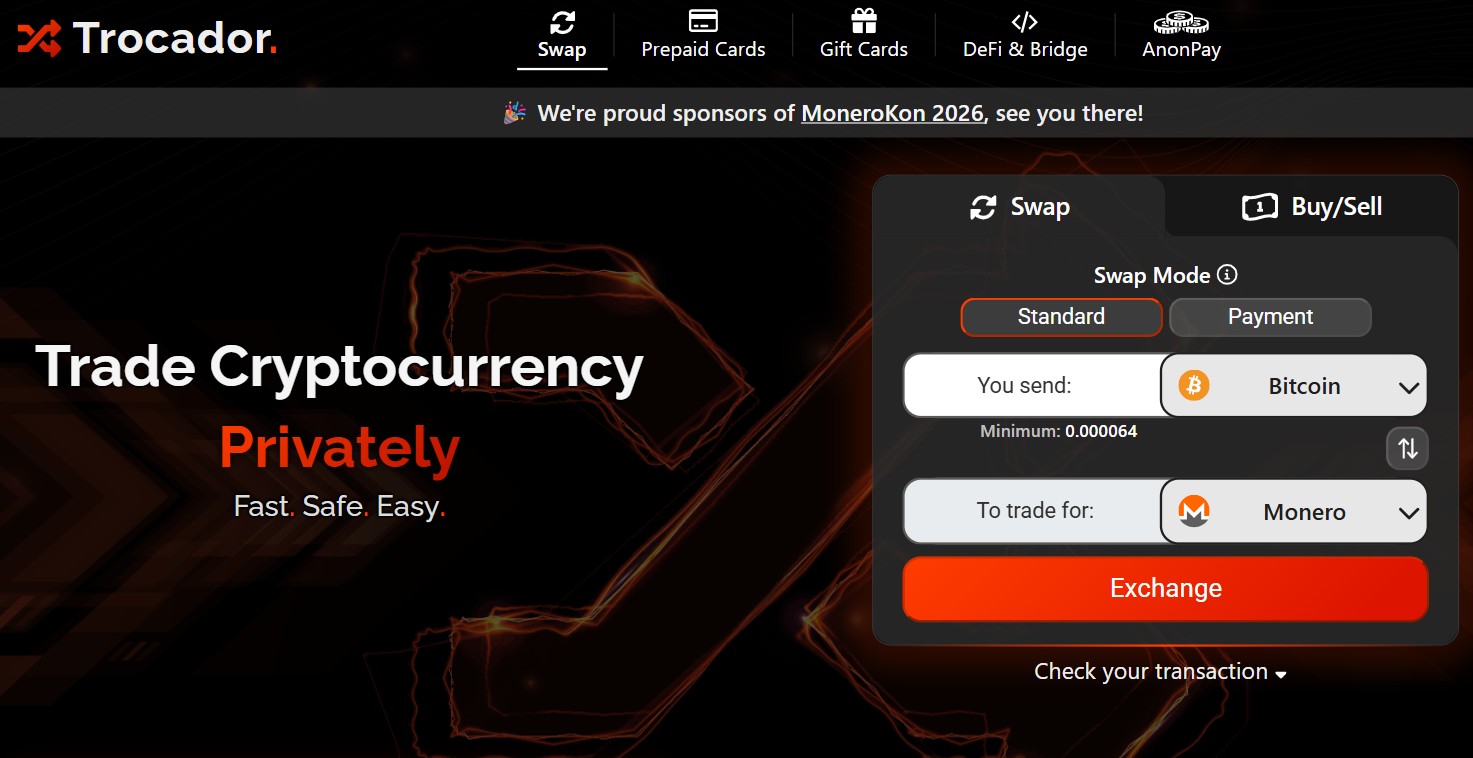
That combination makes it one of the few swap-adjacent platforms usable in Tor Browser without leaking identifying metadata through script execution. Trocador also integrates directly with Cake Wallet, the popular Monero and multi-coin mobile wallet, which means XMR users who already use Cake can access Trocador’s rate comparison without opening a separate browser.
The “Monero Tunnels” allow users to route funds from one transparent blockchain to another through Monero as an intermediary, meaning the link between, say, a Bitcoin input and an Ethereum output is obscured on the public ledger. For users who need to move funds between transparent chains without creating an obvious on-chain trail, this is a useful tool.
The KYC risk ratings for various routes are also useful, with color-coded ratings based on historical behavior around compliance requests. That said, Trocador itself cannot prevent a partner exchange from freezing funds once the trade has been routed there.
U.S. residents should note that Trocador’s Terms of Service explicitly prohibit use by U.S. residents and by people in UN-sanctioned countries, that the source code is not public, and that there is a slightly steeper learning curve here.
- No additional aggregator fee on top of partner rates
- Full Tor onion and I2P mirror; JavaScript-free mode
- KYC risk ratings displayed for each partner before you commit
- “Monero Tunnels” for cross-chain privacy routing
- Integration with Cake Wallet
- Partner exchanges can independently freeze fund
- Explicitly unavailable to U.S. users
- Source code is not public
4. RetoSwap (Haveno Network): For Users Who Need Maximum Decentralization
- Fees: 0.1% for makers / 0.5% for crypto takers / 1% for fiat takers
- Supported Pairs: Fiat (USD, EUR, GBP) to XMR; BTC, ETH, LTC to XMR
- Processing Time: Minutes for crypto; up to several days for fiat payment methods
- Limits: Set by individual trade offers
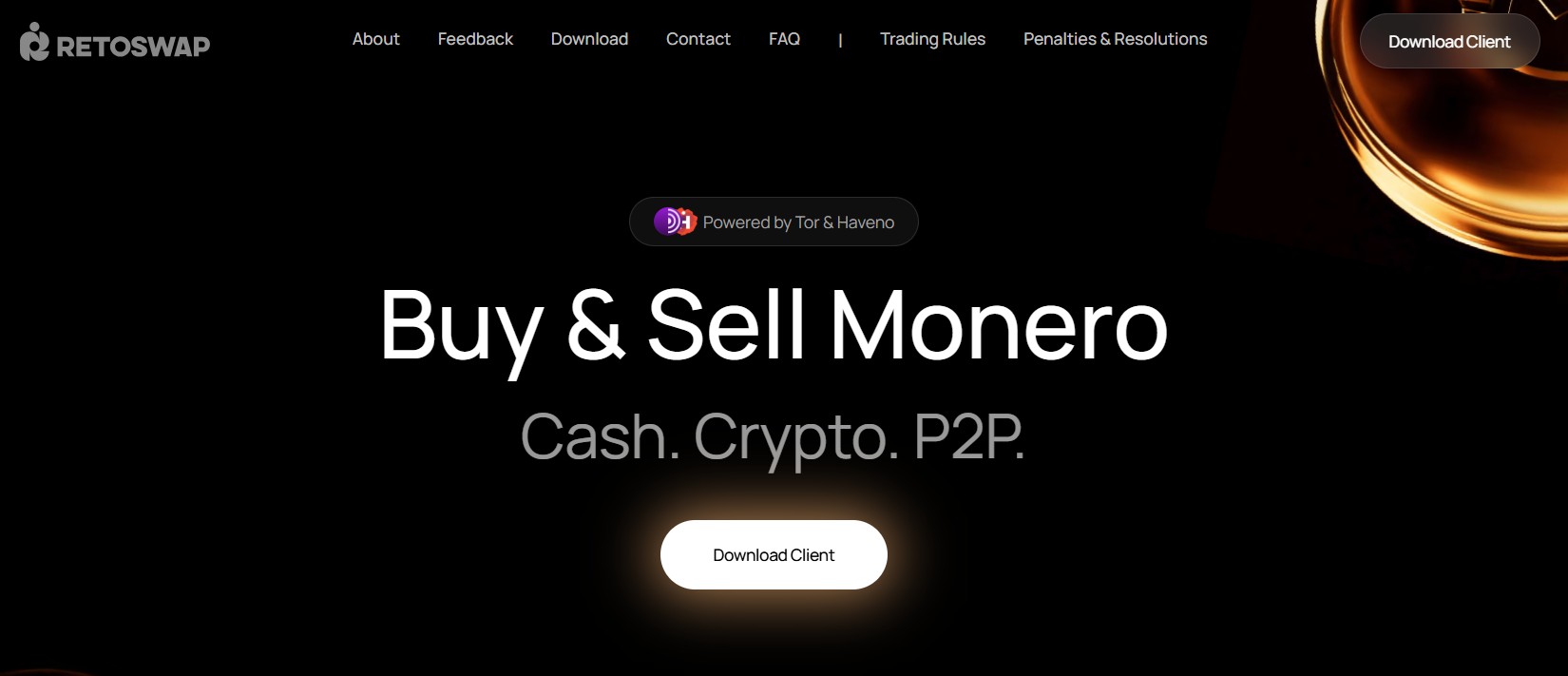
RetoSwap (formerly Haveno-reto, rebranded in November 2024) is a peer-to-peer decentralized exchange built on the Haveno protocol, which is itself a fork of Bisq. It is the most technically demanding option on this list, but also the one with the strongest privacy guarantees at the infrastructure level.
The key difference from every other platform here is that there is no central server for RetoSwap. Each user running the RetoSwap desktop client is running their own node, and trades execute via 2-of-3 multisignature wallets, with the three key holders being the buyer, the seller, and an arbitrator. No single party can freeze or seize funds unilaterally. The arbitrator holds a key but requires the cooperation of one of the trade parties to move anything. All network communication is routed through Tor by default.
If you want to buy Monero directly with euros or U.S. dollars without going through a centralized exchange, RetoSwap is one of the few functional options. Payment methods vary depending on available trade partners, and fiat transfers can take anywhere from minutes to several days.
We’d recommend that crypto-to-XMR trades are faster, typically completing within minutes once both parties confirm, but it’s good to have more options.
RetoSwap introduced fees in 2025 after an initial period of zero-fee trading. At 0.1% for makers and 0.5% for crypto takers, they are competitive relative to centralized alternatives, though the fiat taker rate of 1% is somewhat higher. Liquidity is the practical constraint, particularly outside peak hours in European and U.S. time zones.
The setup process involves syncing with Tor, running a local node, and understanding how multisig escrow works. Improvements in 2025 make the setup a little easier, but RetoSwap is still not an appropriate first platform. But for those who are already knowledgeable of these concepts, it’s a great service.
- No central operator, so funds cannot be frozen unilaterally by any single party
- Fiat-to-Monero peer-to-peer (USD, EUR, GBP and more)
- All traffic routed through Tor by default
- Fully open-source
- Desktop client required (no browser-based access)
- Fiat trades can take days depending on payment method
- Technical setup is not beginner-friendly
- Liquidity depends entirely on available counterparties
5. FixedFloat: Lightning Network Support, With Caveats Worth Reading
- Fees: 1% fixed rate or 0.5% floating rate, plus network fee
- Supported Pairs: BTC (including Lightning), ETH, LTC, and others to XMR and ZEC
- Processing Time: Near-instant for Lightning-enabled BTC inputs
- Limits: Undisclosed
FixedFloat has been running since 2018, which is a long operational history for a no-KYC instant swap service. What it offers above all others is Lightning Network integration, which means fast and cheap Bitcoin deposits. For users who hold Bitcoin on Lightning and want to move into XMR or ZEC, FixedFloat removes the wait associated with on-chain confirmations.
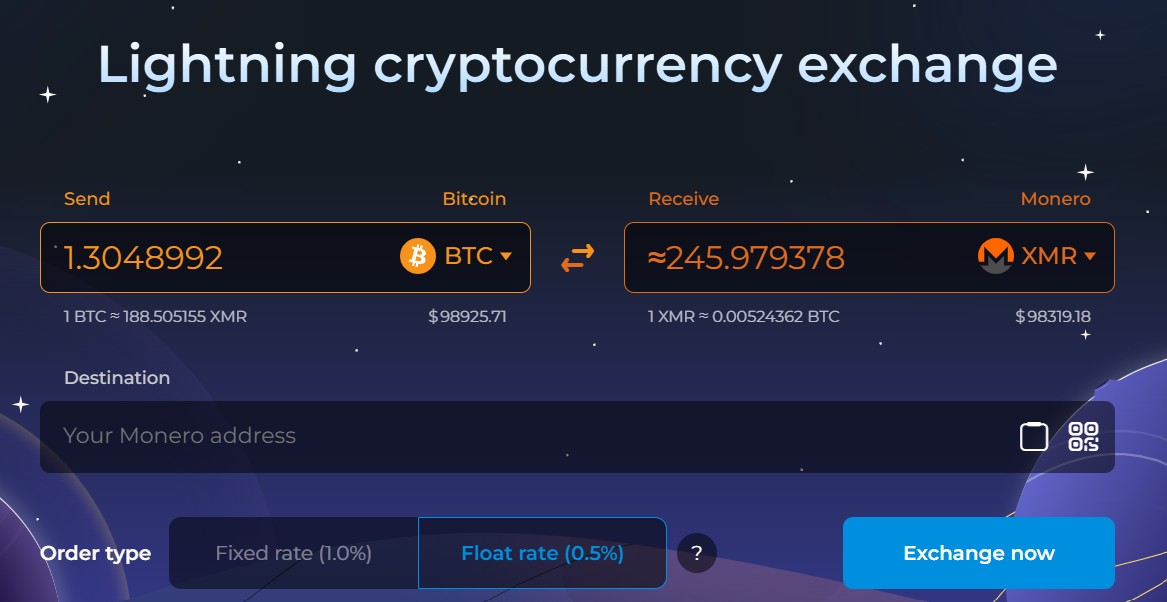
The security history, however, is a significant caveat, as FixedFloat was hacked twice in 2024 for a combined total of approximately $28 million. The funds belonged to the exchange, not to users mid-swap, and the platform resumed operations after both incidents. That said, we can’t not point it out.
While FixedFloat does not require registration, it operates what has been described as a “shotgun KYC” model, where automated compliance systems can suspend orders when transactions are flagged. For smaller swaps, users typically clear without issue, but for larger or more unusual transactions, the risk of an automated hold is real.
- Lightning Network support for fast, cheap Bitcoin inputs
- Fixed and floating rate options
- Operating since 2018
- XMR and ZEC both supported
- Two hacks in 2024 totaling ~$28 million
- Automated AML system can freeze funds and demand verification retroactively
- Platform may share data, including IP addresses, with authorities upon request
Monero vs. Zcash: What You’re Actually Swapping Into
XMR and ZEC are not interchangeable from a privacy-mechanics standpoint.
Monero uses ring signatures, stealth addresses, and RingCT to obscure the sender, receiver, and transaction amount on every single transaction by default. There is no “transparent” mode. Privacy is mandatory and uniform, which is why blockchain analytics firms have found XMR significantly harder to trace than ZEC and why Monero has seen the most severe regulatory pressure.
Zcash uses zk-SNARKs and supports both transparent addresses (t-addresses, visible on-chain) and shielded addresses (z-addresses, hiding sender, receiver, and amount). The opt-in nature of ZEC privacy is a double-edged sword in that it gives Zcash somewhat more regulatory flexibility (since exchanges can require transparent-only deposits), but it also means that ZEC privacy is only as strong as how you use it. If you receive ZEC at a transparent address, the privacy advantage over Bitcoin or Ethereum is minimal.
For users receiving ZEC on GhostSwap or SwapRocket who plan to use shielded privacy, this means specifying a z-address (starting with “zs”) rather than a t-address as the destination. The Zashi wallet, which is recommended by the Zcash ecosystem, defaults to shielded transactions and is a straightforward option for this purpose.
How to Swap Into a Privacy Coin: Step by Step
The steps below use GhostSwap as the example, but the same approach applies to most browser-based no-KYC instant swap services. The XMR version uses Monero as the output; the ZEC version requires choosing a shielded z-address as the destination wallet.
Step 1: Set up a self-custodial wallet for your chosen privacy coin
For Monero: Feather Wallet on desktop or Cake Wallet on mobile are recommended options, and never receive XMR to an exchange wallet.
For Zcash: Zashi (shielded-default, mobile) or Cake Wallet (which supports both XMR and ZEC) are practical choices. Specify a shielded z-address as your destination.
Hardware wallet users should note that some Trezor models support XMR; ZEC shielded address support on hardware wallets is more limited.
Step 2: Go to GhostSwap and select your pair
Select your input asset (BTC, ETH, USDT, or any of the 1,600+ supported coins) and XMR or ZEC as the output. Enter the amount. The platform will display the all-in exchange rate (with the service fee embedded in the spread) before you confirm anything.
Step 3: Enter your destination address
For XMR, paste your Monero wallet address. For ZEC with shielded privacy, paste a z-address. Double-check the address character by character, as privacy coin transactions are irreversible, and the platform cannot recover funds sent to the wrong address.
Step 4: Send to the generated deposit address
GhostSwap generates a unique one-time deposit address for your swap, with a QR code for mobile scanning. Send the amount shown. Do not send from an exchange account if you want to maintain transactional privacy; send from a self-custodial wallet instead.
Step 5: Wait for confirmations
Bitcoin inputs require one to two network confirmations, typically ten to twenty minutes. ETH inputs confirm faster. Once the input confirms, GhostSwap executes the swap and sends your privacy coin to the destination address.
XMR takes ten block confirmations to become spendable in most wallets after receipt; ZEC varies by wallet. Track progress using the transaction hash provided at the time of the swap.
Security note: We recommend you always run a small test transaction on any platform or pair you have not used before. Zcash and Monero network fees are typically less than a few cents, making a test swap worth it. The cost of confirming a platform works for your pair is negligible compared to the cost of a failed large swap.
Conclusion
For most users, we recommend GhostSwap as the best starting point. It supports both XMR and ZEC (including shielded z-addresses), applies no registration requirement at any swap size, and has handled over hundreds of millions of dollars in swaps without collecting user data.
SwapRocket is a close second with broader liquidity aggregation across 2,000+ pairs, and the rest are worth noting for their specific features but usually come with a bit of extra technical debt or caveats.
Visit GhostSwapFAQs
Is it legal to swap crypto for XMR or ZEC without KYC?
What is the difference between swapping into XMR versus ZEC for privacy?
Do GhostSwap or SwapRocket have upper limits on privacy coin swaps?
Do I need to report privacy coin swaps for tax purposes?
What happens if a privacy coin swap fails or gets stuck?
About the Author