Registering on Exchanges: How Much Data Is Needed?





Registering for trading on cryptocurrency exchanges can be a tricky business. On one hand, you may be reluctant to hand over a lot of your data because it may seem that a selfie where you hold your ID card in your hand is over the top. On the other, cryptocurrency exchanges deal with assets that have often been called criminal tools, and knowing their customers is a step to protect themselves – and one that they have to take very seriously.

P.A.ID Strategies, a provider of technology market intelligence, published a report called “Cryptocurrency Identity Crisis” where, among other things, they rank both wallets and exchanges by the amount of personal information they ask for before they permit their clients to start trading.
The exchanges with 9 as the highest score are Coinbase, Gemini, Poloniex and ItBit. No wallets have scored higher than 8, and Luno and Bonpay are ranked the highest among those. On the other side of the rating, Indacoin is the lowest-graded exchange at 2, and SpectroCoin is the least-compliant wallet with the same grade.
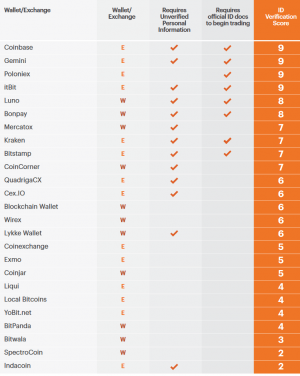
The two regions that are focus of P.A.ID Strategies assessment are North America and Europe. According to the company, some of the providers are new to the space and perhaps unaware of what constitutes good service, but stress that this process is “key in determining the overall impression of a service. A poorly thought out, implemented or conceived process can deliver an impression of poor security, poor customer service or a generally untrustworthy site (which is a key issue affecting the cryptocurrency sector).”
They add that the majority of crypto exchanges and wallets don’t have proper KYC (know your customer) procedures in place, and are not ready for the implementation of the Fifth Anti-Money Laundering Directive in the EU next year, a new directive aimed at the prevention of money laundering and tax-avoidance, and minimizing the ability of criminals to use those proceeds to fund crime and terrorism.
The implementation of AMLD5 next year may be an overload of new directives addressing cryptocurrency- and blockchain-related businesses in the light of many of these currently struggling with staying GDPR-compliant.
- Elon Musk Grok AI Just Made a Surprisingly Bullish XRP Price Predicts
- Google Gemini AI Predicts Ethereum Could Become the Trade Retail Misses in 2026
- Dario Amodei Claude AI Predicts Solana Could Be Heading for a Bigger Comeback Than Expected
- Treasury’s $14 Billion Buyback Triggered a $3.5 Billion Crypto Short Squeeze
- XRP Price Prediction: 22% Rally, But Ripple Still is Undervalued
2M+
250+
8
70





- Elon Musk Grok AI Just Made a Surprisingly Bullish XRP Price Predicts
- Google Gemini AI Predicts Ethereum Could Become the Trade Retail Misses in 2026
- Dario Amodei Claude AI Predicts Solana Could Be Heading for a Bigger Comeback Than Expected
- Treasury’s $14 Billion Buyback Triggered a $3.5 Billion Crypto Short Squeeze
- XRP Price Prediction: 22% Rally, But Ripple Still is Undervalued
More Articles


 in numbers