How to Exchange Monero (XMR) to Bitcoin (BTC): Best Methods for 2026


If you want to exchange Monero to Bitcoin — or the other way around — you have more options in 2026 than ever before. Most of them require no account, no identity verification, and no waiting period.
That’s a significant shift from the regulated exchange landscape, where Monero has been progressively delisted under compliance pressure from Binance, Kraken, and others. The result is that non-custodial swap platforms now handle the majority of XMR/BTC volume, and they’ve become genuinely polished tools in the process.
The demand for this specific trading pair isn’t hard to explain. Bitcoin is transparent by design with every transaction, wallet balance, and payment history permanently visible on a public ledger. Monero uses ring signatures, stealth addresses, and RingCT to obscure the sender, receiver, and amount in every transaction by default, making each XMR coin indistinguishable from any other. Users moving between these two assets are either seeking Monero’s privacy protections or stepping back into Bitcoin’s liquidity and wider acceptance.
This guide covers how to swap XMR to BTC (and BTC to XMR) using the best platforms available in 2026: a step-by-step walkthrough using GhostSwap, detailed reviews of the top three platforms, and a framework for choosing the right service for your situation. All information has been verified directly from platform websites and independent testing.
How to Exchange Monero for Bitcoin (and Vice Versa)
The mechanics are the same whether you’re converting XMR to BTC or BTC to XMR. Non-custodial crypto swap platforms work without order books; instead, they aggregate liquidity from multiple providers and execute your trade at a quoted rate. You provide a destination wallet address, send your crypto to a generated deposit address, and receive the converted funds directly. No account required.
Here’s a full walkthrough using GhostSwap as an example, which is currently one of the most widely used platforms for this pair.
Step 1: Set Up a Wallet for Your Receiving Currency
Before initiating any swap, make sure you have a self-custodial wallet ready for the asset you’re receiving.
- If receiving XMR: Download Cake Wallet (iOS/Android) or Feather Wallet (desktop). These are the most recommended non-custodial Monero wallets. Do not use an exchange wallet address for receiving XMR — it defeats the privacy purpose and some exchanges don’t support Monero deposits.
- If receiving BTC: Any standard Bitcoin wallet works. Hardware wallets (Ledger, Trezor) or software wallets like Electrum are solid options. Generate a fresh receiving address if privacy matters to you.
Step 2: Navigate to GhostSwap
There are several options for exchanging Monero to Bitcoin, but we prefer GhostSwap due to it being 100% private, very simple to use, and cost-efficient. Head to the GhostSwap homepage to get started.
Step 3: Select Your Trading Pair
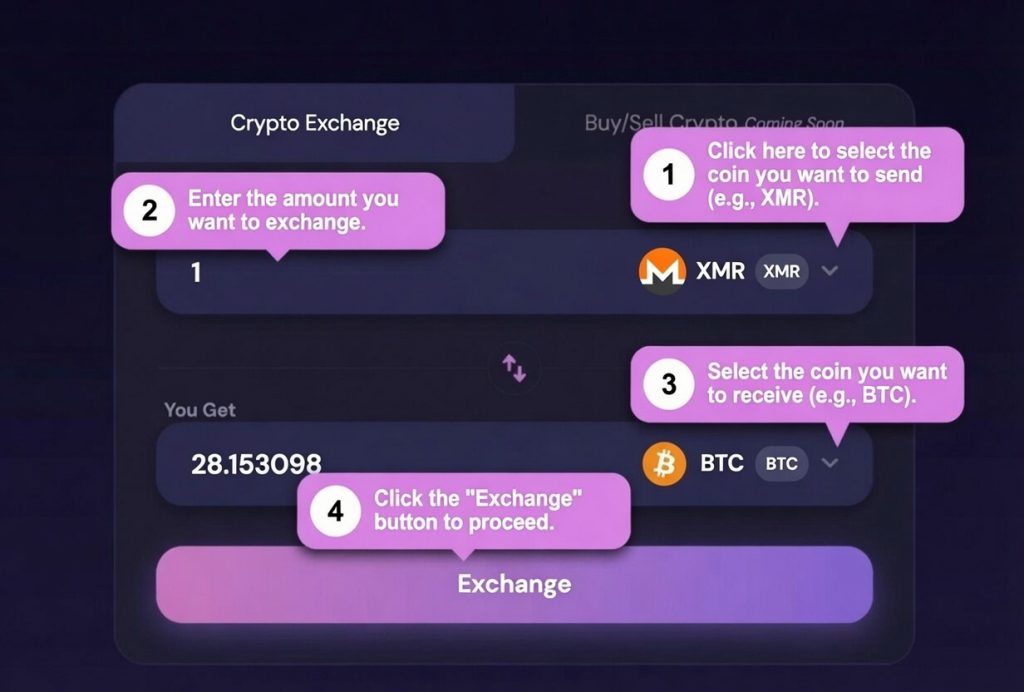
On the main interface, use the currency selector to choose:
- “You send”: Select XMR (or BTC, depending on direction)
- “You receive”: Select BTC (or XMR)
Enter the amount you want to swap. GhostSwap immediately calculates and displays the estimated output based on live market rates. The quoted amount already includes the platform’s service fee and outgoing network costs; what you see is what arrives.
Step 4: Enter Your Destination Wallet Address
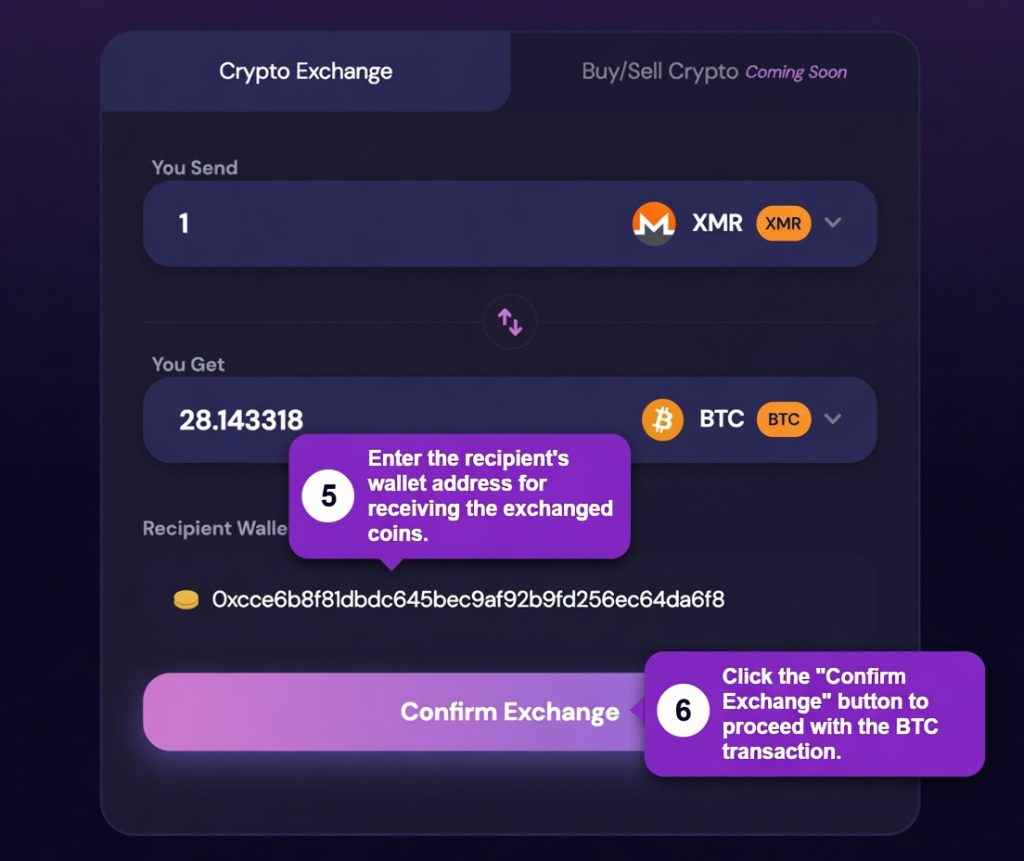
Paste your receiving wallet address into the destination field. This is the only piece of information GhostSwap asks for and there’s no email, name, or ID requested.
Double-check every character. Cryptocurrency transactions are irreversible. For Monero addresses specifically, verify the first and last four characters at minimum. Many Monero wallets allow you to generate a new subaddress for each transaction, which adds another layer of privacy.
Step 5: Review and Confirm the Swap
GhostSwap shows you a summary before you commit: the exact amount you’re sending, the exchange rate, and the estimated amount you’ll receive. Review this carefully. Once confirmed, GhostSwap generates a unique one-time deposit address for your transaction.
Note down your Order ID at this point. It’s the only reference you’ll have if you need to contact support about a delayed transaction.
Step 6: Send Your Crypto to the Deposit Address
From your personal wallet, send the exact amount displayed to the GhostSwap deposit address. The address is unique to your transaction and expires after a set period, so send promptly after initiating.
- BTC deposits: Typically require 1–2 network confirmations (~10–20 minutes) before GhostSwap begins processing.
- XMR deposits: Monero requires 10 confirmations before the exchange can proceed. At Monero’s ~2-minute block time, this adds roughly 20 minutes.
Do not send from an exchange wallet if you’re doing a BTC to XMR swap, as it creates a paper trail linking your exchange account to the privacy coin transaction.
Step 7: Receive Your Funds
GhostSwap processes the swap automatically once your deposit confirms. Most BTC/XMR swaps complete within 10–30 minutes under normal network conditions. You can monitor progress using the order tracker on GhostSwap’s site.
Once the exchange status shows “Finished,” open your destination wallet and verify the funds have arrived. If there’s a delay beyond 30 minutes, GhostSwap’s 24/7 live chat support can track your transaction hash and provide an update.
Best Platforms to Swap XMR to BTC
1. GhostSwap
GhostSwap is the most established no-KYC swap platform for XMR/BTC trades, with over $750 million in completed swaps and more than 1.5 million users since launch. It operates as a non-custodial aggregator, so your funds never sit in a GhostSwap account, moving directly between your wallet and the destination through automated routing across multiple liquidity providers.
The platform supports over 1,600 cryptocurrencies, with XMR/BTC and BTC/XMR among the most actively traded pairs. Cross-chain swaps are handled natively, meaning you can move assets between different blockchain networks without manually bridging or interacting with wrapped tokens.
The fee model is spread-based: GhostSwap embeds its margin into the exchange rate displayed before you confirm, so there are no hidden charges added at checkout. Network fees are factored into the quoted rate as well. Based on independent testing across major review sites, GhostSwap’s rates are often cheaper than centralized exchange taker fees on popular pairs.
One standout feature is the lack of any transaction limits. There are no daily or monthly volume caps, and no upper limit on swap size for most pairs. The interface is minimal and requires no learning curve: select a pair, enter a wallet address, and the swap begins. GhostSwap also offers 24/7 live chat support, which is particularly useful when Monero’s 10-confirmation requirement creates longer-than-expected waits.
🟢Pros:
- Fully non-custodial, funds never held by the platform
- No KYC, no registration, no personal data collected
- Competitive rates aggregated from multiple liquidity providers
- No transaction limits on most pairs
- 24/7 live chat support
- Supports 1,600+ cryptocurrencies including all major XMR pairs
🔴Cons:
- Floating rates only (no fixed-rate option during volatile periods)
- No fiat on/off ramp
2. SwapRocket
SwapRocket launched in mid-2025 and built a substantial following quickly among privacy-focused traders. Like GhostSwap, it operates as a non-custodial aggregator where funds move wallet-to-wallet without the platform taking custody at any point. It pulls real-time rates from over 20 liquidity providers, including major centralized exchanges like Binance, Kraken, KuCoin, OKX, and Gate.io, which means it can often deliver competitive pricing even on less common pairs.
This crypto exchange supports over 2,000 cryptocurrencies across all major blockchain networks, including Ethereum, BNB Chain, Solana, Avalanche, Polygon, Arbitrum, and Base. Privacy coins are fully supported and unrestricted; Monero (XMR), Zcash (ZEC), and Dash (DASH) all trade freely on SwapRocket without identity checks, which is notable given the regulatory pressure that has driven these assets off most centralized platforms.
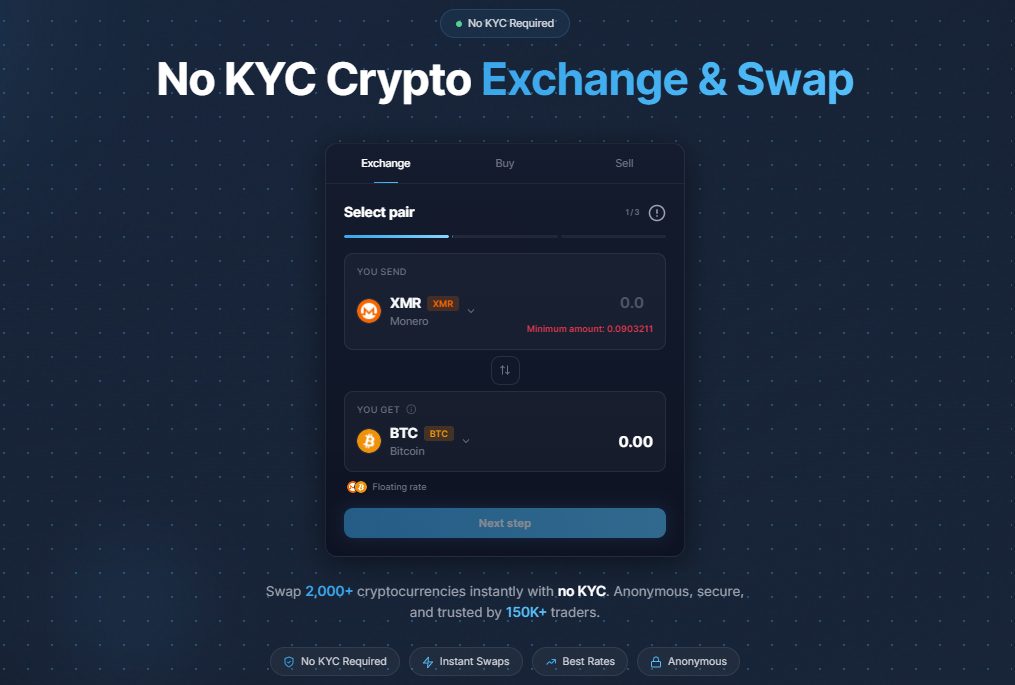
For XMR/BTC specifically, the process is clean: select BTC as the input and XMR as the output (or vice versa), enter your Monero wallet address, and send your deposit to the generated one-time address. The system routes the exchange automatically with a real-time progress tracker showing each stage. All-in pricing is shown before confirmation, with fee and network costs already included in the quoted output figure.
Fees are stated at approximately 0.5–2%, with popular pairs like XMR/BTC typically landing toward the lower end of that range. SwapRocket is also fully compatible with VPNs and the Tor browser, which matters for users who want network-level privacy in addition to on-chain anonymity.
The main drawback is that SwapRocket is newer than GhostSwap, giving it a shorter track record for large transactions. It also offers only floating-rate swaps, which introduces some pricing uncertainty during volatile market conditions. Customer support options are less prominent than GhostSwap’s 24/7 live chat.
🟢Pros:
- Aggregates from 20+ liquidity providers for competitive rates
- Supports 2,000+ cryptocurrencies including full XMR pair coverage
- Fully non-custodial with no data collection
- Tor and VPN compatible
- Clean, fast web interface requiring no downloads
🔴Cons:
- Shorter track record than GhostSwap
- No fixed-rate option
- Customer support less established
3. Godex
Godex has been operating since 2018, making it one of the oldest continuously running no-KYC swap platforms in the market. It’s registered in the Seychelles and functions as a fully automated non-custodial aggregator, scanning multiple liquidity sources in real time to find the best available rate for each swap.
The platform supports 936+ cryptocurrencies, with native XMR pairs including XMR/BTC, XMR/ETH, and XMR/USDT. What distinguishes Godex from most competitors is its fixed-rate option: when you initiate a swap, you can lock in the quoted rate for 30 minutes, protecting you from market movement during the time it takes for your deposit to confirm. This is particularly valuable for larger swaps or trades executed during volatile periods.
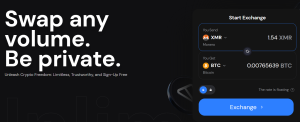
Godex enforces no maximum limits on crypto-to-crypto swaps — no daily, weekly, or volume caps. Minimum deposit thresholds are low and displayed live in the interface before you commit. The platform requires no account, no email, and collects no personal data. Order information is automatically deleted after two weeks. Multiple independent tests, including large transactions above $15,000, have confirmed no KYC requests on Godex even for substantial swap sizes.
Fees are approximately 0.5% all-in on popular pairs, embedded in the exchange rate with no additional hidden charges. Network fees for outgoing transfers are included. This positions Godex among the lowest-fee no-KYC platforms, though it still carries a premium compared to large centralized exchanges (which, for XMR, are largely unavailable anyway).
One limitation worth noting: Godex does not offer a mobile app, relying instead on a mobile-optimized website. For users who prefer native app functionality, this is a minor friction point. Some Trustpilot reviews also flag occasional delays in support response for larger transactions — though the platform has generally resolved issues when escalated.
🟢Pros:
- Fixed-rate option locks in the price for 30 minutes
- Operating since 2018 — established track record
- No KYC verified even on large transaction sizes
- No transaction volume limits
- Order data auto-deleted after two weeks
🔴Cons:
- No mobile app (web-only)
- Smaller asset selection (936) compared to GhostSwap and SwapRocket
- Some user reports of slow support for complex issues
How to Pick a Monero to Bitcoin Swap Platform
Choosing the right platform isn’t simply a matter of picking the one with the lowest advertised fee. Here are the factors that actually matter when choosing a Monero exchange for Bitcoin swaps.
Security and Non-Custodial Architecture
The most important security consideration on any swap platform is whether it holds your funds. A non-custodial service executes wallet-to-wallet transfers without maintaining a pool of user assets, and therefore limits your exposure in the event of a breach. If the platform doesn’t hold your crypto, a hack of the platform itself doesn’t directly threaten your funds. GhostSwap, SwapRocket, and Godex all operate non-custodially: your deposit goes to a one-time address, the swap executes automatically, and the converted funds go straight to your destination wallet.
No KYC
For XMR swaps specifically, no-KYC access isn’t just a convenience but essential. Monero is delisted from most regulated exchanges precisely because it resists transaction tracing. Using a platform that requires identity verification to buy or sell XMR partially undermines the reason for using Monero in the first place. All three platforms reviewed here operate without mandatory KYC for standard swaps. Note, however, that depending on your jurisdiction, tax obligations on capital gains from crypto-to-crypto swaps remain regardless of whether a platform collects your identity.
Fees
Fees on non-custodial swap platforms are always embedded in the exchange rate, so there’s no separate fee line at checkout. What matters is the spread between the wholesale liquidity rate and the rate you’re quoted. For XMR/BTC pairs, typical all-in costs across reputable no-KYC platforms range from 0.5% to 2%. On high-liquidity pairs, the better platforms sit toward the lower end of that range. Always compare the quoted output against the live spot rate on CoinGecko or CoinMarketCap before confirming — this tells you exactly what the real-world spread is.
Supported XMR Pairs
Monero’s delistings have concentrated XMR liquidity on non-custodial platforms, but pair coverage still varies. At minimum, you want XMR/BTC, XMR/ETH, XMR/SOL, and XMR/USDT covered, as these are the most liquid and commonly traded routes. GhostSwap supports XMR against 1,600+ assets, SwapRocket against 2,000+, and Godex against 936. Broader coverage matters if you want to move into XMR from less common assets without routing through an intermediate swap.
Liquidity
Liquidity determines whether the rate you see is the rate you get. Platforms that aggregate from multiple providers (GhostSwap routes through 15+ sources, SwapRocket through 20+) produce more competitive and stable quotes than single-source services. On less common XMR pairs, liquidity can thin out, leading to higher slippage. Always check the quoted rate against spot before committing, particularly for larger swaps.
User Experience
The best swap platforms are designed for maximum simplicity. You simply select a pair, enter an address, and send your deposit – that’s the entire flow. Where platforms differentiate is in transparency (is all-in pricing shown upfront?), progress tracking (can you monitor the swap in real time?), and support quality (is someone available if a transaction stalls?). GhostSwap’s 24/7 live chat and Godex’s long operating history both score well on support reliability.
Things to Consider When Trading XMR to BTC
- Always use a self-custodial wallet for receiving XMR. Exchange wallets that support Monero deposits are rare, and using one defeats much of the privacy benefit. Cake Wallet (mobile) and Feather Wallet (desktop) are the most widely recommended non-custodial options. Generate a new subaddress for each incoming transaction.
- Start with a test swap. Regardless of which platform you use, run a small test transaction first on any unfamiliar pair or platform. Cryptocurrency transfers are irreversible, and verifying the full process with a small amount costs little but eliminates risk.
- Factor in Bitcoin confirmation times. BTC deposits typically require 1–2 network confirmations before a swap begins. At 10 minutes per confirmation, that’s a 10–20 minute baseline before processing starts. For XMR deposits, Monero’s 10-confirmation requirement adds roughly 20 minutes. Total swap time under normal conditions is typically 20–60 minutes — plan accordingly.
- Understand the tax treatment in your jurisdiction. Using a no-KYC exchange doesn’t eliminate tax obligations. In most jurisdictions, swapping BTC for XMR constitutes a taxable disposal of Bitcoin, and any capital gain is reportable regardless of whether an exchange collected your identity. Monero’s private ledger is opaque to outside observers, but you retain full knowledge of your own transaction history and remain legally responsible for accurate reporting.
- Use the correct address format. Monero uses standard addresses (95 characters beginning with “4”) and subaddresses (95 characters beginning with “8”). If a platform asks for a Monero address, either format works for receiving, but double-check carefully, as sending to an incorrect address is not recoverable.
Conclusion
For most users looking to exchange Monero to Bitcoin or trade XMR to BTC in 2026, GhostSwap is the most complete option: no-KYC, non-custodial, zero transaction limits, 1,600+ supported pairs, and 24/7 support. It handles the XMR/BTC pair reliably, quotes all-in rates upfront, and has processed over $750 million in swaps for more than 1.5 million users.
SwapRocket is a capable alternative with a slightly wider asset selection and competitive aggregated rates, while Godex stands out specifically for users who want a fixed-rate option to protect against market movement during the swap window.
Whether you want to swap XMR to BTC for liquidity, or exchange BTC to XMR for privacy, the process takes under 30 minutes from start to finish on any of these platforms, with no account required.
Visit GhostSwapFAQs
Can I exchange Monero to Bitcoin without KYC?
How long does an XMR to BTC swap take?
What fees should I expect when swapping XMR to BTC?
Is swapping BTC to XMR legal?
What Monero wallet should I use when receiving XMR?
What happens if my swap doesn’t arrive?
2M+
250+
8
70





 in numbers