

Opinion.trade Review
- Innovative AI oracle resolution system
- CLOB trading model (more professional than AMMs)
- Zero maker fees encouraging order book depth
- On-chain settlement and audited contracts
Opinion.trade is a legitimate and generally safe prediction market platform built on blockchain infrastructure. The protocol has undergone independent smart contract audits, uses on-chain settlement for transparent payouts, and relies on predefined rules and data sources to resolve markets.
Its architecture, which combines an order-book exchange, an AI oracle system, and token-based incentives, aims to create a transparent environment for trading real-world event probabilities.
In this review, we’ll explain how Opinion works, break down its architecture and tokenomics, and evaluate its user experience, liquidity, market coverage, and fees. We’ll also compare it with other major prediction markets like Polymarket and Kalshi, before walking you through how to start trading on the platform.
Opinion Labs Review – Key Takeaways
- Decentralized prediction market with broad market coverage, including macroeconomic events, crypto, politics, sports, and cultural events.
- Uses a central limit order book (CLOB), enabling precise pricing and familiar exchange-style trading.
- Opinion AI oracle helps resolve markets using multiple data sources and AI model verification.
- Zero maker fees encourage liquidity; taker fees vary based on market uncertainty.
- Opinion Points System (PTS) rewards traders for liquidity provision, trading activity, and holding positions.
- Built on BNB Chain with on-chain settlement for transparent payouts and verifiable transactions.
- Still early-stage, with limited public user reviews and some roadmap features yet to launch.
What Is Opinion.trade?
Opinion.trade is a prediction market where people trade on the outcomes of real-world events, especially economic and macro events.
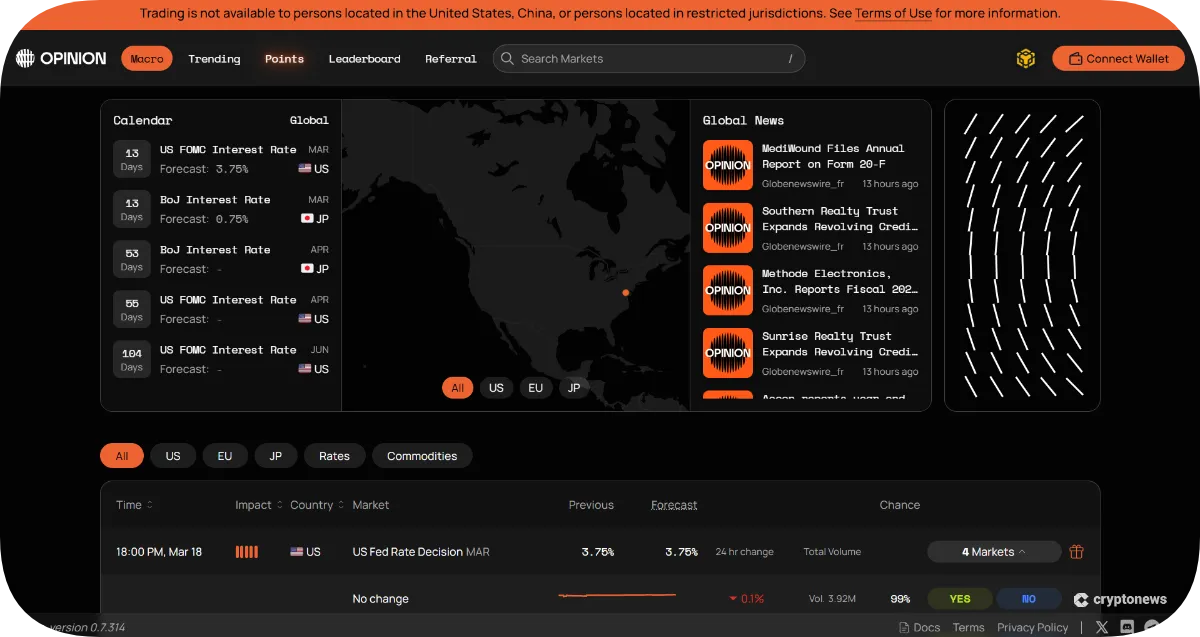
Instead of trading assets like stocks or crypto to indirectly bet on what might happen (asset prices going up or down based on real-world events), Opinion lets you trade the event itself. For example, you could trade on questions such as whether the Federal Reserve will cut interest rates, whether inflation will rise, or whether Bitcoin will reach a certain price.
Each market has two sides, typically “Yes” and “No.” The price of a share reflects the market’s estimated probability of that outcome. For example, if “Yes” shares trade at $0.65, the market believes there is roughly a 65% chance the event will happen. If the outcome is correct, the share settles at $1; if it’s wrong, it settles at $0.
Traders can profit either by holding their position until the event resolves or by selling earlier if market expectations change.
In practice, Opinion.trade works like a financial exchange for predictions. Users connect a crypto wallet, browse markets, place orders through an order book, and trade probabilities based on their own analysis or information. The goal is to turn economic insights into tradable positions.
What sets Opinion apart from other prediction markets is its delicate architecture, which combines AI oracles, unified liquidity, and protocol infrastructure to overcome common issues competing platforms face, as we’ll explore in the following sections.
Application Layer: Opinion.trade User Interface
Opinion.trade is the application layer of the Opinion ecosystem (i.e., the user-facing interface where traders discover markets, analyze data, and place trades). The platform resembles a macro trading terminal, displaying prediction markets alongside charts, probabilities, and event details such as rules and resolution criteria.
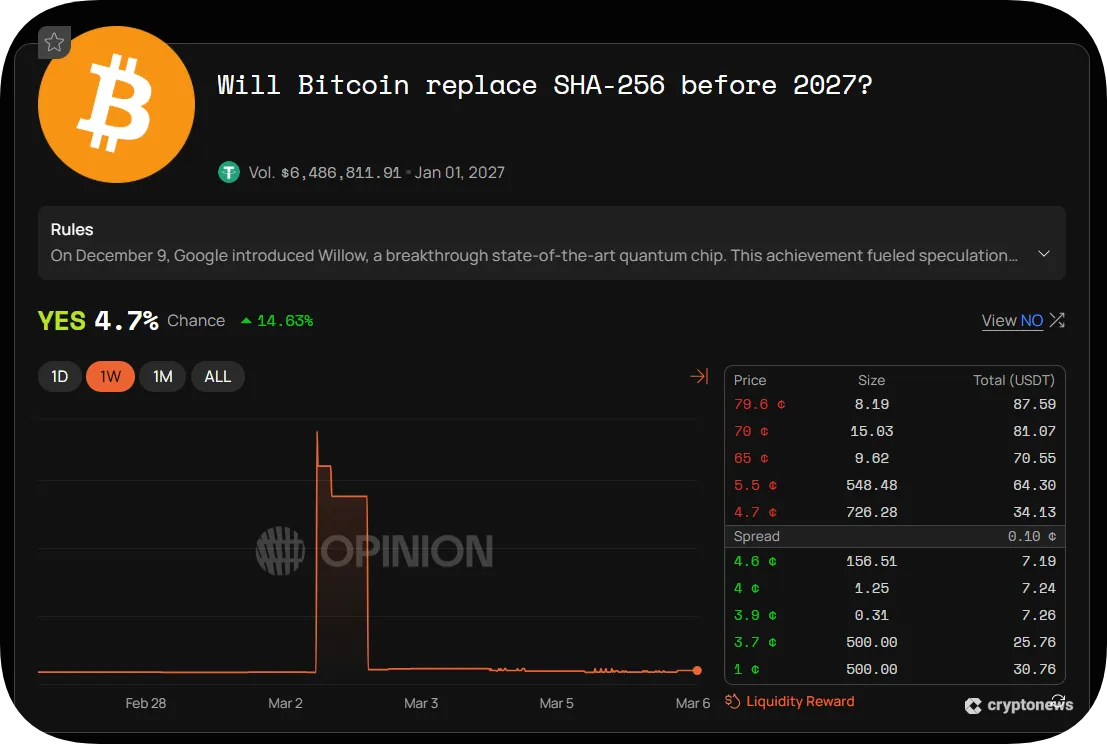
Users can browse markets through filters and categories, view price history and order books, and trade “Yes” or “No” outcome shares using market or limit orders. Positions, open orders, and P&L are managed directly through the portfolio dashboard.
Protocol Layer
The protocol layer is the underlying infrastructure that standardizes how prediction markets are created, traded, and integrated across the ecosystem. Through the Opinion Protocol, each market produces conditional tokens representing the possible outcomes, which can be traded, transferred, or integrated into other applications.
This layer ensures that markets follow consistent rules and token standards, enabling interoperability across different interfaces or services. Developers can also access market data and build tools through the Opinion Open API and CLOB SDK.
Unlike other platforms, Opinion’s prediction contracts are programmable financial primitives, allowing them to integrate with DeFi systems and external applications rather than remaining confined to a single platform.
Resolution Layer: Opinion AI
The resolution layer determines how prediction markets are finalized once an event concludes. On Opinion, this process is primarily handled by Opinion AI, a decentralized multi-agent oracle designed to interpret real-world data and determine market outcomes.
Opinion AI analyzes structured and unstructured information, such as economic releases, official announcements, and news sources, to resolve whether a market outcome is true or false. It also assists in market creation by helping define clear rules and verifying that a proposed topic can be resolved objectively.
One of the biggest challenges in prediction markets is contract resolution — determining the final outcome in a way that traders trust. Traditional systems often rely on committees, token voting, or single data sources, which can be slow, prone to conflict, or vulnerable to manipulation.
Opinion attempts to address this with AI-based market resolution, where predefined models evaluate multiple information sources using transparent rules. This approach aims to make resolution more scalable, neutral, and resistant to manipulation, which is critical as prediction markets grow and handle more complex real-world events.
Settlement Layer
The settlement layer is responsible for finalizing trades once a market outcome has been resolved. After Opinion AI determines the correct result, the system automatically settles the corresponding conditional tokens on-chain. Winning outcome tokens redeem for their full value (typically $1 per share), while losing tokens become worthless.
This process is executed through smart contracts, so that payouts are transparent, automated, and verifiable on the blockchain. Because settlement occurs on-chain, users do not need to rely on a centralized intermediary to distribute funds.
Liquidity, Incentives, and Governance Layers: Opinion (OPN) Token
The liquidity, incentives, and governance layers coordinate how capital flows through the platform and how participants are rewarded for contributing to market efficiency. At the core of this system is the Opinion token (OPN) and the platform’s incentive mechanisms.
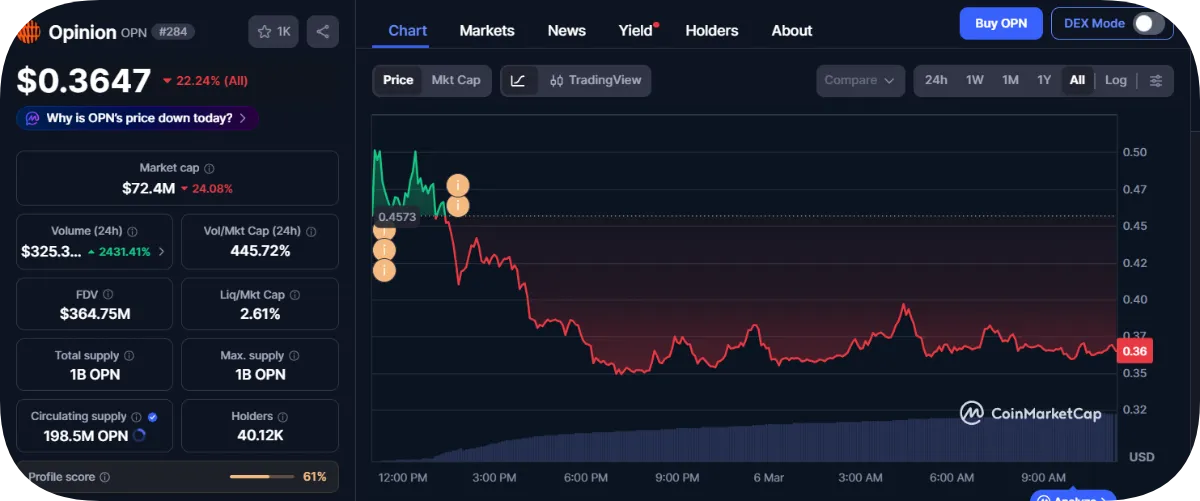
Liquidity is primarily supported through an order book model with zero maker fees, encouraging traders to place limit orders and provide market depth.
Only takers pay trading fees. These fees follow a probability-based curve; they’re higher when market uncertainty is greatest (around 50%) and lower when outcomes are more certain. This structure is designed to promote meaningful price discovery rather than speculative noise.
Incentives are reinforced through the Opinion Points System (PTS), which we’ll discuss in the following section.
The Opinion Point System (PTS) and Airdrop Farming
The Opinion Points System (PTS) is the platform’s incentive program for rewarding users who actively contribute to the quality and liquidity of its prediction markets. Instead of rewarding activity purely based on trading volume, the system evaluates how users participate in ways that improve price discovery and market efficiency.
Points are distributed from a fixed weekly allocation, with leaderboards updated regularly. To qualify, you must reach at least $200 in trading volume. Once eligible, you can earn points through three main activities:
- Providing liquidity with limit orders
- Executing trades
- Holding positions over time
Orders that are closer to the current market price, larger in size, or remain in the order book longer typically earn more points. Early liquidity providers and activity in designated markets may also receive additional multipliers.
Because points determine your proportional share of future incentives, many participants treat the system as an airdrop farming opportunity.
By consistently trading, supplying liquidity, and maintaining positions, you accumulate points that may later translate into token rewards or other ecosystem incentives. Early participation is particularly valuable, as rewards tend to be higher when the user base is smaller.
In-Depth Opinion Prediction Market Review
Opinion is one of the most ambitious prediction markets to emerge. While many competitors focus on politics, entertainment, or broad news cycles, Opinion was initially designed to let users trade economic narratives directly, from central bank decisions to inflation and crypto price milestones.
Its architecture is also more differentiated than most, combining a CLOB-based exchange, AI-assisted resolution, on-chain settlement, and a points-driven liquidity system. This gives it a more structured, market-terminal feel than many retail-focused prediction platforms.
The result is a platform that feels less like a betting site and more like a serious attempt to build infrastructure for trading economic probabilities.
1. User Experience on Opinion.trade
Opinion’s markets are organized around economic events and indicators, allowing you to quickly browse opportunities such as central bank decisions, inflation data, or crypto price milestones.
Each market page provides key information, including probability charts, market rules, and an order book, so you can evaluate both the event itself and current market sentiment before entering a position.
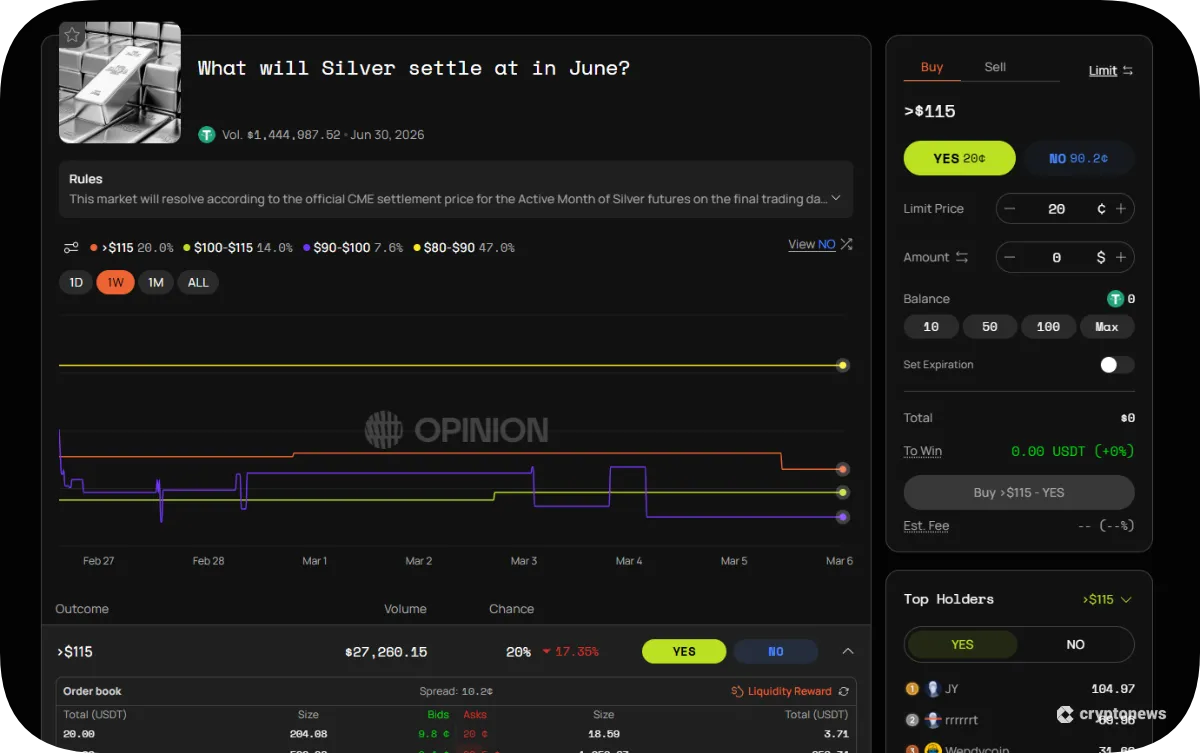
Trading follows a familiar exchange-style workflow. Users can place market or limit orders, monitor the bid–ask spread, and track positions, open orders, and P&L through a portfolio dashboard. The ability to use limit orders with zero maker fees encourages deeper order books and makes the experience more comparable to traditional financial trading platforms.
One of the platform’s strengths is its data-driven layout, which integrates market odds, historical price charts, and a global news feed.
2. Market Design and Mechanics
Opinion.trade uses a straightforward binary market design that follows the standard mechanics of modern prediction markets.
Each contract typically resolves to a “Yes” or “No” outcome, with prices ranging from $0 to $1. These prices represent the market’s implied probability. For example, a $0.80 price suggests an 80% chance that the event will occur. If the prediction is correct, the token settles at $1; otherwise, it settles at $0.
Trading is conducted through an order-book model, allowing you to place market orders for instant execution or limit orders to provide liquidity at a specific price. This structure supports more precise price discovery than automated market maker systems and allows you to enter and exit positions before the event resolves.
A notable design feature is Opinion’s probability-based fee model, but we’ll discuss this in an upcoming section.
3. Liquidity and Market Depth
Opinion has demonstrated strong liquidity for a relatively new prediction market platform. Shortly after launch, the exchange recorded over $3 billion in cumulative trading volume, with periods where weekly volume briefly exceeded that of larger competitors.
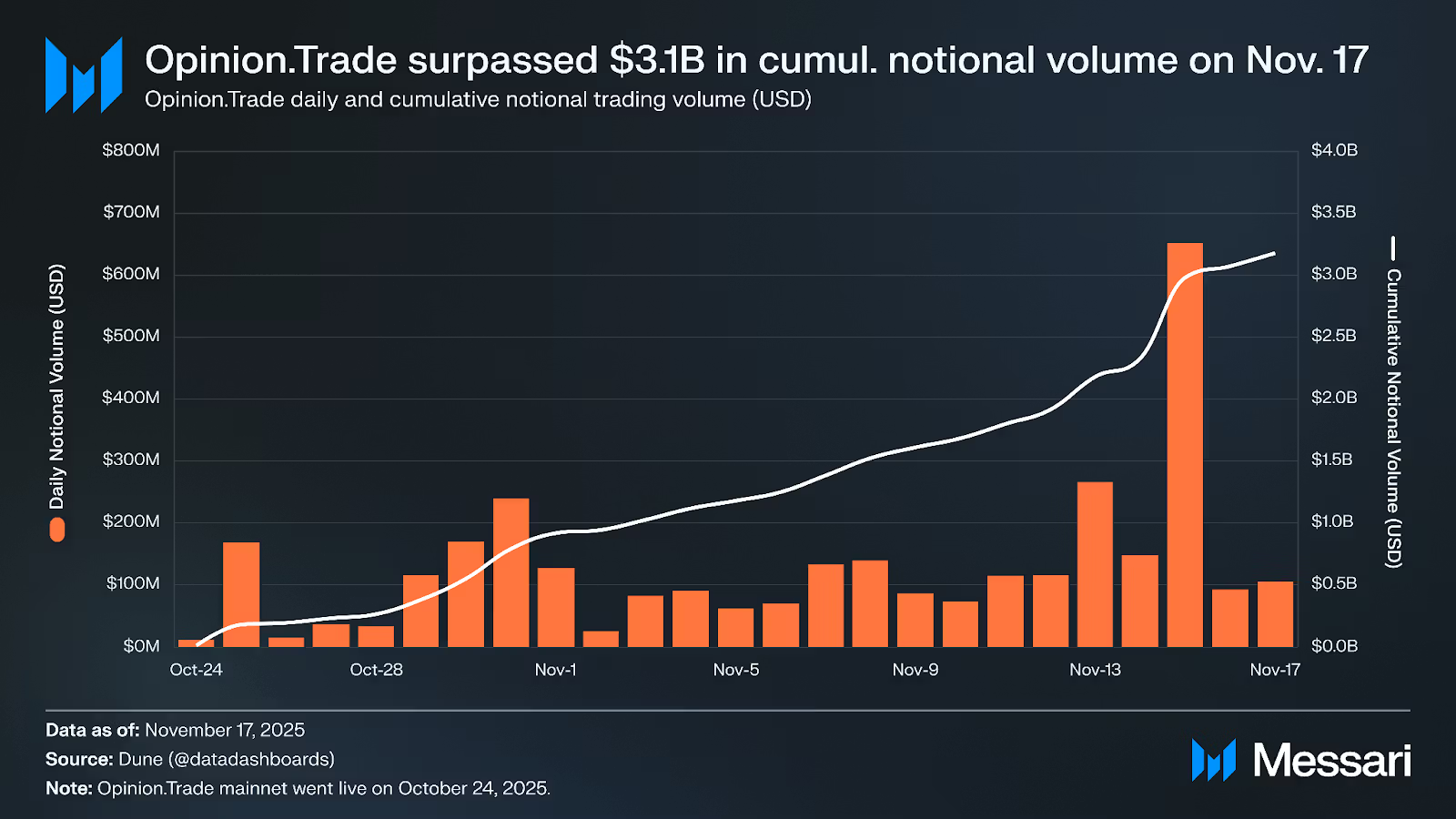
Open interest has also reached tens of millions of dollars, indicating that many traders hold positions rather than simply trading short-term volatility.
Liquidity on the platform is supported by its order-book structure and maker-friendly fee model, where traders placing limit orders pay no fees. This design encourages users to provide liquidity and helps maintain tighter bid–ask spreads.
In addition, the Opinion Points System incentivizes traders to supply liquidity by rewarding limit orders placed close to current market odds.
Looking ahead, the planned Opinion Metapool aims to further improve market depth by linking liquidity across semantically similar prediction markets, potentially reducing fragmentation that often limits liquidity. This is a common problem across the broader prediction market ecosystem, and Opinion Labs is pioneering this solution.
4. Oracle and Resolution System
As mentioned, Opinion.trade uses Opinion AI as its primary oracle and resolution system. When a market expires, the system gathers information from predefined sources, such as official economic releases or trusted data feeds, and proposes an outcome.
This proposal is then reviewed by a multi-model “jury” of AI systems, including models from providers like OpenAI, Anthropic, and others, before a final determination is confirmed through human verification.
For objective markets, such as macroeconomic data or price levels, the platform may also ingest data from external oracle providers like Chainlink. Oracles act as external agents that retrieve and deliver real-world data to blockchain systems so smart contracts can execute correctly.
Overall, Opinion’s approach aims to reduce manipulation risks and improve the reliability of market resolution compared with simpler single-source or committee-based systems used in many prediction markets.
5. Opinion (OPN) Tokenomics and Roadmap
Opinion’s tokenomics are structured to balance ecosystem growth, community incentives, and long-term development. The token has a fixed maximum supply of 1 billion OPN, with allocations distributed across airdrops, investors, the team, ecosystem incentives, and other operational categories.
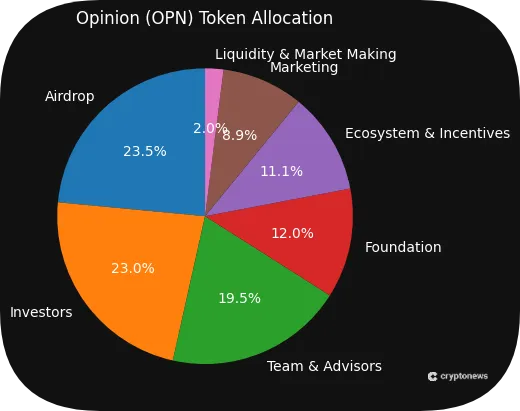
Notably, a large share of the supply is directed toward community distribution and ecosystem incentives, reflecting its focus on rewarding early participation and liquidity provision. The Opinion Points System (PTS) reinforces this approach, as previously discussed.
However, like many emerging crypto projects, the long-term value of the token will depend on how clearly its utility and governance roles evolve as the ecosystem matures. As features such as governance participation and broader protocol integrations develop, the token’s role within the platform’s economic model should become clearer.
Regarding Opinion Token’s roadmap, the current phase centers on token distribution, exchange listings, and marketing expansion. Upcoming plans include centralized exchange listings, staking features, and a mobile application in 2026, followed by longer-term initiatives such as cross-chain integration and DAO governance.
Early milestones in 2025 included platform development, smart contract audits, and the launch of its community and token design.
6. Market Coverage
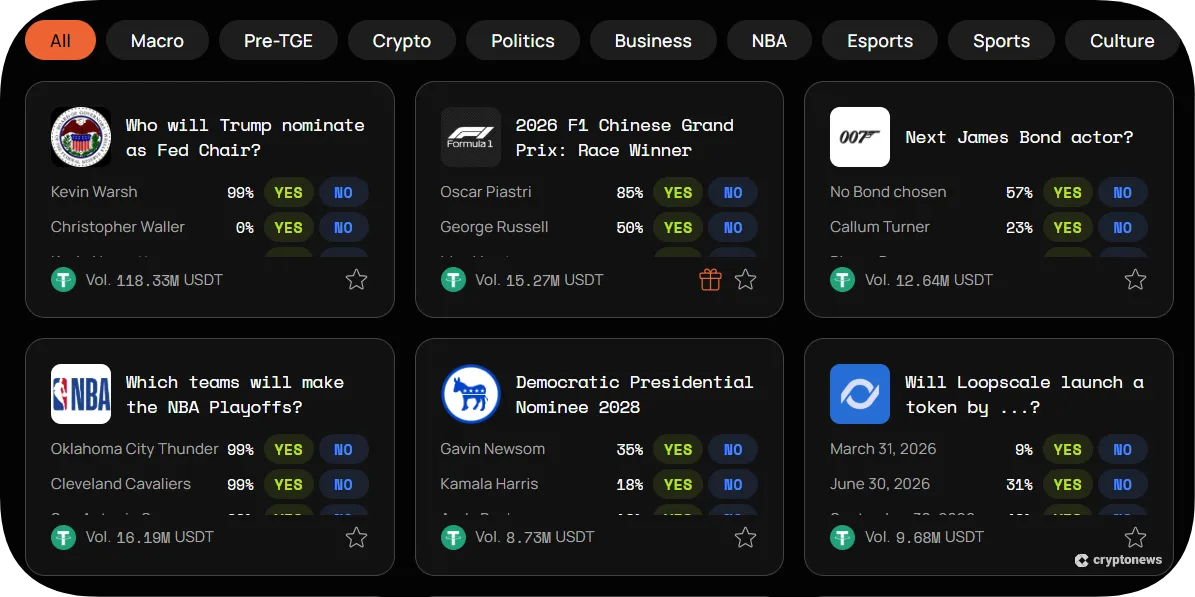
Opinion.trade offers broad and diverse market coverage, extending beyond its core focus on macroeconomic events. While the platform is designed primarily for trading outcomes related to economic indicators, such as interest rates, inflation, and policy decisions, it also lists markets across categories like crypto, politics, business, sports, esports, and culture.
The interface organizes markets through category filters (e.g., Macro, Crypto, Politics, NBA, Esports), making it easy to explore different topics. Individual market cards display probabilities, trading volume, and quick “Yes/No” trading options, so you can assess opportunities at a glance.

Current markets range from central bank appointments and presidential nominees to sports results and crypto-related events, alongside hourly price-direction markets for major assets like ETH, BTC, and BNB. This variety helps attract a wider audience while maintaining the platform’s macro-trading foundation.
7. Security and Transparency
Opinion Labs ensures security and transparency through a combination of on-chain infrastructure, external audits, and verifiable data sources.
Core components of the platform, including its conditional token framework and exchange engine, have undergone independent security audits by firms such as Zellic and ScaleBit, which helps identify potential vulnerabilities in the protocol’s smart contracts.
Market settlement and payouts are handled on-chain, allowing anyone to verify outcomes and transactions directly on the blockchain. The platform also relies on clearly defined market rules and predefined data sources to support transparent resolution.
For data integrity, Opinion AI operates within Trusted Execution Environments (TEEs) and uses a multi-model review process when resolving markets, reducing the risk that a single system or operator can manipulate results. In addition, external oracle providers are used for objective data feeds such as price or macroeconomic indicators.
8. Trading, Withdrawal, and Other Fees
The maker–taker fee model is designed to encourage liquidity while reflecting market uncertainty. Traders who place limit orders (makers) typically pay no fees, since their orders add liquidity to the order book. Fees are charged only to takers, meaning orders that execute immediately against existing liquidity.
The platform applies a dynamic fee curve, where fees increase as the market probability approaches 50%, the point of maximum uncertainty and trading activity, and decrease as outcomes move closer to 0% or 100%. In practice, trading fees generally range from 0% to around 2%, depending on the probability at the time of execution.
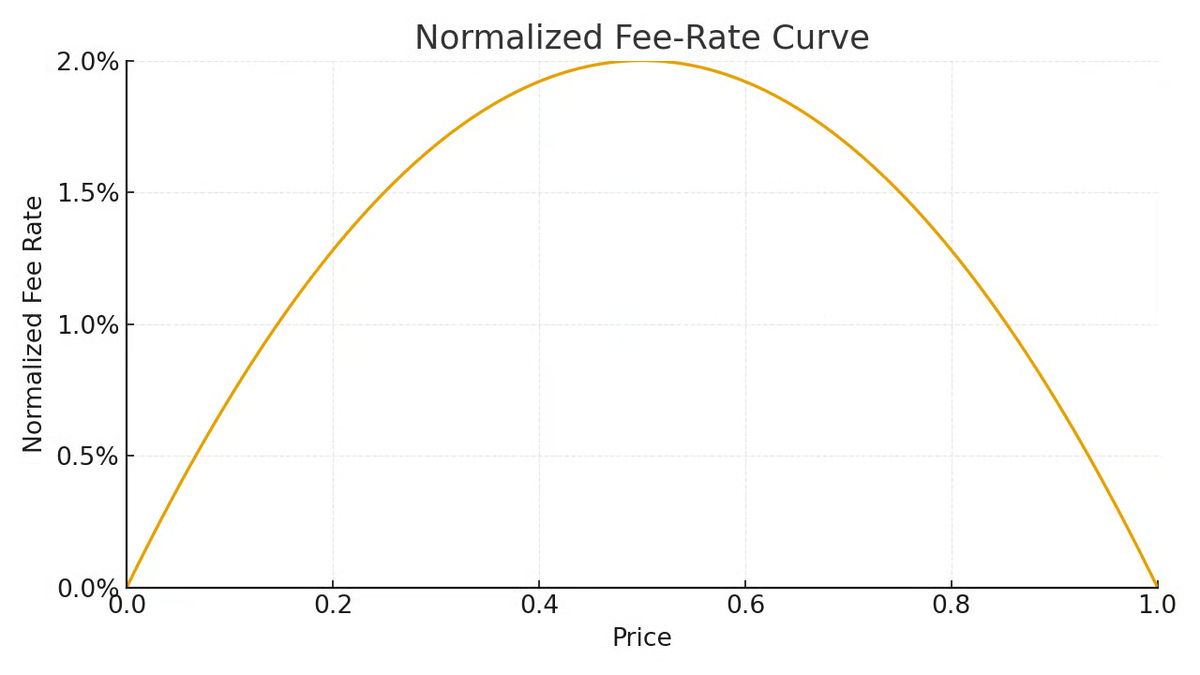
Opinion also enforces minimum thresholds, including a $5 minimum order size and a $0.50 minimum fee, which helps prevent extremely small trades from exploiting the fee structure.
9. User Reviews and Feedback
Public feedback is still relatively limited, but the available reviews and discussions provide a mixed early picture. On Trustpilot, the project’s associated site has a low TrustScore of around 2.5/5 based on a very small number of reviews, with several users reporting issues such as survey disqualifications or unclear payouts in unrelated market-research tasks.
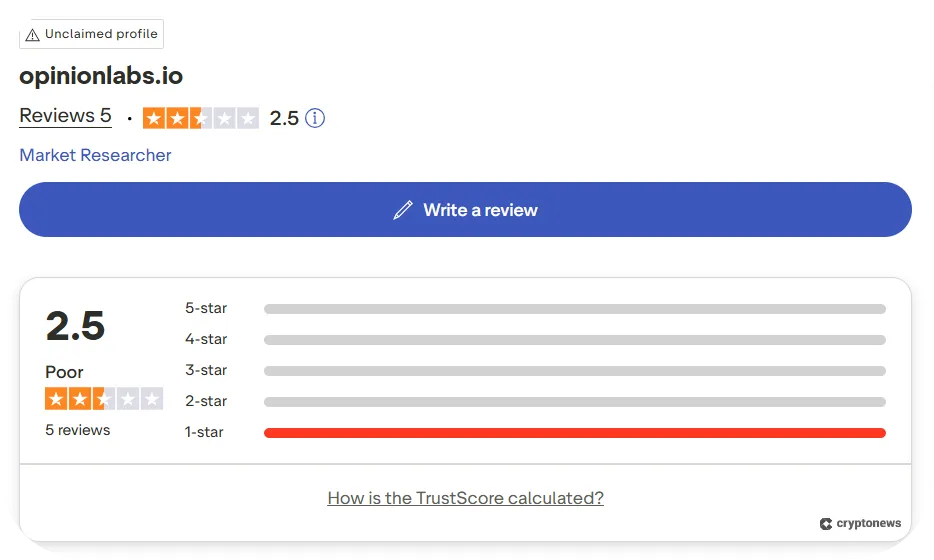
However, the sample size is extremely small, making it difficult to draw firm conclusions about the platform itself.
Outside review platforms, most discussions take place in crypto communities like subreddits rather than formal review sites. In these spaces, Opinion is generally mentioned alongside other prediction markets like Polymarket and Kalshi as a new entrant focused, though detailed user feedback remains sparse.
The limited number of public reviews shows that Opinion.trade is still early in its adoption cycle; more meaningful user feedback will likely emerge as the platform’s user base grows.
Comparison: Opinion Labs vs. Polymarket vs. Kalshi (2026)
The parameters in the table highlight the most important structural differences between Opinion, Polymarket, and Kalshi. Each factor helps explain how the platform operates, how trustworthy its outcomes are, and how accessible it is to users. Together, these parameters allow you to compare how each prediction market platform is designed and operated.
| Opinion (Opinion Labs) | Polymarket | Kalshi | |
|---|---|---|---|
| Model | Central limit order book (CLOB) prediction exchange | Order-book prediction market built on blockchain | Traditional exchange-style event contracts |
| Oracle | Opinion AI multi-agent oracle + external data feeds | UMA optimistic oracle | Centralized data sources and exchange verification |
| Primary Infrastructure | BNB Chain | Polygon | Centralized infrastructure (U.S. exchange) |
| Market Focus | Macroeconomic indicators, crypto, and global events | Politics, geopolitics, crypto, and current events | Economic indicators, weather, sports, and real-world events |
| Incentives | Opinion Points System (PTS) and potential OPN rewards | No token incentives | No token incentives |
| Fees | Maker free; dynamic taker fee (~0–2%) tied to probability | Generally low or zero trading fees, depending on the market | Approx. 0.01–0.05% trading fees |
| Regulation | Crypto-native platform | Offshore crypto platform with past CFTC enforcement | CFTC-regulated U.S. prediction market exchange |
Several differences stand out when comparing Opinion, Polymarket, and Kalshi. The most notable is regulation, which shapes everything from market access to product design.
- Kalshi operates as a CFTC-regulated exchange in the United States
- Opinion and Polymarket are crypto-native platforms that operate outside the traditional regulatory framework
Another key distinction lies in resolution mechanisms. Opinion introduces an AI oracle system, while Polymarket relies on the UMA optimistic oracle, and Kalshi resolves markets using centralized verification based on official data sources. Each system comes with different trade-offs between decentralization, transparency, and institutional reliability.
There are also differences in incentive structures. Opinion actively incentivizes participation through its Points System and potential token rewards, whereas Polymarket and Kalshi largely rely on organic liquidity without token-based incentives.

How to Start Trading on Opinion: a Step-by-Step Guide
Opinion: trade works like other decentralized prediction exchanges. Instead of trading assets, you trade probabilities of real-world events, such as interest rate decisions, inflation releases, or crypto price milestones. Below is a practical walkthrough of how to trade on the platform.
1. Connect Your Crypto Wallet
First, visit opinion.trade and click Connect Wallet in the top-right corner. The platform is compatible with Binance Wallet, MetaMask, OKX Wallet, Coinbase Wallet, Backpack, and Rabby Wallet, so ensure you have an account with one of them before starting.
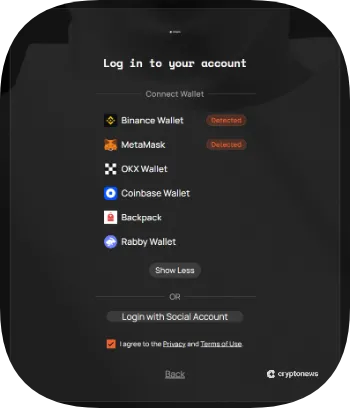
After selecting it from Opinion’s menu, open your wallet and approve the connection request. Once connected, sign the login message to authenticate your session. This step does not move funds; it simply proves ownership of your wallet.
Next, ensure you have USDT on BNB Chain, since Opinion runs on this network and only accepts this cryptocurrency for trading events. After connecting, the platform will display your portfolio dashboard, open orders, and available balance.
2. Select an Event Contract to Trade
Instead of jumping into a random market, take some time to browse the market page and filter categories such as macro, crypto, politics, or sports.
Opinion particularly excels in macroeconomic markets, including central bank decisions, economic data releases, and major policy events.
When evaluating a market, review three things:
- Current probability price
- Market rules and resolution criteria
- Order book liquidity
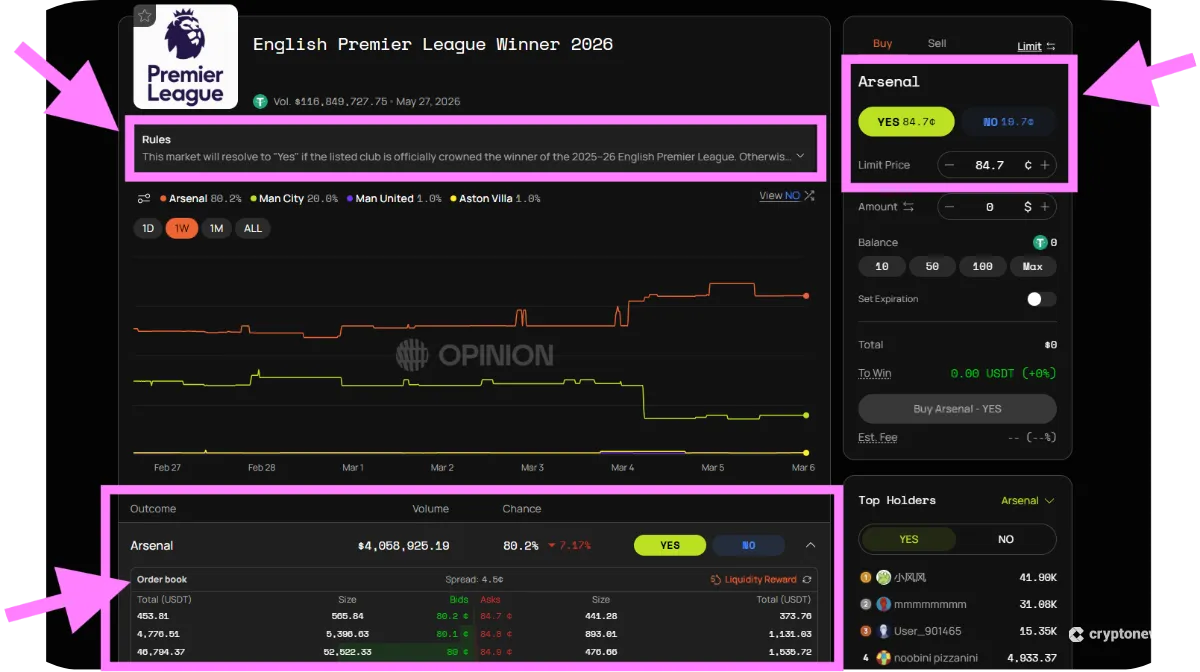
The example above shows Arsenal with an 80.2% probability of winning the English Premier League. However, the current “Yes” price is 84.7¢. This difference occurs because the probability is based on the last executed trade, while the price shown in the buy panel reflects the lowest available sell order (ask) in the order book.
Since Opinion uses a central limit order book, buyers and sellers place their own prices. If no one is willing to sell at the last traded price, the cheapest available shares may be higher. In this case, you could either buy immediately at 84.7¢ or place a limit order and wait for a seller to match your price.
3. Manage Your Position and Execute Limit Orders
Once you’ve chosen a market, open the trading panel on the right side of the screen. You can place two types of trades:
- Market Orders: Executed instantly at the best available price in the order book.
- Limit Orders: Placed at a specific price and added to the order book until a seller matches your order.
Most experienced traders prefer limit orders because makers typically pay no trading fees, you can often enter at better prices, and it helps add liquidity to the market.
For example, as mentioned, the example above shows an 80.2% probability, but the cheapest “Yes” shares are listed at 84.7¢. Instead of buying instantly at that price, you could place a limit order closer to 80¢ and wait until a seller matches it.

Once your order fills, the position appears in your portfolio dashboard, where you can track:
- Unrealized profit/loss
- Current market price
- Position size
You don’t need to wait for the event to conclude (in our example, for the Premier League to finish). If the probability rises, for instance, from 80¢ to 90¢, you can sell early and lock in the 10¢ profit (minus fees).
Final Verdict: Is Opinion Labs the Best Prediction Market in 2026?
Opinion Labs is an ambitious newcomer in the prediction market space, combining a professional trading interface with a layered architecture designed to improve liquidity, resolution, and market scalability.
Its focus on macroeconomic events, order-book trading model, and AI-assisted oracle system give it a structure that feels closer to a financial exchange than a typical event-betting platform.
However, it’s still a relatively new platform. Some roadmap features remain under development, and public user feedback is limited. As the ecosystem matures, factors such as liquidity growth, reliable market resolution, and token utility will play a key role in determining its long-term success.
If you’re looking for an alternative, Polymarket remains the most widely used prediction market today. It offers deep liquidity, a large selection of markets, and a well-established user base, making it a popular starting point for many traders.
FAQs
Does Opinion Labs have a native token?
Can I trade on O.LAB in the US?
Is Opinion.trade legal?
Is Opinion.trade legit?
Is Opinion.trade safe?
References
- Technical Documentation (Opinion.trade)
- How AI judges can scale prediction markets: The case for locking LLMs into the blockchain to resolve the hardest contracts (a16z)
- Opinion: An Emerging Player in Prediction Markets (Messari)
- Empirical Evidence in AI Oracle Development (Chainlink)
- Tokenomics — Distribution, utility, and economics overview (Opinion Token)
- Roadmap — Milestones and progress (Opinion Token)
- Security: Audit Reports (Opinion Docs)