
How to Buy Divine Ray (DRC): A Complete Guide to the Consciousness Economy’s Native Token

Divine Ray is the first social media ecosystem on Earth built on both a live mobile application and a sovereign blockchain. The platform serves a specific audience: spiritual organizations, retreat centers, conscious communities, and wellness creators. That audience has existed for years without a dedicated platform built around its economy – scattered across tools designed for mainstream content, paying fees to platforms that take a cut of everything and offer nothing back.
Unlike most crypto presales that launch tokens before products, Divine Ray already operates a fully functional platform, with a live app and blockchain. The DRC token already trades on Osmosis, a major decentralized exchange. The ICO is now open on the official site at ico.divineray.ca.
This guide covers what Divine Ray is, what DRC does inside the ecosystem, and how to buy the token step by step – before it reaches centralized exchanges.
What Is Divine Ray?
Divine Ray is a social media platform powered by its own blockchain, with the mobile app already live on Google Play and Apple App Store. The platform runs on a dedicated Cosmos-based blockchain connected to the IBC (Inter-Blockchain Communication) ecosystem.
Open the Divine Ray app, and you will see profiles, posts, followers, messaging – everything you expect from a social network. The platform also rewards creators, sells memberships, and runs ads using the DRC token.
The app also offers streams, chats, groups, and a marketplace, and a free tier is available, while a premium membership costs $7.99 per month and unlocks live streaming, group creation, and extended video lengths of up to 90 seconds, versus the 30-second cap for free accounts.
A meditation teacher does not need a separate booking tool, a separate payment processor, and a separate social profile – they can host their content, handle session scheduling, and collect payment all in one place.
A user can find a practitioner, book a one-on-one session, and pay – without leaving the platform.
DRC is the currency circulating within it, meaning every completed transaction on the platform represents real demand for the token.
The custom Cosmos-based blockchain is decentralized, meaning no single company controls the data – the platform belongs to its users.
This also means fair features that centralized apps cannot offer: creator rewards paid automatically via smart contracts, transparent advertising so everyone can see where the money goes, and community governance that gives token holders a real voice.
The Divine Ray Ecosystem at a Glance
- App Availability: iOS App Store and Google Play (live now).
- Blockchain: Sovereign Cosmos SDK chain, secured by Tendermint BFT consensus (more energy-efficient than Proof-of-Work and built for high-throughput social interactions).
- Interoperability: Divine Ray is fully integrated into the Cosmos ecosystem. IBC means interoperability with Osmosis, Cosmos Hub, and dozens of other chains from launch.
- Token Uses: Memberships, advertising, creator rewards, NFT minting, marketplace payments, and future staking and governance.
- Burn Mechanisms: 5% of gas fees burned permanently; 10–80% of in-app promotion fees burned (typically 50%).
- Total Supply: 5 trillion DRC.
- Current Trading: Osmosis DEX (live now) and the official ICO presale at ico.divineray.ca.
- Monetization: Premium subscriptions at $7.99/month, in-app promotions, and direct creator-to-audience payments.
Why the Wellness and Consciousness Economy Needs Its Own Platform
Today, traditional social media platforms control algorithms that unfairly monetize creators and fragment authentic communities. For a yoga teacher building a client base or a retreat center trying to find an audience, the current tools are a patchwork: one platform for content, another for payments, a third for scheduling, and a fourth to manage groups.
Few of them talk to each other, and none are specifically built for this audience.
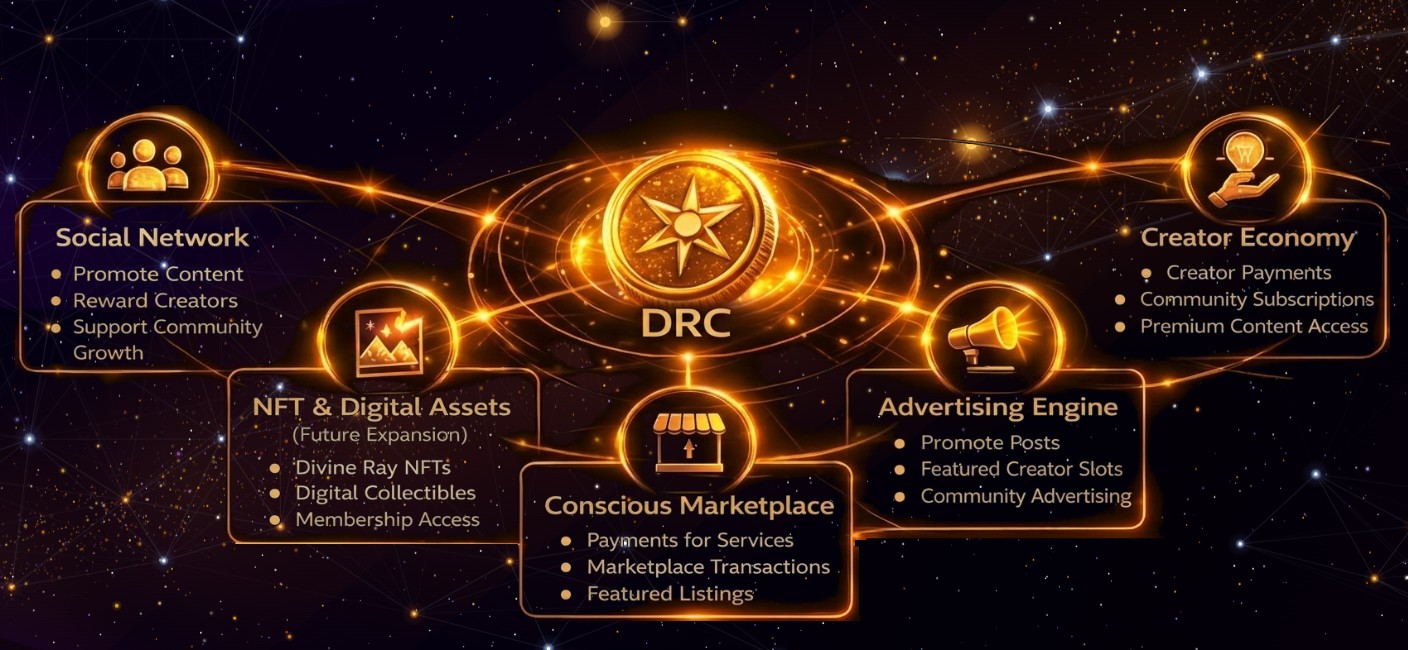
From retreat centers, spiritual organizations, yoga studios, meditation teachers, and life coaches – millions of creators and businesses serve this audience, and the wellness and consciousness industry is one of the fastest-growing sectors on the planet. Divine Ray connects them all through one social platform and a blockchain-powered economy.
The platform caters to subcultures including shadow work, light language, and chakra healing – communities with large online followings but have never had a payment rail, a calendar, and a social feed in the same place. Divine Ray allows creators, communities, retreat centers, educators, and organizations to operate with ownership and sovereignty.
That is the specific problem Divine Ray is solving. It’s not “decentralized social media” in the abstract sense that dozens of projects have attempted and abandoned, but a concrete, vertical-specific platform for a paying audience that already exists.
What Is the DRC Token?
DRC – Divine Ray Coin – is the native utility token of the Divine Ray blockchain. DRC powers the entire Divine Ray ecosystem and, as the Divine Ray network grows, DRC becomes the platform’s financial engine.
Multiple token utilities drive demand for DRC, including memberships, advertising, NFT minting, creator rewards, and community growth inside the platform. As the platform grows and more users join, the number of drivers multiplies. Creator rewards flow in DRC every time a user engages with content. Community growth incentives can also distribute DRC to people who invite friends and build the network.
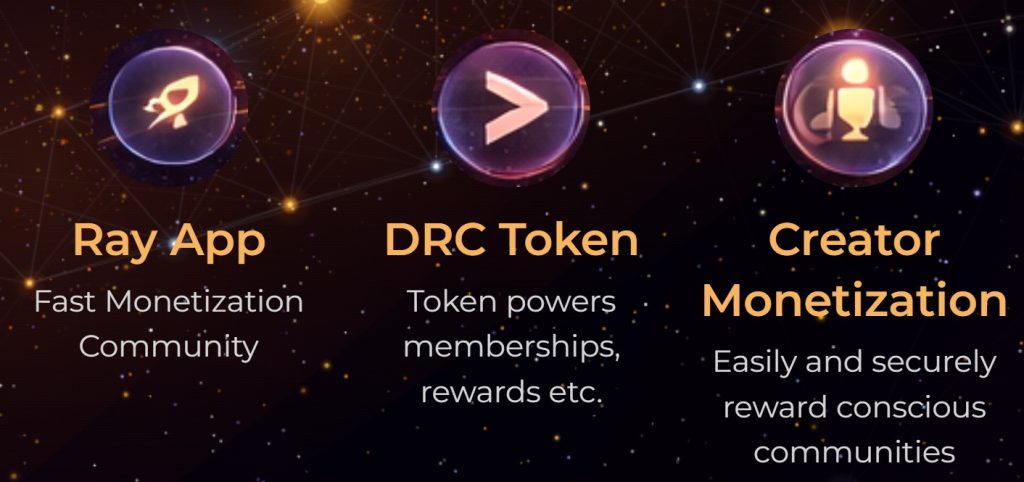
Planned NFT minting and future governance features will add more utility, and burn mechanics are also built in. The first method is tied to the chain itself: 5% of every gas fee paid on the Divine Ray blockchain is permanently destroyed, with the remaining 95% paid out to validators.
The second method is that when a creator or business pays DRC to promote content on the platform, around 50% of that payment is burned rather than redistributed. The default burn rate on promotions is 50%, with a hard floor of 10% and a ceiling of 80%. Both mechanisms mean that as platform activity grows, the token supply contracts.
For these reasons and more, DRC makes it onto our best crypto presales list.
The Divine Ray Blockchain: Why Cosmos?
Most social media projects talk about Web3, then build a simple frontend on top of Ethereum or Solana, which is usually slow, expensive, and not scalable. Divine Ray took a different direction by choosing to build its own blockchain.
That means full control over technology, scalability, and future development, without reliance on Ethereum gas fees or Solana outages. If Ethereum is congested during a bull market, Divine Ray’s transaction fees remain tiny because the chain’s capacity is not shared with other projects competing for block space.
Behind the scenes, the Divine Ray blockchain processes transactions and secures the network with Proof-of-Stake validators.
How to Buy Divine Ray DRC: Step-by-Step
Divine Ray launched its ICO in April and quickly raised $100,000 in the first few days. The presale runs in four phases, with the price stepping up at each stage. Anyone who wants immediate access rather than waiting for the ICO to close can also buy DRC directly on the Osmosis decentralized exchange.
Step 1: Visit the Official ICO Site
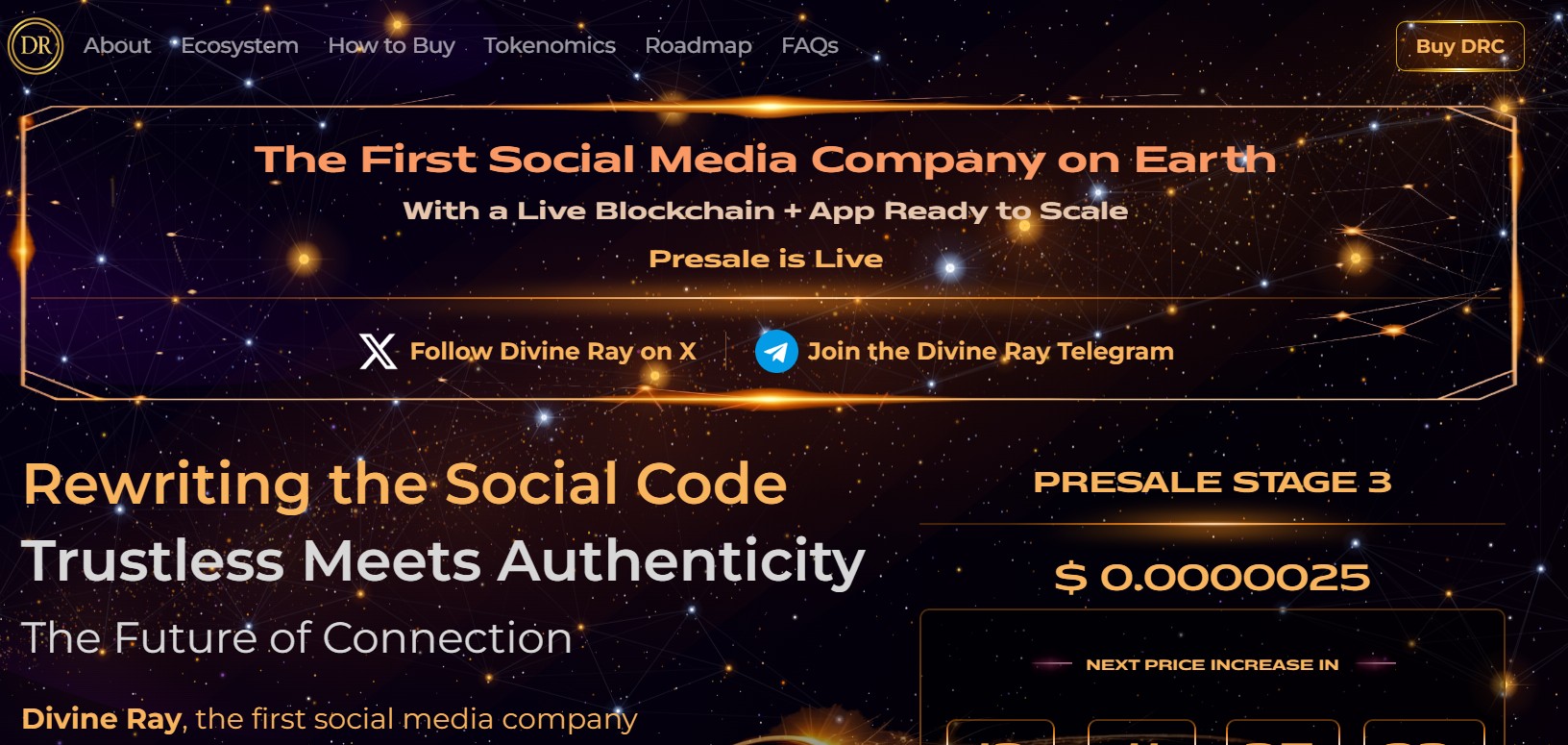
Go to ico.divineray.ca (type it manually or use our link, rather than following links from search results, social media posts, or direct messages). Active presales attract copycat sites. The real site is the only place where your contribution is recorded on the Divine Ray blockchain.
Step 2: Set Up a Keplr Wallet
Divine Ray runs on a Cosmos-based chain, so you need a wallet built for that ecosystem. Keplr is the most widely used option, and the presale checks for it as part of the buying process. Install it as a Chrome Web Store extension.
When you create a new wallet, Keplr generates a recovery phrase – typically 12 or 24 words. Write it down by hand and keep it in a physically secure place. If you lose it, no one can recover your tokens – Keplr holds nothing on your behalf. But if someone else gets access to your keys, your crypto is at risk.
Step 3: Fund Your Wallet
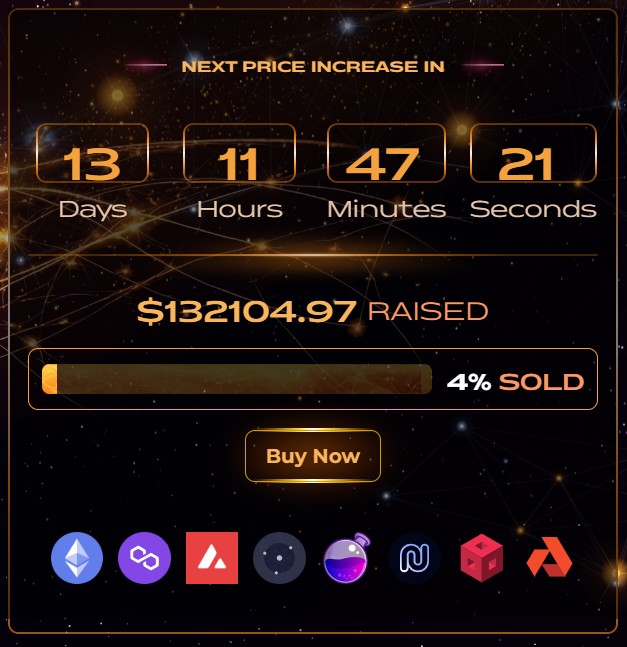
The ICO accepts several currencies: ETH, USDC via Noble, ATOM, MATIC, and Avalanche. Buy whichever you prefer on any major exchange (Binance, Kraken, and Crypto.com all carry them) and then send the funds to your Keplr wallet address.
Step 4: Connect Your Wallet and Enter Your Amount
On the official ICO page, click “Buy Now” and enter your email address. The site will prompt you to connect your Keplr wallet. Select your funding currency, enter the amount you want to spend, and approve the transaction in Keplr. The contribution registers on your dashboard straight away, without a waiting period.
Step 5: Claim Your Tokens
DRC allocations are locked until the ICO period ends. Once it closes, return to ico.divineray.ca, reconnect your Keplr wallet, and claim. Tokens move directly to your wallet address. If you bought through Osmosis DEX instead, the swap settles in the same block – no claim step needed.
[/su_list]DRC Tokenomics Explained
The total DRC supply is fixed at 5 trillion tokens. Of that, 1.5 trillion – 30% of the entire supply – is reserved for the ICO.
The ICO is split into four phases (via the on-site whitepaper):
Phase 1: 400 billion DRC at $0.0000015 - total raise $600,000
Phase 2: 350 billion DRC at $0.000002 - total raise $700,000
Phase 3: 320 billion DRC at $0.0000025 - total raise $800,000
Phase 4: 257 billion DRC at $0.0000035 - total raise $900,000
Each phase is priced higher than the previous one. Phase 1 buyers get the lowest entry point; Phase 4 buyers pay more than double that price for the same token. The implied market cap at Phase 1 pricing is around $7 million, well below the levels most comparable ICOs open at.
On the supply side: 40% goes toward ecosystem development, marketing, and exchange listings; 25% is allocated to the team and developers; and 5% is set aside for influencer and community incentives.
How Divine Ray Compares to Other Social Crypto Projects
Every major social network - Facebook, Instagram, TikTok, X - runs on centralized servers owned by one company. Several Web3 projects have tried to fix that, but most have built thin interfaces on top of Ethereum or Solana, inheriting their scalability and cost problems without solving the product question. Users showed up, found nothing compelling to do, and left.
Divine Ray's approach differs in two ways. First, it built a chain rather than renting blockspace on someone else's infrastructure, and uses it to run an app that is live on both major app stores.
Second, it chose a specific vertical rather than trying to speak to the whole world. Retreat centers, spiritual organizations, yoga studios, meditation apps, life coaches - millions of creators need a dedicated platform.
The Osmosis DEX listing adds an extra strength that most ICO comparisons overlook or skip. DRC already has a live listing on Osmosis, a major DEX in the Cosmos ecosystem.
Is DRC a Good Buy?
For anyone whose default ICO posture is "show me the product first," Divine Ray clears that bar. Unlike almost every other crypto presale, the product was live before the token sale started. Many presales ask for capital before any working code has been deployed. So, whereas most presales ask you to believe, Divine Ray asks you to download the app and see for yourself.
The dual burn mechanism means DRC has a deflationary pressure built into real usage, not a theoretical vesting schedule or future governance vote. As in-app activity grows, fewer tokens remain in circulation. That is an economic structure that rewards early holders when the platform grows.
The consciousness economy is a massive market sector, and Divine Ray is one of the first blockchain projects built specifically for it. The platform is not trying to displace Meta or Twitter, but to become the default infrastructure for a specific community.
The risks are the same as for any early-stage token: execution risk, adoption timelines, competitive pressure, and the general volatility of the crypto market. But while many projects are little more than a meme and a Telegram group, Divine Ray has a live app, a working blockchain, and an existing DEX listing.
FAQs
How do I buy DRC tokens?
What currencies are accepted in the Divine Ray ICO?
What is the total supply of DRC?
Does DRC have staking?
What blockchain does Divine Ray run on?
Where is DRC trading now?
When will ICO tokens be delivered?
About the Author