


How to Exchange XMR to ETH: Best Monero to Ethereum Exchanges 2026
Every Ethereum transaction is permanently written to a public ledger. Wallet balances, DeFi positions, swap histories — all of it is visible to analytics firms, regulators, and anyone with a block explorer. Monero was built to be the antidote to exactly that. Through ring signatures, stealth addresses, and RingCT, XMR enforces privacy at the protocol level rather than offering it as an optional add-on. The sender, receiver, and transaction amount are hidden by default on every single transfer.
The decision to move between XMR and ETH shows up for different reasons. Some holders rotate Monero profits into Ethereum to deploy capital in DeFi. Others convert ETH to XMR to exit the transparent blockchain environment entirely. And some simply need to rebalance between the two assets. Whatever the direction, the swap itself is straightforward — provided you use the right platform.
That qualifier matters more than it used to. Regulatory pressure has pushed most large centralized exchanges to delist Monero entirely. What the market has in their place is a mature layer of non-custodial instant swap services — platforms where you send one coin and receive another directly to your wallet, without an account, without ID, and without your funds ever sitting in a third-party wallet. The four platforms below are the strongest options available for XMR-to-ETH and ETH-to-XMR swaps in 2026.
Best Exchanges to Swap Monero to Ethereum Ranked
- GhostSwap — Best overall exchange for XMR/ETH swaps. Completely private with no KYC.
- SwapRocket — Best runner-up. Aggregates 20+ liquidity sources, 2,000+ assets, no volume caps.
- SimpleSwap — Reliable established option with fixed-rate protection and a clean interface.
- StealthEX — Privacy-focused service with a mobile app and fast log purging.
Top Monero to Ethereum Exchanges Reviewed
1. GhostSwap
There is a specific detail that separates GhostSwap from most of its competitors: it does not apply KYC at any transaction size. This is not a common standard in the non-custodial swap space. Many platforms market themselves as no-KYC but quietly trigger verification requests above a certain dollar threshold. GhostSwap operates differently — the same policy applies whether you are swapping $50 of XMR or $50,000. The platform’s own position is simple: “No ID, Ever.”
In practice, this means the swap experience is entirely self-contained. You choose XMR as your send asset and ETH as your receive asset, enter an Ethereum destination address, review the quoted rate, and send your deposit to a one-time Monero address that GhostSwap generates for the transaction. From there, the routing engine handles execution automatically. Monero’s confirmation time is typically the longest part of the process — once the network confirms the deposit, the ETH transfer follows quickly. Most swaps land between 5 and 30 minutes, with real-time status updates at each stage.
The pricing model is worth understanding. GhostSwap aggregates rates from multiple liquidity sources in the background, which means the quoted rate reflects the best available price across those providers rather than a single fixed spread. Fees are embedded in that rate — no separate line items, no post-confirmation deductions. The figure shown before you confirm is what arrives in your wallet.
For XMR users specifically, the platform’s Tor and VPN compatibility is relevant. Routing your Monero swap through Tor maintains consistency between how you hold the asset and how you move it. The platform also launched a Telegram bot in 2025, which processes swaps through the same engine as the web interface — useful for users who prefer not to open a browser for routine transactions. Support is live 24/7 via on-site chat, with a swap ID system for tracking any transactions that run longer than expected.
The one thing GhostSwap does not do is fiat. It is strictly crypto-to-crypto, so users who need to convert XMR or ETH to local currency will need a separate service for that step.
🟢Pros
- Genuinely unconditional no-KYC — no thresholds, no exceptions
- Aggregates multiple liquidity providers for competitive XMR rates
- Non-custodial; funds move wallet-to-wallet with no intermediate custody
- Fully functional over Tor and VPN
- Telegram bot for browser-free swaps
- 24/7 live chat with swap ID tracking
🔴Cons
- No fiat on-ramps or off-ramps
- Monero network congestion occasionally pushes completion beyond 30 minutes
2. SwapRocket
SwapRocket entered the market in mid-2025 and has since built a user base of over 150,000, which is a meaningful adoption rate for a platform less than a year old. The core architecture is similar to GhostSwap — non-custodial aggregator, no registration, wallet-to-wallet execution — but there are meaningful differences in coverage and approach.
The platform pulls real-time quotes from more than 20 liquidity providers simultaneously, running price discovery in the background so the rate shown on screen already reflects the best available option across that network. For XMR pairs specifically, aggregation matters because Monero liquidity is thinner than it is for Bitcoin or Ethereum. A single-source platform may quote a wider spread on XMR/ETH than an aggregator would, and SwapRocket’s model is built to minimize that gap.
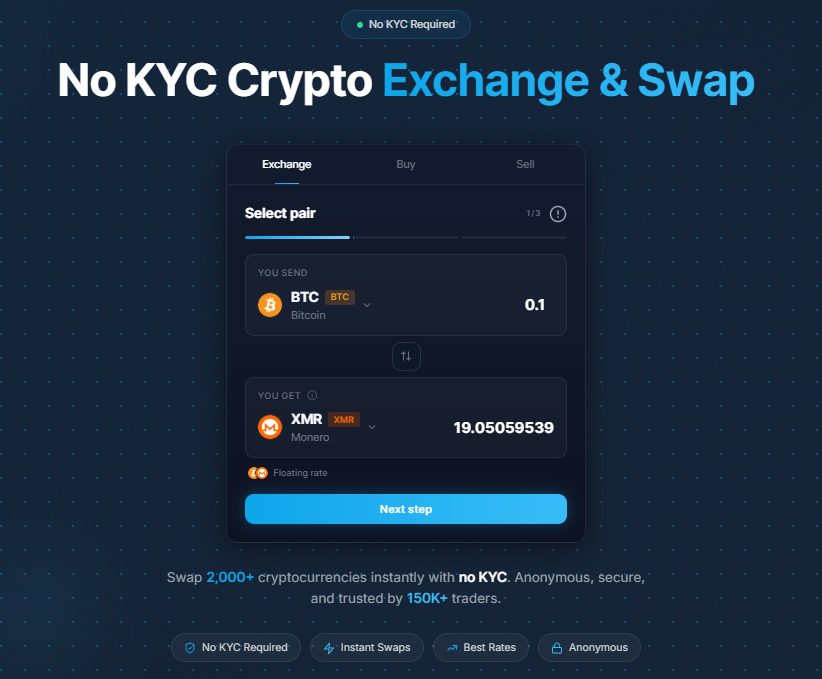
Asset coverage is broader than GhostSwap — over 2,000 cryptocurrencies — with native support across Ethereum, BNB Chain, Solana, Avalanche, Polygon, Arbitrum, and Base in addition to the Monero network itself. That makes it a practical choice for traders who need to move between multiple ecosystems, not just XMR and ETH. Privacy coins are fully supported without restriction, which is no longer guaranteed on most regulated venues.
Pricing is all-in from the start. SwapRocket displays a complete quote — service spread and network costs factored in — and what you see before confirming is what arrives on the other end. There are no volume tiers, no daily caps, and no thresholds that trigger additional verification. Swaps complete in under 10 minutes under normal conditions, with a real-time tracker showing progress throughout.
The honest caveat is that SwapRocket is newer than the other three platforms on this list. Its security record is clean and its growth trajectory is strong, but traders who specifically value long operational history may weigh that accordingly.
🟢Pro
- Real-time aggregation from 20+ providers narrows spreads on XMR pairs
- 2,000+ supported assets with broad cross-chain coverage
- No volume caps or KYC triggers at any swap size
- All-in pricing with no hidden post-confirmation deductions
- Compatible with VPN and Tor connections
🔴Cons
- Newer platform with a shorter operating track record than competitors
- No fiat support; crypto-to-crypto only
3. SimpleSwap
SimpleSwap has been operating for several years and has accumulated a track record that newer platforms cannot match. It supports over 1,500 cryptocurrencies — Monero well among them — and processes XMR-to-ETH swaps without account registration or mandatory identity checks for standard transaction sizes. For users who have encountered swap services that quietly broke down on Monero pairs, SimpleSwap’s consistent support for XMR is worth noting.
Where SimpleSwap differentiates itself is the fixed-rate option. When you select a fixed rate for an XMR-to-ETH swap, the ETH amount shown at confirmation is guaranteed regardless of how Monero’s price moves during the confirmation window. For anyone swapping during a period of elevated XMR volatility, this removes the risk of receiving meaningfully less ETH than quoted because the market shifted while Monero’s network was processing the deposit. Floating-rate swaps are also available and typically carry a tighter spread, at roughly 1.0–1.5% embedded in the rate, while fixed-rate swaps sit closer to 1.5–2.0% in exchange for that certainty.
The interface is intentionally lean. There is no aggregator complexity, no rate comparison across multiple providers, and no multi-step workflow. You select your pair, enter an amount, paste your receiving address, and confirm. For users who find aggregator platforms overwhelming or who just want to execute a routine swap quickly, SimpleSwap’s simplicity is a genuine advantage rather than a limitation.
The trade-off is that the pricing model is single-source rather than aggregated, which can mean marginally wider spreads on XMR pairs compared to platforms that route across multiple liquidity providers. For smaller swap amounts the difference is minimal. For larger XMR positions, it may be worth comparing a live SimpleSwap quote against GhostSwap or SwapRocket before committing.
🟢Pros
- Fixed-rate option locks in ETH output during volatile XMR periods
- Established operating history and consistent XMR pair support
- Minimal interface; no learning curve for straightforward swaps
- Both floating and fixed rate available on XMR/ETH
- 1,500+ supported assets
🔴Cons
- Single-source pricing can produce wider spreads than aggregators on larger XMR amounts
- Completion time ranges up to 30–60 minutes on some pairs — wider window than competitors
4. StealthEX
StealthEX occupies a distinct position among the platforms on this list: it is the only one with a dedicated mobile app (Google Play) and a browser extension for in-page swaps, and it has built a particular following within the Monero community for its data-minimization approach. The platform collects only what is necessary to route a transaction and purges logs faster than most instant swap services, which gives users a cleaner post-swap privacy profile than they would have on many alternatives.
The service supports over 2,000 cryptocurrencies and imposes no artificial volume limits on swaps. XMR/ETH and ETH/XMR are both directly supported, and the execution process follows the same pattern as the other platforms here — no account, no login, direct wallet-to-wallet routing. For users who regularly swap from a phone, the mobile app is a practical convenience that GhostSwap and SwapRocket do not currently offer through a native application.
The conditional KYC threshold is the most important thing to understand before using StealthEX for larger transactions. The platform operates no-KYC for most swap sizes, but may pause and request verification for transactions above approximately €700 equivalent. This is a meaningful distinction from GhostSwap and SwapRocket, where no such threshold exists. For most retail users swapping everyday amounts, the limit is rarely triggered. For anyone moving larger XMR positions, it is a relevant factor in platform selection.
🟢Pros
- Native mobile app (Google Play) for swaps on the go
- Browser extension for in-page swaps without visiting the site
- Fast transaction log purging for post-swap privacy
- Strong reputation specifically within the Monero community
- 2,000+ trading pairs with no volume caps
🔴Cons
- Conditional KYC threshold at ~€700; not unconditional
- No iOS mobile app
How to Swap Monero for Ethereum (and Vice Versa)
The steps below use GhostSwap. SwapRocket, SimpleSwap, and StealthEX follow the same general flow with minor interface variations.
Step 1: Set up a Monero wallet (if swapping ETH to XMR)
Before initiating any swap, make sure you have a Monero wallet address ready to receive XMR. Feather Wallet is a well-regarded lightweight option for desktop; Cake Wallet works well on mobile and has built-in swap functionality. Generate a fresh subaddress rather than reusing an existing one — Monero supports this natively and it adds a layer of address hygiene to the transaction.
Step 2: Go to GhostSwap
Navigate to ghostswap.io to get started with swapping. There is no account creation step, no onboarding screen, and no email confirmation — the swap interface is the landing page. If you are connecting via Tor Browser or a VPN, the site loads without compatibility issues.
Step 3: Select XMR to ETH (or ETH to XMR)
In the “You Send” field, select XMR. In the “You Receive” field, select ETH. The live rate populates automatically. To swap in the reverse direction, simply flip the selections — ETH in, XMR out.
Step 4: Enter the amount and choose your rate type
Type the amount of XMR you want to send. GhostSwap displays both a fixed-rate and a floating-rate option. Fixed rate locks in the ETH output for the swap window — the amount shown is the amount received, regardless of market movement during confirmation. Floating rate adjusts to live market conditions and can occasionally produce a slightly better outcome if XMR appreciates before your deposit confirms. For most users swapping during normal conditions, either works. If Monero is moving sharply at the time, fixed rate removes the uncertainty.
Step 5: Enter your Ethereum receiving address
Paste the ETH wallet address where you want to receive the Ethereum. If you use a hardware wallet such as a Ledger or Trezor, verify the displayed address matches your device screen before proceeding. There is no recovery mechanism for funds sent to an incorrect address — this step warrants careful attention.
Step 6: Review the swap summary
GhostSwap presents a summary showing the send asset and amount, the receive asset and estimated amount, the rate type selected, and the destination address. Read through each field before confirming. The quoted ETH figure is all-in — no fees are subtracted after the fact.
Step 7: Send your XMR deposit
After confirming, GhostSwap generates a one-time Monero deposit address tied to your specific swap. Send the exact XMR amount from your wallet to this address. Do not send more or less than specified — discrepancies can cause delays that require support intervention to resolve.
Step 8: Monitor and receive
A progress screen tracks the swap through each stage: deposit detected on the Monero network, swap executing, ETH dispatched. Monero’s confirmation speed varies with network load but is generally reliable. Once the deposit confirms, the ETH transfer follows quickly. Save your swap ID before navigating away — it is the only identifier support can use to locate your transaction if something stalls.
How We Ranked the Best XMR to ETH Exchanges
Security and non-custodial structure
Every platform on this list is non-custodial — assets route directly between user wallets and are never held by the platform at any point in the swap. This architecture eliminates the counterparty risk that has defined some of crypto’s worst exchange failures. We did not consider custodial platforms, regardless of their fee structure or pair coverage, because the custody model introduces a category of risk that non-custodial swaps avoid entirely.
Fees
Because all four services embed their fee in the quoted exchange rate, the meaningful comparison is implied spread against spot price at the time of the quote. Aggregator platforms — GhostSwap and SwapRocket — pull from multiple liquidity sources, which tends to compress the spread on XMR pairs specifically. SimpleSwap and StealthEX operate on tighter liquidity networks and may carry marginally wider spreads on larger XMR amounts, though the difference is often small for retail-sized swaps.
XMR swap pair coverage
We looked at how many Monero trading pairs each platform actively supports — not just which pairs appear in a dropdown, but which pairs have consistent liquidity and fill reliably. GhostSwap covers XMR against 1,600+ assets; SwapRocket extends that to 2,000+. Both support key XMR pairs including XMR/ETH, XMR/BTC, XMR/USDT, and XMR/SOL. Broader coverage matters for traders who swap XMR against multiple assets, not just Ethereum.
Liquidity
XMR has lower liquidity than BTC or ETH across most venues, and the impact of thin order books shows up in spread widening and occasional fill failures on larger swaps. Aggregators that route across multiple providers — as GhostSwap and SwapRocket both do — handle this more gracefully than platforms relying on a single source, particularly for swaps above a few thousand dollars equivalent.
Accessibility and no-KYC policy
GhostSwap and SwapRocket enforce no KYC at any transaction size — this is genuinely unconditional and consistently applied. SimpleSwap operates without identity checks for standard swap sizes. StealthEX applies a conditional threshold at roughly €700, above which verification may be triggered. We distinguished between these policies in the rankings because “no-KYC” is not a uniform claim across platforms, and the practical implications differ significantly for users with larger swap requirements.
User experience
We weighted interface clarity, progress tracking reliability, mobile access, Tor compatibility, and support quality. For Monero users specifically, Tor compatibility matters: using GhostSwap or SwapRocket over Tor is fully supported and adds an additional layer of network-level privacy that is consistent with how most privacy-focused XMR holders operate. StealthEX adds a mobile app and browser extension. SimpleSwap wins for raw simplicity if you want the most frictionless path from XMR to ETH without comparing rates.
Conclusion: Which Platform is Best in 2026?
GhostSwap is the strongest choice for XMR-to-ETH swaps in 2026. Its unconditional no-KYC policy, liquidity aggregation model, Tor compatibility, and $750 million+ in processed volume combine to make it the most reliable and privacy-consistent option available. The XMR/ETH pair is among its most actively used routes, liquidity is deep relative to single-source competitors, and the all-in pricing model means there are no unpleasant surprises on the receiving end.
For the best results, start on GhostSwap, compare SwapRocket’s live rate if the swap is sizable, and use a freshly generated Monero subaddress as your destination whenever ETH is the send asset.
Visit GhostSwapFAQs