Best Crypto Payment Processors & Gateways for Businesses in 2026
We believe in full transparency with our readers. Some of our content includes affiliate links, and we may earn a commission through these partnerships. However, this potential compensation never influences our analysis, opinions, or reviews. Our editorial content is created independently of our marketing partnerships, and our ratings are based solely on our established evaluation criteria. Read More



In 2026, the digital economy has reached a significant milestone, with cryptocurrency gently becoming a standard tool of global commerce. For modern enterprises, the question is no longer if they should accept digital assets, but which infrastructure will provide the most secure, compliant, and cost-effective bridge to this trillion-dollar market.
As traditional fiat systems face rising cross-border fees and settlement delays, blockchain-based payments offer a 24/7 alternative that settles in seconds. However, the landscape today is also more regulated than ever, with frameworks like Europe’s MiCAR (Markets in Crypto-Assets Regulation) and the US stablecoin acts setting high bars for service providers.
Our guide provides an in-depth review of the best crypto payment processors for businesses in 2026, helping you understand the world of gateways, liquidity, and compliance.
The Best Crypto Payment Gateways for Businesses Ranked
Before diving into the detailed reviews, this table summarizes how the top players stack up across key business metrics.
| Rank | Provider | Best For | Business Rates | Support Coins | Fiat Payments | Integration |
| 1 | Payhound | Enterprise & Regulated Sectors | Competitive / Volume | BTC, ETH, USDT, USDC+ | Yes (Instant) | API, SDK, Dashboard |
| 2 | Arrows Global | High-Speed B2B Transactions | Custom Scaling | Major Assets & L2s | Yes | API, Widget |
| 3 | BitPay | Enterprise Compliance | 1% – 2% | 15+ Major Coins | Yes | Plugins, POS, Invoicing |
| 4 | Coinbase Commerce | Direct Ecosystem Integration | 1% | BTC, ETH, Base, MATIC | Yes | Shopify, WooCommerce |
| 5 | NOWPayments | Altcoin Variety | 0.4% – 0.5% | 300+ Tokens | No (via 3rd Party) | 10+ Plugins, API |
| 6 | BVNK | Cross-Border Treasury | Custom | Stablecoins/Major | Yes | API, SWIFT/SEPA |
| 7 | Triple-A | White-label Solutions | 0.8% – 1% | BTC, ETH, USDT | Yes | API, No-code |
| 8 | CoinGate | Small Business Flexibility | 1% | 70+ Coins | Yes | POS, Billing, API |
An Introduction to Crypto Payment Processors
A crypto payment processor acts as the intermediary between a merchant and the blockchain. While anyone can technically accept crypto by sharing a wallet address, doing so at scale presents massive logistical hurdles: volatility risk, tax reporting nightmares, and AML (Anti-Money Laundering) compliance.
How the Technology Functions
When a customer selects “Pay with Crypto” at checkout, the processor generates a unique, single-use address for the transaction. Behind the scenes, the processor monitors the blockchain for the specific hash corresponding to the payment. Once detected, the processor “locks” the exchange rate and settles the funds.
Depending on the merchant’s preference, the processor can:
- Keep the funds in crypto: Useful for businesses building a digital treasury.
- Convert instantly to stablecoins: Minimizing volatility while staying on-chain.
- Settle in Fiat: Converting the crypto to USD, EUR, or GBP and sending it to a traditional bank account.
Why It Is Important in 2026
In the current fiscal year, “banking hours” feel like a relic of the past. Crypto payment processors provide liquidity on demand. For global businesses, these processors bypass the 3–5 day wait times of the SWIFT network. Furthermore, as regulatory scrutiny increases, processors provide the necessary “Travel Rule” compliance—identifying the origin and destination of funds—which is now a legal requirement for most business transactions.
Why Businesses Should Accept Cryptocurrency Payments in 2026
The shift is backed by hard data. In 2026, the global cryptocurrency payment apps market is estimated to reach $718.26 million, part of a larger trend toward a $2.95 billion valuation by 2035.
Key Advantages vs. Challenges
The Pros
- Elimination of Chargebacks: In the legacy credit card world, chargebacks cost merchants over $100 billion annually. Because blockchain transactions are irreversible, “friendly fraud” is virtually non-existent.
- Reduced Transaction Costs: Credit card networks often slice 3% or more from every sale. Crypto gateways typically operate between 0.5% and 1%, directly impacting the bottom line.
- Instant Global Reach: You can sell to a customer in Singapore as easily as one in Seattle, with no international “cross-border” surcharge.
- Programmable Money: Modern processors allow for automated payouts. For example, a marketplace can automatically split a payment: 90% to the vendor and 10% to the platform, all settled in one transaction.
The Challenges
- Regulatory Complexity: Frameworks like MiCAR in the EU require strict adherence to KYC (Know Your Customer) rules.
- Wallet UX: While improving, some customers still find “gas fees” and “network selection” (e.g., ERC-20 vs. TRC-20) confusing.
- Technical Integration: Businesses must ensure their gateway of choice plays nicely with their existing ERP or accounting software.
Top Crypto Payment Solutions for Businesses 2026 Reviewed
1. Payhound
Best for: Regulated Industries & High-Volume Merchants
Payhound has become the clear market leader for businesses that operate in sensitive or highly regulated sectors, such as iGaming, Forex, and Investment firms. While other processors focus on broad retail, Payhound owns the “Institutional Standard” sector. Licensed as a Class 3 Virtual Financial Assets (VFA) provider since 2021, they have perfected their compliance engine, making them one of the safest payment gateways in 2026.

The platform’s real-time conversion engine is arguably the best feature. For businesses processing millions in volume, even a 5-minute window of volatility can mean thousands of dollars in lost revenue. Payhound averts this by locking the exchange rate the moment the transaction is initiated, meaning the merchant receives exactly what they invoiced. Their API is developer-friendly but backed by an institutional-grade security architecture that includes segregated client funds.
Furthermore, Payhound excels in Mass Payouts. For businesses that need to pay out hundreds of affiliates or winners globally, Payhound allows for bulk settlements in either crypto or fiat. This dual-rail approach, and being able to move money between the legacy banking world and the blockchain with ease, is why they remain the top recommendation for enterprise-scale operations.
- Pros: Full regulatory compliance (MFSA/MiCAR), instant fiat off-ramping, specialized in high-volume industries, 24/7 technical support.
- Cons: Not suitable for small, “hobbyist” merchants due to rigorous KYB (Know Your Business) onboarding.
| Key Stat | Detail |
| Business Rates | Custom/Volume-based |
| Compliance | MFSA Class 3 VFA / MiCAR Ready |
| Settlement | Instant Fiat / Crypto / Stablecoin |
2. Arrows Global
Best for: High-Speed B2B Transactions & Supply Chain
Arrows Global has, in our eyes, completely changed how B2B transactions function in 2026. While most gateways focus on the “Consumer-to-Business” (C2B) flow, Arrows Global is optimized for the Business-to-Business (B2B) ecosystem. Their platform acts as a sophisticated treasury tool, allowing companies to settle invoices across 160+ countries with the speed of a local transfer.
The core of the Arrows Global value proposition is its Layer 2 (L2) optimization. By routing payments through high-speed networks like Base, Polygon, and Arbitrum, they reduce “gas fees” to fractions of a cent, making even smaller B2B settlements viable. Their dashboard provides a real-time look into liquidity across multiple chains, which is essential for CFOs managing digital assets.
The next feature that truly differentiates Arrows Global is the Hedge features. They allow businesses to protect their payables and receivables from currency fluctuations by locking in FX rates for over 60 currencies. This synergy between crypto and traditional Forex hedging makes them the go-to for international trade and supply chain management, and shows just how powerful blockchain can be for businesses without requiring them to reorganize their operations around it.
- Pros: Optimized for L2 networks, excellent treasury management tools, built-in FX hedging.
- Cons: Steeper learning curve for non-financial staff; dashboard can be complex.
| Key Stat | Detail |
| Business Rates | Custom Scaling |
| Best For | B2B & Global Payouts |
| Integration | Advanced API & Dedicated Widget |
3. BitPay
Best for: Established Enterprise Retailers
As one of the oldest names in the space, BitPay is the “safe” choice for large-scale retailers like Microsoft or AMC. In 2026, BitPay’s greatest strength is its ecosystem maturity, having built a comprehensive suite of tools that includes a dedicated POS app for physical stores, professional invoicing, and deep integrations with accounting software like QuickBooks and Xero.
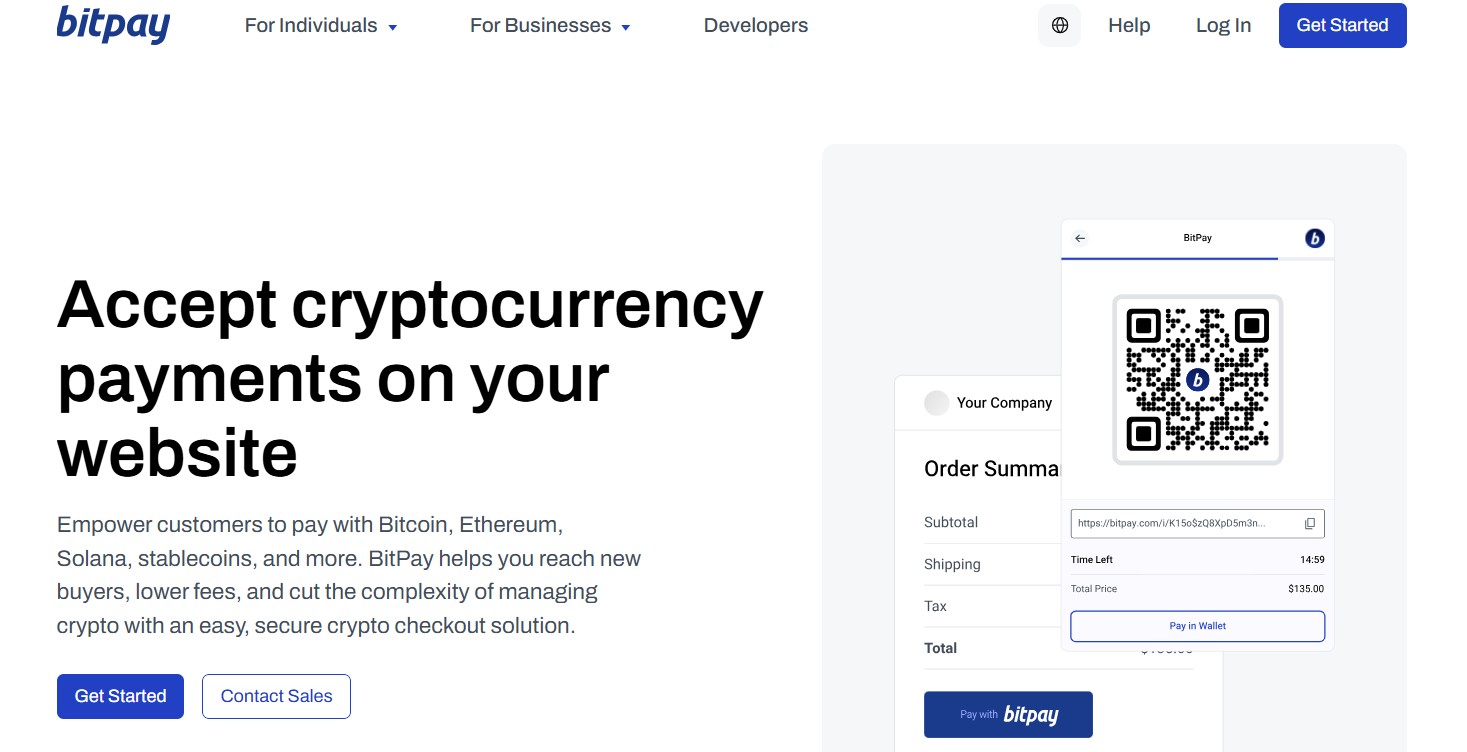
BitPay’s fees are transparent, ranging from 1% to 2% based on volume. This may be higher than some “disruptor” gateways, but the premium covers a suite of compliance and security tools that are PCI-compliant. For a retail giant, the ability to have a unified dashboard that handles both online and in-store crypto payments is invaluable.
However, BitPay has a somewhat limited coin support (currently hovering around 15–20 major assets). They prioritize “quality over quantity,” focusing on the coins with the most liquidity to ensure they can always offer reliable fiat settlement.
- Pros: Longest track record, excellent retail POS tools, direct bank settlement in 35+ countries.
- Cons: Higher fees for smaller merchants, strictly regulated (requires full KYC for all users).
| Key Stat | Detail |
| Business Rates | 1% – 2% + $0.25 |
| Coins Supported | 15+ (BTC, ETH, LTC, USDC, etc.) |
| Settlement | Bank Transfer / Crypto Wallet |
4. Coinbase Commerce
Best for: Shopify Merchants & Small Business Startups
Coinbase Commerce has leveraged the massive user base of the Coinbase exchange to create a “one-click” payment experience for millions. In 2026, they have moved toward a unified “Coinbase Business” platform. Their new Commerce Payments Protocol, built on the Base network, allows for sub-second settlement and an “authorize-and-capture” model similar to credit cards.
For small businesses, the integration is incredibly simple. If you use Shopify, WooCommerce, or Magento, you can be up and running in under 10 minutes. They offer two account types: Self-Managed (you keep your keys, no fiat settlement) and Managed (Coinbase handles everything, including fiat withdrawals).
The primary drawback is the lack of “deep” altcoin support. While they support the majors and anything on the Base network, businesses looking to accept more exotic tokens will find Coinbase too restrictive.
- Pros: Seamless Shopify integration, very high trust factor, low fees for Base network users.
- Cons: Customer support is often automated; fiat withdrawals only available in “Managed” accounts.
| Key Stat | Detail |
| Business Rates | 1% flat |
| Ease of Use | Extremely High |
| Primary Network | Base / Ethereum |
5. NOWPayments
Best for: Altcoin Diversity & Creator Economy
If your business caters to the “long tail” of the crypto community, NOWPayments is the undisputed champion. Supporting over 300 cryptocurrencies, they allow you to accept everything from Bitcoin to niche meme coins and utility tokens. This makes them a favorite for SaaS platforms, indie game developers, and the creator economy.
NOWPayments operates on a non-custodial model, meaning they do not hold your funds. Payments go directly from the customer to your designated wallet. While this is great for security and decentralization, it means they do not offer native fiat settlement. To get USD or EUR, you must use their third-party partner, Guardarian, which introduces extra steps and fees.
Their fee structure is one of the most aggressive in the industry, starting at 0.5%. They also offer unique tools like “Mass Payouts” for affiliate networks and a “Donation” widget for nonprofits.
- Pros: Unmatched coin variety, very low fees, non-custodial (your keys, your coins).
- Cons: No native fiat off-ramp, requires more technical setup for wallet management.
| Key Stat | Detail |
| Business Rates | 0.5% – 1% |
| Coins Supported | 300+ |
| Payout Type | Crypto-to-Crypto (Fiat via 3rd party) |
6. BVNK
Best for: Stablecoin Infrastructure & Institutional Rails
BVNK is less of a “checkout button” and more of a “financial operating system.” In 2026, they have become the backbone for businesses that use stablecoins (USDT, USDC, PYUSD) as their primary moving capital. They focus on “programmable settlement,” allowing businesses to orchestrate complex payment flows across global jurisdictions.
BVNK is particularly strong in the “Emerging Markets” sector. For businesses operating in regions with volatile local currencies, BVNK allows them to hold their treasury in USD-backed stablecoins and settle via local bank rails (SEPA, SWIFT, FPS) whenever needed.
- Pros: Institutional-grade security, excellent for stablecoin-centric businesses, bridge to traditional banking.
- Cons: Not designed for retail e-commerce “checkouts”; custom pricing only.
| Key Stat | Detail |
| Focus | Stablecoins & Infrastructure |
| Integration | Heavy API focus |
| Target | Mid-to-Large Enterprises |
7. Triple-A
Best for: Luxury Brands & White-Label Needs
Triple-A is a Singapore-based provider that has captured the luxury retail market. Their primary selling point is their White-Label Checkout. Many high-end brands don’t want a “Pay with BitPay” logo on their site; they want a seamless, branded experience. Triple-A allows for this level of customization while handling all the backend compliance.
They are regulated by the Monetary Authority of Singapore (MAS), giving them high credibility in the Asia-Pacific region. Their “no-code” setup also makes them accessible to non-technical business owners.
- Pros: Branded (White-label) options, MAS-regulated, very easy for non-developers.
- Cons: Higher fees for the branded experience; limited support for niche altcoins.
| Key Stat | Detail |
| Business Rates | 0.8% – 1.2% |
| License | MAS Licensed |
| Best For | Luxury & White-label |
8. CoinGate
Best for: Mid-Market Flexibility
CoinGate offers a balanced approach that fits the “Goldilocks” zone—not too big, not too small. They support over 70 coins and offer a variety of payout options, including bank transfers, BTC, or even gift cards. Their dashboard is one of the most intuitive for tracking sales and managing refunds.
A unique feature for 2026 is their support for the Lightning Network, which allows for near-instant, near-zero-fee Bitcoin payments. This makes them a strong contender for businesses with high transaction counts and low average order values.
- Pros: Supports Lightning Network, 70+ coins, very user-friendly dashboard.
- Cons: Fees can add up with withdrawal costs; support is good but not “enterprise-level” like Payhound.
| Key Stat | Detail |
| Business Rates | 1% flat |
| Coins Supported | 70+ |
| Tech Focus | Lightning Network |
How to Pick a Crypto Payment Gateway for Your Business
Choosing a gateway is a long-term commitment. In 2026, the criteria have evolved from “Does it work?” to “Is it compliant and efficient?”
1. Regulatory Alignment (The MiCAR Era)
The first question you must ask is where the provider is licensed. If you are doing business in Europe, using a provider like Payhound that is aligned with MiCAR is essential for legal safety. Operating through an unlicensed gateway can lead to frozen bank accounts or heavy fines.
2. Settlement Method: Fiat vs. Crypto
Decide your treasury strategy. If you need the money for payroll and rent in USD, you need a provider that offers Instant Fiat Settlement. If you are looking to hold crypto as an asset, a non-custodial provider like NOWPayments is better, as it gives you full control over the private keys.
3. Integration Type: API vs. Plugin
- API: Best for custom-built websites and large enterprises (Payhound, BVNK).
- Plugins: Best for Shopify, WooCommerce, or Wix (Coinbase Commerce, BitPay).
- No-Code: Best for simple invoicing or social media selling (Triple-A).
4. Fee Structure and “Gas” Optimization
Look beyond the headline transaction fee. Check for:
- Withdrawal Fees: What does it cost to move money to your bank?
- Network Fees: Does the gateway support Layer 2 networks to save your customers money?
- Currency Conversion Fees: Is there a markup on the exchange rate?
5. Support and Account Management
For businesses processing high volumes, email-only support is a dealbreaker. Look for providers that offer dedicated account managers and 24/7 technical assistance.
Our Conclusion: Which is the Best Crypto Payment Processor in 2026?
After analyzing the landscape, the winner for 2026 is Payhound.
While competitors like BitPay offer history and NOWPayments offer variety, Payhound provides the most complete mix of regulatory compliance, institutional-grade security, and instant fiat liquidity. For the modern enterprise that needs to bridge the gap between “Web3 potential” and “traditional financial stability,” Payhound is the most reliable partner.
For businesses focused specifically on B2B international trade, Arrows Global is the clear runner-up, providing essential FX hedging tools that other gateways lack.
Methodology: How We Reviewed Crypto Payment Gateways
Our 2026 review process involved a rigorous 50-point inspection of each provider:
- Security Audit: We examined the use of multi-signature wallets, cold storage, and 2FA/Biometric security.
- Compliance Check: We verified active licenses across major jurisdictions (EU, US, Singapore).
- Transaction Testing: We performed live checkouts to measure confirmation speeds and “gas” efficiency.
- Customer Service: We reached out to support teams with “critical” issues to measure response times.
- Fee Transparency: We dissected the fine print to find hidden markups on exchange rates.
FAQs
Is it legal to accept crypto in 2026?
How do I protect my business from Bitcoin’s volatility?
What is the “Travel Rule” and does it affect me?
Can I pay my employees in crypto using these gateways?
Are there any hidden costs?
2M+
250+
8
70





 in numbers