

 Bitbase Review 2026
- All financial tools under one roof
- Competitive rates across all financial instruments
- Focus on security and trust
“Trust Through Every Cycle” is the philosophy that runs through the core of Bitbase, and it is a strong statement from the new global digital asset platform, with a stated goal of shifting the industry away from gambling and toward a transparent, professional trading environment.
It is a strong start, underpinned by the services on offer, including spot and USDT-margined futures, TradFi instruments, fiat on-ramping, and security front and center, as we’ll see below.
Whether the user is simply a buyer wanting to purchase Bitcoin with a credit card, a derivatives trader hunting tight spreads on perpetuals, or a TradFi crossover investor who wants gold exposure without opening a separate brokerage account, Bitbase is one of those rare platforms that handle all three, without any service feeling bolted on.
Our review covers what Bitbase offers, how the fee structure compares to competitors, the pros and cons, and which types of traders it suits best.
Bitbase Pros & Cons
Bitbase is built around traders, and we found the fee structure genuinely competitive, a security infrastructure that draws on MPC-based multi-signature technology (rather than simpler custody arrangements), and a product range that extends into TradFi instruments beyond pure crypto.
Onboarding is smoother than on most regulated platforms, with users able to register and begin trading without a document-heavy process. Fiat on-ramping and 24/7 live chat support are both present.
Pros
- Non-KYC onboarding allows users to register and start trading smoothly
- Spot and USDT-M futures trading are available under one account
- TradFi instruments provide access to markets beyond pure crypto
- Fiat on-ramping helps users coming in from traditional finance
- Standard spot fees of 0.1% maker/taker are in line with industry benchmarks
- Competitive futures fees of 0.02% maker / 0.06% taker
- MPC-based multi-signature custody with hot/cold wallet separation
- 24/7 live chat support
- Clean interface suited to straightforward trading
Cons
- Globally launched in April 2026, so it has a limited long-term track record at scale
- 325+ trading pairs is a good start, but the asset range will hopefully increase over time
What is Bitbase?
Bitbase describes itself as a next-generation crypto derivatives exchange dedicated to providing institutional-grade infrastructure for the global trading community, combining what it calls cutting-edge security with a high-performance matching engine.
In practice, the platform is broader than pure derivatives, combining spot trading, USDT-margined futures, TradFi products, and fiat on-ramps in a single account structure.

The platform’s matching engine and risk management framework demonstrated stable performance, with 99.99% system uptime and <10ms order-matching speed. The exchange is a custodial platform, where users hold balances on-platform rather than in self-custody wallets. This is the standard model for active trading exchanges, enabling fast execution and cross-product margin management that futures traders rely on. It also means the platform's own infrastructure security matters considerably, which is where Bitbase's engineering choices become relevant (as we discuss further down).
Features & Services
Spot, futures, and TradFi under one roof is the key thrust of Bitbase. Let’s dig in a bit deeper.
Spot and Futures Trading
Bitbase offers both crypto spot trading and USDT-margined (USDT-M) perpetual futures, two product lines serving different users, but living under the same account, which means traders can move between them without dealing with separate accounts.
Spot trading is straightforward in that you buy or sell assets at the current market price, and it’s for those who want exposure to crypto assets without leverage risk, or who are accumulating a longer-term position.
USDT-M futures are settled in USDT regardless of the underlying asset, meaning that profit and loss are denominated in a stablecoin, which simplifies accounting for traders running multiple positions simultaneously. Bitbase’s published standard futures rate sits at 0.02% maker and 0.06% taker – numbers that are squarely in line with what competitive mid-to-large exchanges charge at the base tier. We explore how to trade futures on Bitbase in our guide.
On the spot side, 0.1% maker/taker is the rate, consistent with exchanges like Binance at their base tier before volume discounts apply.
TradFi Products
One of the more interesting features on Bitbase is the inclusion of TradFi instruments – products that give access to traditional financial markets from within a crypto exchange account. Available instruments include major equities such as Apple (AAPL), Amazon, Intel, and others, alongside commodities like Copper, and precious metals such as PAX Gold and Tether Gold.
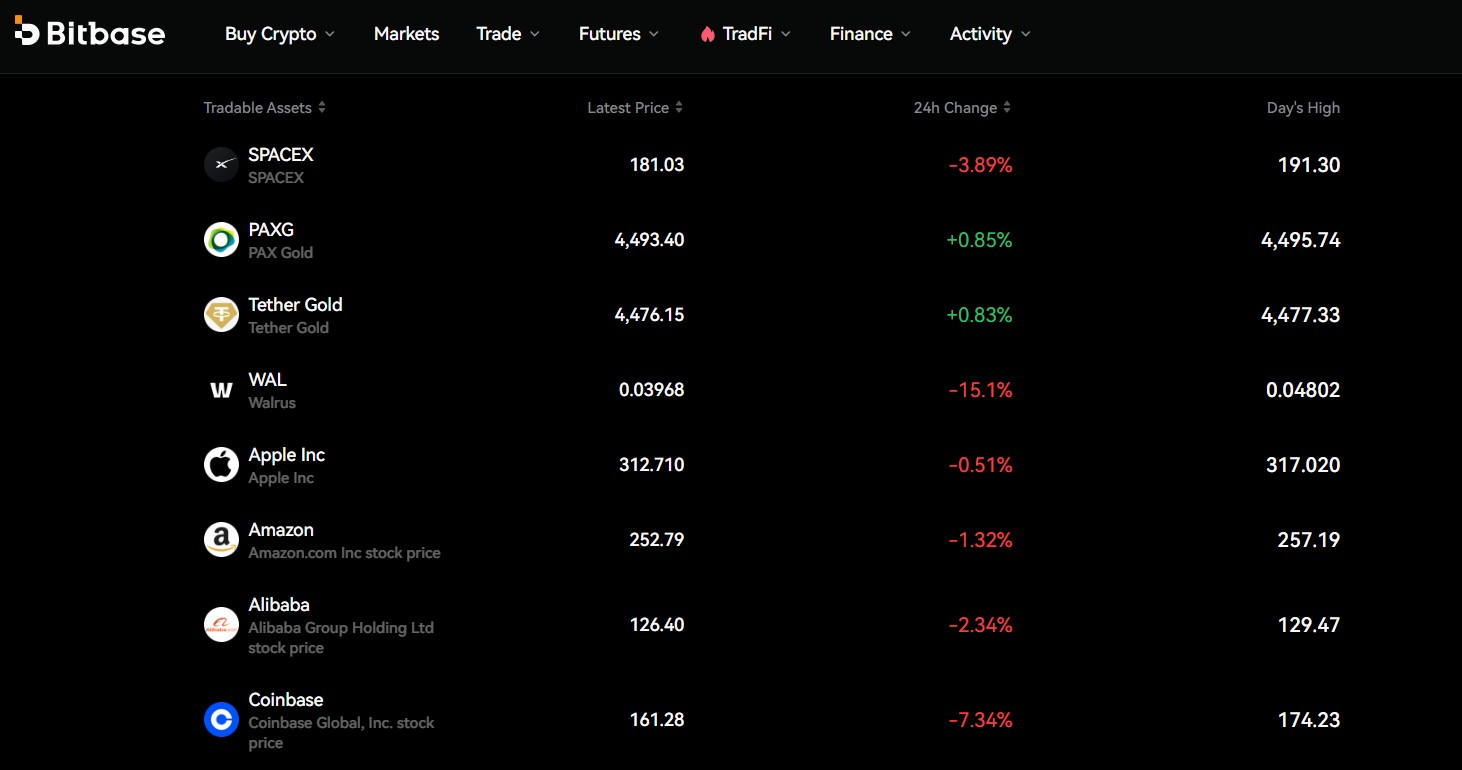
These are usually not direct stock or asset ownership, but rather USDT-margined perpetual futures contracts that track the underlying price, so traders can go long or short with leverage on traditional assets, settle P&L in USDT, and benefit from the same cross-margin system used for crypto futures. A built-in position calculator helps estimate outcomes.
It’s a compelling value proposition for crypto-native users, meaning you can use one account for an active BTC futures position while also maintaining gold exposure. Everything lives in the same environment with the same base currency.
We’d suggest the options will typically suit active traders with familiarity across asset classes and who are chasing a great rate, rather than first-time crypto buyers. That said, the exchange is as straightforward as comparable exchanges for first-timers.
Fiat On-Ramping
Bitbase includes fiat on-ramp functionality, allowing users to fund their accounts through fiat-related channels rather than requiring an existing crypto holding to get started. You can use Visa, Mastercard, Google Pay and Apple Pay, among others, and using AmoPay, based on our testing, attracts a flat fee of 99c up to around $2,000.
Non-KYC Onboarding
Most regulated exchanges require identity verification before a user can do anything useful, aka deposit, trade, or withdraw. It’s a process that can take hours or days and creates annoyance for users who want to get started quickly.
Bitbase’s approach lets users register and start trading without the full documentation gatekeeping typical of heavily regulated platforms. This is not the same as completely anonymous trading, as the platform’s security infrastructure includes withdrawal security checks, but it does mean the path from registration to first trade is shorter.
Specific KYC requirements for higher-volume accounts apply, but you can get going quickly if you want to try the platform.
Trading Fees
Bitbase has a standard spot fee of 0.1% for both makers and takers, and a standard futures fee of 0.02% maker / 0.06% taker, exactly in the ballpark of other exchanges. You won’t find much lower, and many places will be higher. On the spot side, 0.1% is the standard industry starting point for many larger exchanges.
| Spot trading (maker) | 0.1% | Standard rate |
| Spot trading (taker) | 0.1% | Standard rate |
| Futures trading (maker) | 0.02% | USDT-M |
| Futures trading (taker) | 0.06% | USDT-M |
| Volume-based discounts | Undisclosed | Verify directly |
| Fiat deposit fees | Undisclosed | Depends on method |
| Withdrawal fees | Undisclosed | Network-dependent |
Security Infrastructure
Especially as a newer platform, excellent security is a must, and Bitbase is extremely comprehensive. User funds are protected by hot and cold wallet separation, MPC-based multi-signature technology, multi-layer approval workflows, tiered access controls, and real-time monitoring and interception of suspicious withdrawals.
Separating hot and cold wallets limits the amount of user funds held in internet-connected wallets, which is often the primary attack surface for exchange hacks. Cold wallets hold the bulk of assets offline, with only the daily float kept hot.
Multi-Party Computation (MPC) multi-signature goes further, meaning private keys are never held in a single location or by a single party. Signing a transaction requires coordination across multiple independent key shares, which eliminates single points of failure from the custody model.
This is the same technology used by institutional custody providers and is far more robust than standard multi-signature setups.
Multi-layer approval workflows and tiered access controls mean that even if an internal account is compromised, not every action can be executed immediately without additional authorization steps. Real-time monitoring and interception of suspicious withdrawals adds a final layer, working as an active check rather than a passive one.
User Experience
We found Bitbase’s interface to be clean across the web and the mobile app, designed to support fast trading with minimal friction. The platform is perhaps built for users who already know what they’re doing (spot trading, futures positions, TradFi instruments) rather than for first-time crypto buyers who need hand-holding through every step.
Yet every service is easy to use, and we saw thoughtful and secure touches throughout – for instance, using your mobile as a quick way to log in on desktop, and as few clicks as possible to make trades.
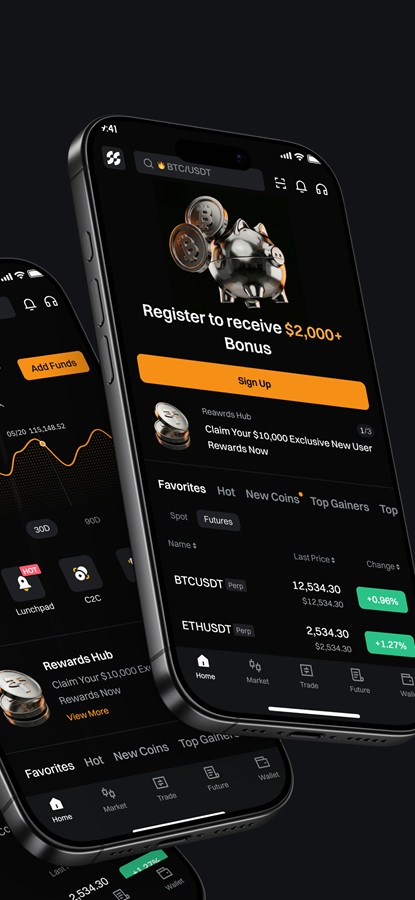
It’s noticeable how much easier it becomes when you have spot, futures, and TradFi products in a single account, and despite the range, navigation is uncluttered. There’s a design language across the site, meaning you can trade across products with familiarity, while always knowing where you are. If you’re trading in crypto and then want to dabble in TradFi, you won’t face a learning curve, and vice versa.
Bitbase also provides 24/7 instant live chat support, which is not a minor feature when you’re trying to fill a position at 3am. There are also full self-service support pages.
How to Get Started on Bitbase
Getting an account running on Bitbase is a reasonably fast process:
- Go to bitbase.com and create an account. The registration process is designed to be smooth and does not require extensive documentation before you can begin trading.
- Fund your account either through fiat on-ramp channels using traditional payment methods to convert fiat into your trading balance or by depositing into existing crypto holdings directly.
- Choose your market, all clearly available in the top navigation bar.
- Spot trading is appropriate for direct asset exposure without leverage
- USDT-M futures are appropriate for leveraged directional bets or hedging, with profit and loss settled in USDT
- TradFi products give access to non-crypto instruments within the same account.
- Place your first order. For futures, ensure your margin settings and leverage levels are configured before entering a position. Fund your account with enough to cover the position.
Who is Bitbase Best For?
We’d suggest Bitbase is built for active traders, and the fee structure, product mix, security infrastructure, and platform design all point to someone who trades regularly across spot and futures. For anyone who wants TradFi exposure alongside crypto (or vice versa), it’s an excellent service.
It is less suited to investors looking for an earn product or staking yield and the platform’s TradFi instruments also carry their own risk profile – CFD-style exposure to equities, commodities, or forex is genuinely different from holding crypto spot, so users unfamiliar with those instruments should understand the difference if exploring for the first time.
But safety, low fees, and quick execution are the center of what Bitbase offers, and the “Trust Through Every Cycle” is a strong promise that should serve the platform well over the next few bull runs.
EXCLUSIVE OFFER! Join on our link below and gain VIP7 status for 30 days, granting you exclusive fees, including 0.01% maker / 0.02% taker fees on trades over $100,000
Our Crypto Exchange Review Methodology
Our crypto exchange reviews are based on using the platform for a number of weeks. We evaluate exchanges across supported products and trading pairs, fee structures, user interface quality on desktop and mobile, security architecture, customer support accessibility, and unique features. Where possible, we compare metrics against industry benchmarks to provide useful context. We report only what we can verify from personal testing or live sources
FAQs
Is Bitbase a legitimate exchange?
What are Bitbase’s trading fees?
Does Bitbase require KYC?
What products does Bitbase offer?
How does Bitbase handle security?
Is Bitbase suitable for beginners?