Spot Ether ETF Applications Prompt S&P Alarm on Ethereum’s Concentration Risks





S&P Global warned on Tuesday that approving proposed Spot Ethereum ETFs in the US could worsen the network’s concentration issue by centralizing staked tokens among a few providers.
Certain proposed US spot ether ETFs, including applications from Ark Invest and Franklin Templeton, seek to boost yield through “staking” the underlying ether.
Staking involves validators, also referred to as participants, securing a specific quantity of ether in a cryptocurrency wallet as collateral to sustain the blockchain’s functionality.
According to S&P analysts Andrew O’Neill and Alexandre Berry, Spot Ether ETFs that only hold ether won’t impact the validator mix in Ethereum’s consensus mechanism. However, those that involve staking will — especially if there are substantial inflows.
Outside the US, some Ether ETFs have already integrated this. S&P Global estimates that the total assets under management of non-US Spot Ether ETFs incorporating staking is around $800m.
SEC Decision Deadline Nears for Spot Ethereum ETFs
The SEC is currently assessing eight applications for Spot Ether ETFs, with the initial decision deadline set for May 23, 2024. Analysts at Bernstein indicate a 50% likelihood of an ETH ETF approval by May, with a near certainty expected by year-end.
S&P noted that the trading volume of US spot bitcoin ETFs reached $12b one month after approval as of Feb. 14.
Based on this data, the analysts suggested that US Spot Ether ETFs including staking “could become large enough to change validator concentrations in the Ethereum network.”
This potential shift could expose the network to risks like inactivity due to a single point of failure or malicious collusion.
Coinbase Eyes Bigger Pie?
Coinbase serves as a custodian for 8 out of the 11 recently approved US bitcoin ETFs. It’s also identified as a staking entity in three out of the four largest Ether staking ETFs outside the US.
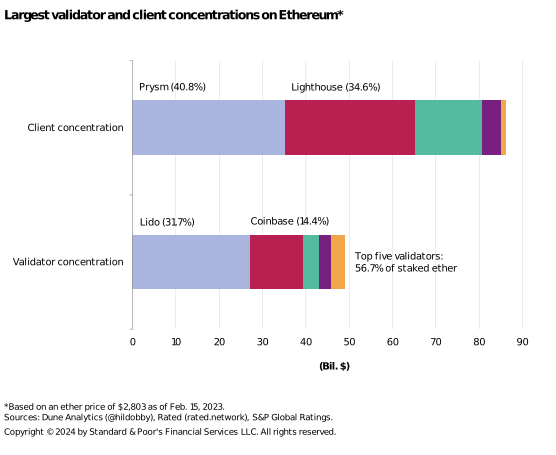
The analysts said Coinbase also controls the second-largest share of validators on Ethereum, accounting for 14.4%. Meanwhile, decentralized staking protocol Lido’s share is higher at 31.7% of the staked tokens.
Yet, S&P suggested that US institutions launching Ether staking ETFs are unlikely to directly interact with decentralized protocols such as Lido. Instead, they are expected to choose an institutional digital asset custodian like Coinbase, potentially mitigating risks associated with Lido’s validator concentration.
“The emergence of new digital asset custodians may enable ETF issuers to spread their stakes across different entities and mitigate this risk,” S&P said.
- Perplexity AI Predicts a Wild Finish to 2026 for XRP
- Bitcoin Price Rebounds Again, Peter Schiff Repeats His Crash Warnings
- Quant Crypto Soars 18% as QNT Charges Toward $250
- Elon Musk’s Grok AI Predicts When Bitcoin Will Finally Hit its Ultimate Price Target
- XRP Eyes $15 as Ripple Wins Final Bank Approval Ahead of Swell
2M+
250+
8
70





- Perplexity AI Predicts a Wild Finish to 2026 for XRP
- Bitcoin Price Rebounds Again, Peter Schiff Repeats His Crash Warnings
- Quant Crypto Soars 18% as QNT Charges Toward $250
- Elon Musk’s Grok AI Predicts When Bitcoin Will Finally Hit its Ultimate Price Target
- XRP Eyes $15 as Ripple Wins Final Bank Approval Ahead of Swell
More Articles


 in numbers