South Korea Weighs Crypto Market Makers After JPYC Price Surge





A token engineered to track a single currency moved four times its intended value in about an hour. That gap between design and price is now forcing South Korea top financial regulator to confront a question it has avoided for years on crypto markets.
JPYC, a stablecoin designed to track the Japanese yen, began trading on Upbit on September 17. The market opened at 12 Korean won per token and climbed to a high of 37.6 won an hour later, or more than four times its estimated yen-linked market value.
That is not how a stablecoin is supposed to behave. The whole premise of the asset class is that the price tracks a reference value tightly enough that traders don’t need to think about it. Why the spike? The move to limited liquidity on Upbit rather than any change in JPYC’s underlying yen backing.
A reference peg is a promise about redemption value, not a guarantee that every exchange order book will price the token correctly at every moment. When there isn’t enough resting liquidity on either side of the book, a handful of aggressive buy orders can push the traded price far from where arbitrage would normally pull it back.
Earn $50 and Enter $300K Prize Draw on EdgeXThe Policy Problem and The Price Spike
South Korea Financial Services Commission is now reviewing whether to introduce a formal market-making system for crypto in response to the episode. Yoo Young-joon, director of digital finance policy at the FSC, said the agency would examine the issue at a conference in Seoul.
“We will also review the need to introduce systems such as market-making activities to increase the efficiency and stability of the digital asset landscape,” Yoo said. He added that criticism had emerged over user losses tied to the post-listing price surge, and that “demands for discipline in this area are expanding.”
The regulatory bind is structural. South Korea’s Virtual Asset User Protection Act currently contains no exemption for market-making from its market-manipulation provisions, which effectively blocks firms from providing continuous two-sided liquidity the way automated market makers do on other venues. Yoo’s comments suggest the FSC may be reconsidering that stance.
This isn’t a new debate. A 2024 peer-reviewed paper in Seoul Law Review, authored by KB Securities researcher Lee Min Jung, argued that regulators had previously disallowed crypto market-making over manipulation concerns, but suggested a carve-out could be considered once the market matured.
Separately, a paper by Yoonyoung Choi at the Korbit Research Center argued that the absence of a formal market-maker system had produced serious liquidity problems in Korea’s domestic crypto market, citing the persistent Kimchi premium as evidence of structural inefficiency.
Trade Crypto on Bybit and Get a Chance to Win Our $1,000 USDT AirdropWhat a South Korea Crypto Market-Making Regime Would Solve?
It’s worth being precise about what’s actually on the table. The FSC is considering whether to introduce market-making, not announcing an approved exemption, a timetable, or a pilot program.
A regulated market-making framework could plausibly tighten spreads and reduce the kind of order-book vacuum that let JPYC print at four times its expected value. What it would not do is guarantee that any stablecoin always trades at its reference price, and liquidity provision improves price efficiency.
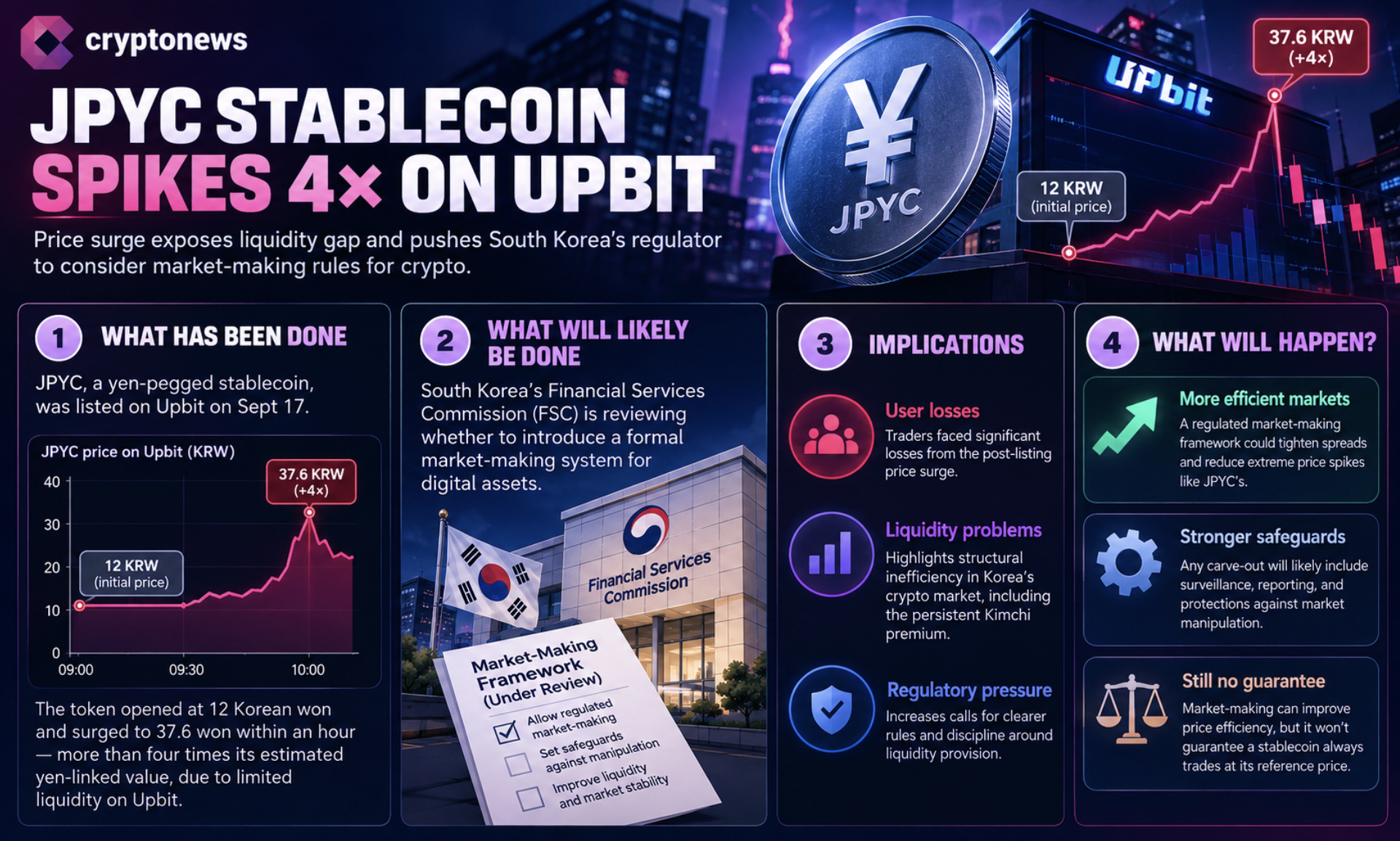
The existing law still requires exchanges to maintain surveillance for suspicious transactions and to report them to the Financial Supervisory Service, with the FSC empowered to investigate and sanction unfair trading activity. Any future carve-out for legitimate liquidity provision would need to sit alongside those manipulation controls, not replace them.
For now, the signal worth watching isn’t whether Korea eventually allows market makers, as the academic and regulatory groundwork for that has existed for years. It’s whether the FSC designs safeguards precise enough to separate legitimate liquidity provision from the manipulation that the current law is built to catch, because a framework that fails that test just relocates the risk rather than removing it.
Discover: The Best Token Presales
- XRP News: Ripple’s Multi-Asset Payments Model Predates Resurfaced XRP Remarks
- XRP News: Ripple Takes Aim at SWIFT, Pantera CEO Says
- Quant Crypto Blasts 3x in a Week Following Huge US Bank Deal
- Bitcoin Price Never Closed Below Expectation in 2026 Bear Market
- Elon Musk Grok AI Predicts a Bold Move for Ethereum in 2026
2M+
250+
8
70





- XRP News: Ripple’s Multi-Asset Payments Model Predates Resurfaced XRP Remarks
- XRP News: Ripple Takes Aim at SWIFT, Pantera CEO Says
- Quant Crypto Blasts 3x in a Week Following Huge US Bank Deal
- Bitcoin Price Never Closed Below Expectation in 2026 Bear Market
- Elon Musk Grok AI Predicts a Bold Move for Ethereum in 2026
More Articles

 in numbers