Ethereum News: Ethereum’s pERC-20 Proposal Would Make Token Transfers Private by Default




Ethereum News: A draft Ethereum token standard called pERC-20, formally tracked as ERC-7605, proposes making token transfers private by default, hiding balances, transaction amounts, and counterparties using zero-knowledge proofs baked directly into the token contract.
It is not a wrapper around existing ERC-20 tokens. It is a replacement interface: privacy-native from mint to transfer, designed so encrypted balances never exist in public state at any point in a token’s lifecycle.
The mechanism draws heavily on ZK-UTXO architecture pioneered by Zcash, specifically the Groth16 proof system and Orchard-style note commitments, and adapts them for EVM-native deployment. MetaMask-compatible. No new precompile required.
Tokens exist as cryptographic notes, not public account balances.

The proposal also includes a compliance blacklist mechanism, a deliberate architectural choice that positions pERC-20 not as a privacy-maximalist tool but as regulation-aware infrastructure. That framing matters given the regulatory climate that buried Ethereum privacy work for the better part of three years.
Discover: The Best Crypto to Diversify Your Portfolio
Ethereum News: How pERC-20 Actually Works, The UTXO Model Comes to Ethereum Tokens
Under the current ERC-20 standard, every wallet holding tokens has a publicly readable balance; anyone can query balanceOf on any address and see exactly how many tokens it holds, where they came from, and where they went. pERC-20 removes that interface entirely.
There is no balanceOf, no approve, no allowance, no transferFrom. Instead, the standard introduces a new IPERC20 interface built around mint, burn, and transfer operations, each requiring a valid zero-knowledge proof.
The underlying model is UTXO-style and note-based, the same conceptual architecture behind Zcash Orchard.
A token balance does not live at an address in the traditional sense. It exists as one or more encrypted cryptographic notes, each representing a discrete amount, owned by a key pair, and spendable exactly once. Ownership is proven via standard ECDSA signatures, which is what makes the standard EVM-native and wallet-compatible without requiring custom hardware or new browser extensions.
Transaction validity is verified using Groth16 zero-knowledge proofs, the same proof system Zcash has used at scale.
A Groth16 proof lets the network confirm that a transfer is mathematically sound, that inputs equal outputs, that the spender owns the notes being consumed, without revealing any of the underlying values.
Poseidon hash commitments are used for note construction, optimized for ZK circuit efficiency. Spent-note tracking happens in O(1) with configurable epoch cleanup, preventing the unbounded state growth that plagued earlier on-chain privacy experiments.
One thing the VOSA design does preserve publicly: the transfer graph, which addresses interacted with which. Amounts are hidden; the linkage between Virtual One-time Sub-Accounts is not. That is a deliberate tradeoff, and a significant one for anyone treating pERC-20 as equivalent to full transaction graph privacy.
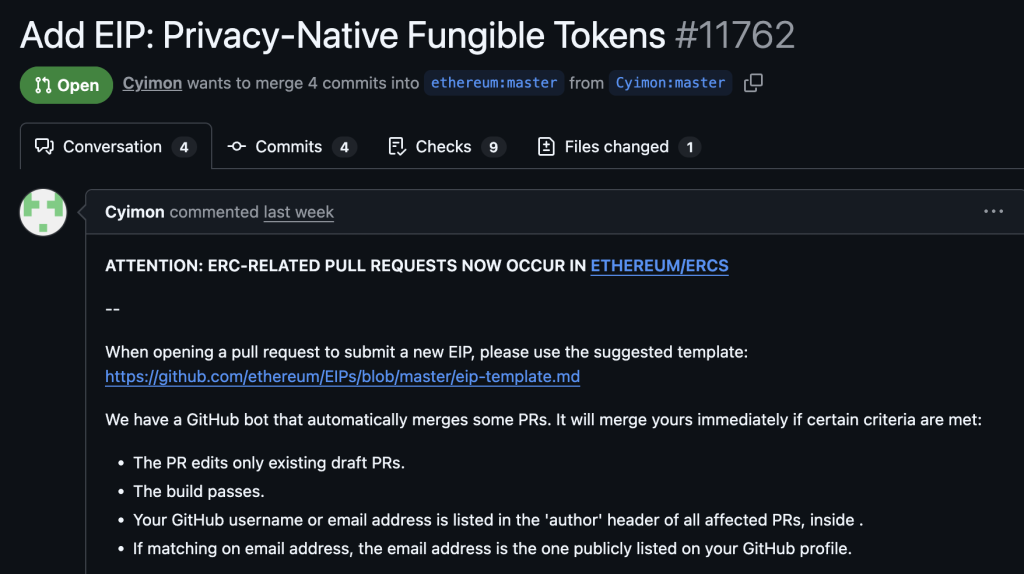
pERC-20 is still a draft, it must survive the full ERC review process before any widespread deployment, and no mainnet changes are required for it to launch as an application-level standard.
The first real test is whether it advances from forum discussion to a stable interface with a reference implementation. If it does, the question of whether Ethereum’s default token layer should be transparent or private by default becomes a live design choice rather than a theoretical one.
Discover: The Best Token Presales
- XRP News: AI Payments Integration With Stripe Driving Ripple Toward $1.50
- Contrarian Crypto Analyst Who Predicted 2026 Perfectly Calls for Caution and Q4 Crash
- Can Ripple Crack $1.80? XRP Price Prediction Says This Week
- XRP News: Exchange Churn Surges, Binance Reserves Barely Move
- Ripple Clears $1.50: XRP Price Prediction Says $2 Next?
2M+
250+
8
70





- XRP News: AI Payments Integration With Stripe Driving Ripple Toward $1.50
- Contrarian Crypto Analyst Who Predicted 2026 Perfectly Calls for Caution and Q4 Crash
- Can Ripple Crack $1.80? XRP Price Prediction Says This Week
- XRP News: Exchange Churn Surges, Binance Reserves Barely Move
- Ripple Clears $1.50: XRP Price Prediction Says $2 Next?
More Articles
 in numbers